Fix and Flip Loans for Beginners: How to Finance Your First Flip
New investors can qualify for fix and flip loans based on the deal, not experience. Learn the 70% rule, cash requirements, and how first-time flips are funded.
nmin readReleased on:November 10, 2024Last updated on:September 9, 2026


Overview:
- A first-time investor can get a fix and flip loan. Hard money lenders underwrite the deal rather than the borrower's history, so a beginner with adequate credit, cash to close, and a project inside the after-repair value limit qualifies.
- Experience changes leverage and pricing, not eligibility. A first-time borrower typically reaches 80% to 85% of purchase plus rehab, while an investor with completed projects reaches 90%.
- Insufficient reserves are the most common reason a first application stalls. Lenders want the down payment plus three to six months of interest payments verified before funding.
Most new investors assume lenders require a proven track record. Hard money lenders evaluate the deal itself, not the borrower’s profile. If the project is profitable, the numbers work, and the exit strategy is clear, a first-time investor can qualify for house flipping financing the same way an experienced flipper can on their twentieth project.
What usually prevents beginners from qualifying is a credit score below the lender’s minimum, insufficient cash for closing, or a project that exceeds the maximum after-repair-value (ARV) threshold. Once those issues are addressed and the deal structure makes sense, most hard money lenders will fund the deal.
This guide covers what lenders actually require, how to run the numbers on your first deal, how much cash to have ready, and how the loan process works from application to draw. The goal is to get you to your first term sheet with no surprises.
What Is a Fix and Flip Loan?
A fix and flip loan is a short-term bridge loan, typically 12 to 18 months, that finances the purchase and renovation of a residential investment property for resale. The loan is secured by the property and sized against its after-repair value, not its current distressed condition. The lender funds both the property purchase and the full renovation budget, so investors can acquire a distressed asset, complete the rehab, and repay the loan from the sale proceeds. Fix-and-flip loans are designed specifically for properties that conventional lenders won't touch: distressed assets, bank foreclosures, properties with deferred maintenance, or anything that fails a standard appraisal.
The Two-Part Funding Structure
Fix-and-flip loans are structured to support the renovation process in two components:
- Initial Advance: Covers the majority of the purchase price along with closing costs.
- Rehab Holdback: The lender holds these funds in reserve and releases them in stages (draws) after each phase passes inspection.
To draw renovation funds, investors submit a draw request at each stage of the project. The lender verifies completion and releases the approved funds. For a full breakdown of how fix-and-flip loans work, see the fix and flip loans guide.
Can Beginners Get Fix and Flip Loans?
Yes. Hard money lenders don't require prior flipping experience. A first-time investor with a 660+ credit score, 20 to 25% down, and a deal that clears the 70% ARV threshold can get funded. Experience affects leverage and pricing, not whether an investor qualifies.
What Changes Without a Track Record
Hard money underwriting is asset-based, so the lender starts with the deal itself. The question is whether the spread between total project cost and after-repair value is strong enough to protect the loan if the project underperforms.
That question does not change for a first-time borrower. What changes is the loan structure. Without completed projects, the lender usually limits leverage, renovation size, and eligible markets.
Three areas matter most on a first deal. Credit score plays a larger role because there is no track record to offset the risk. Rehab scope is limited, and Ridge Street holds first-time borrowers to a renovation budget no greater than 50% of the purchase price. Location also matters, since a first project generally has to be in the borrower’s own state and within driving distance.
Our guide to hard money loan requirements covers the full underwriting bar: credit brackets, reserve requirements, and how ARV and loan-to-cost interact to set the loan amount.
Common Misconceptions About Experience
Some lenders, particularly institutional funds, require prior fix-and-flip experience. Most hard money lenders adjust fix and flip loan terms based on experience rather than decline funding to first-time investors
What experience actually changes:
- Leverage: Investors with a track record of successful flips often qualify for higher leverage, especially on heavier or more complex renovation projects.
- Rate: Experienced borrowers get better pricing. First-time investors pay a rate premium, typically 0.25 to 1.0 percentage points.
- Origination fee: Some lenders adjust origination fees based on the investor’s experience level, with newer borrowers sometimes paying higher fees than experienced flippers. Ridge Street Capital does not apply additional origination fees based on experience.
The 70% Rule: How to Set Your Maximum Offer Price
Before approaching a lender, investors use the 70% rule to calculate the maximum amount to offer on a property.
Maximum Offer = (ARV × 0.70) − Renovation Costs
The remaining 30% covers buying, holding, financing, and selling costs, plus the investor's margin. Fix-and-flip lenders apply a related but separate ceiling: for first-time flippers, the total loan cannot exceed 70% of ARV depending on market strength, so an offer that clears the 70% rule usually sits inside the leverage a lender will extend. See our full breakdown of the 70% rule in house flipping for a worked example and the market conditions that move the percentage. Use Ridge Street's fix and flip calculator to run this math on any deal before submitting.
Fix and Flip Requirements for Beginner Investors
What Makes a Good First Property
Cosmetic rehabs and moderate structural repairs are what most lenders want to see on a first deal, and they are also what a first-time investor can realistically manage. Paint, flooring, fixtures, and kitchen and bath updates run on predictable timelines with predictable costs.
Most fix and flip lenders will not finance properties with major structural damage: failed foundations, collapsed rooflines, or load-bearing walls requiring full replacement. Properties with active environmental contamination or unresolved title issues that prevent a clean transfer are also generally ineligible. Those declines protect the borrower as much as the lender, because a foundation replacement is a contractor-management problem experienced investors solve through relationships built over several projects.
Ridge Street funds single-family homes, 2 to 4 unit properties, and condos. For the full eligibility list and the exclusions that apply across lenders, see our hard money loan requirements guide.
How Much Money Do You Need for Your First Flip?
Before you submit your first deal, you need to know exactly how much cash to bring. The down payment is only one line item. Here is a full breakdown of what to budget.
Down payment: 10–20% of the purchase price. On a $200,000 acquisition at 85% LTC, that's $30,000.
Origination Fees: Fix and flip lenders charge 1% - 4% of the total loan amount as an origination fee. For example, a 2% origination fee (also called 2 points) on a $200,000 loan equals $4,000. Borrowers with strong credit qualify for a lower origination fee.
Legal/Processing Fee: Most lenders will charge a $1,250-$1,995 Underwriting Fee (also called a “processing fee” or “legal fee”) to cover their operational costs of closing a loan
Closing costs: With any real estate transaction, buyers incur “non-lender” costs. These include: title insurance, builder’s risk insurance, state fees, and escrow. This can range 2–4% of the loan amount.
Rehab contingency: Budget 10% above your contractor quote for unexpected conditions, repairs or delays. A $45,000 renovation budget needs a $4,500–$5,000 contingency reserve.
Interest reserves: As with any loan, borrowers will pay interest on the funds being borrowed. Most fix-and-flip loans have an interest rate of 10%-13%.
Draw Fees: Fix and flip lenders typically charge between $200-$300 per rehab draw.
Selling costs: 5–6% of the sale price in agent commissions and closing costs. On a $325,000 sale, that's $16,000–$20,000. These costs are typically deducted from the loan proceeds at closing rather than paid upfront, but they should be included in the profit calculation from the beginning of the project.
A Real First-Time Deal: 56% Return on Investment
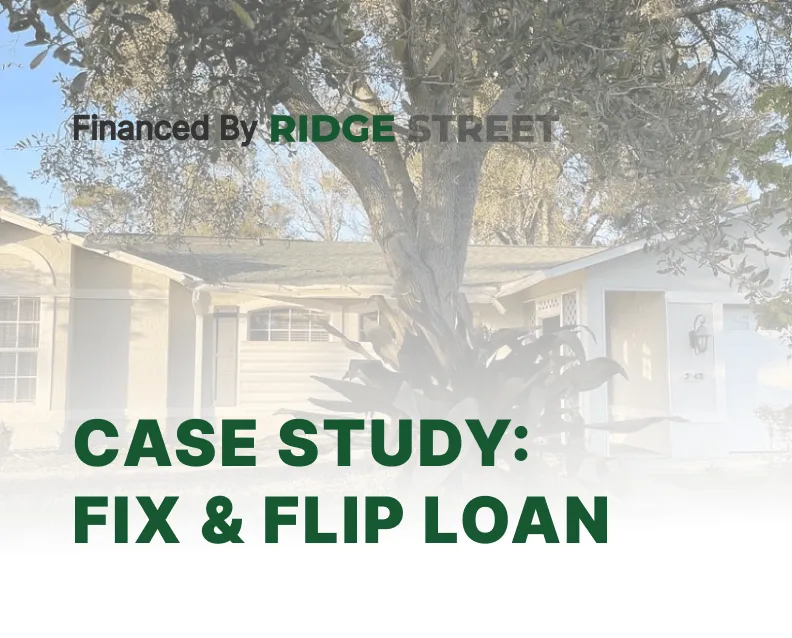
Here's a project we funded for a first-time investor in Cape Coral, Florida. The property was a 3-bedroom, 2-bathroom bank foreclosure listed on the MLS, no wholesale connections required. The house was purchased for $200,900 and required a light cosmetic rehab of $42,450. The conservatively estimated after-repair value was $325,000, with an exit market rent of $2,400. The project showed a clear path to a profitable exit in both fix & flip and fix & refinance scenarios.
The Numbers
Cash to close was approximately $40,000–$45,000, covering the down payment ($35,075), the unreimbursed portion of the renovation budget ($4,575), and closing costs.
Why It Worked
The renovation was cosmetic: paint, flooring, and a kitchen refresh. Cosmetic rehabs run faster, carry fewer unexpected costs and delays, and keep the contingency intact.
This deal also had a clean fallback. At a $2,400 monthly market rent, the property supported a DSCR loan refinance if the resale stalled. The property was sold, but underwriting a deal with two exits is what separates disciplined investors from those betting on a single outcome.
One practical note: this property went under contract the week before Hurricane Milton hit Florida. Ridge Street verified the condition via photos and closed on schedule. A conventional lender would have required a full re-inspection and likely delayed two to four weeks. Use our Hard money loan calculator to run numbers for your deal.
Before committing capital to a project, it's worth asking is it profitable to flip houses in the current market.
Common Fix and Flip Beginner Mistakes and How To Avoid Them
Underestimating renovation costs. Price-per-square-foot averages from the internet are not a substitute for line-item bids. Get contractor quotes from someone who has walked the property, and add a 10% contingency on top of the final bid. Cost overruns are one of the top reasons house flippers lose money on their projects.
Overestimating ARV. The most common way to lose money on a flip is assuming the property will sell for more than the market supports. Always use recently sold comps, not active listings, within proximity, and verify that the planned renovations match the neighborhood.
Skipping the inspection. In competitive house flipping markets, buyers waive inspections to win offers. On a fix-and-flip, that decision can cost thousands. A foundation issue found at inspection either kills a bad deal or creates renegotiation leverage. Either outcome is better than discovering it in the middle of a project.
Choosing a slow lender. Hard money lenders have different closing timelines. A lender that takes 30 days to close can become a deal-breaker. Verify actual close times before committing, and confirm draw turnaround times in advance.
No secondary exit. If the housing market slows, an investor can end up carrying a listed property for months. Before closing on a fix-and-flip, verify whether the property can refinance into a DSCR loan based on the expected after-repair value and market rent.
Choosing the wrong first project. Major structural rehabs, properties with environmental issues, and complex additions carry contractor risk that experienced investors manage through relationships built over multiple projects. Cosmetic rehabs, including paint, flooring, fixtures, and kitchen and bath updates, are manageable on a first fix-and-flip project.
Start Your First Fix and Flip with Ridge Street Capital
Ridge Street Capital lends to first-time investors across 35 states with no prior flipping experience required. If your deal clears the numbers in this guide, you're ready to submit it. See our first-time fix and flip loan guide.
Frequently Asked Questions
Do fix-and-flip loans cover renovation costs?
Yes. Most hard money lenders fund 100% of the approved renovation budget. The lender holds those funds in reserve and releases them in draw installments after each stage passes inspection, not as a lump sum at closing.
What happens if my renovation runs over budget?
If the contingency reserve runs out, there are two options: bring additional cash to cover the overage, or request a loan modification for additional draw funds. Lenders can increase the draw budget in some cases, but the increase requires re-underwriting. Budgeting a 10% contingency before closing is easier than needing it after.
What happens if the property doesn't sell after renovation?
There are three options. First, reduce the asking price and sell below the target ARV: if the deal was structured at 70% of ARV, there is room to negotiate without losing money. Second, rent the property and refinance the hard money loan into a long-term DSCR loan, which pays off the flip loan and converts the asset into a hold. Third, request a loan extension from the lender: most hard money lenders offer 3 to 6 month extensions for a fee. The cleanest approach is underwriting a rental fallback before closing the flip loan, so option two is already modeled.
Do I need a contractor lined up before I apply?
Not to apply or receive pre-approval. A contractor and a written scope of work are required before the lender can issue a final term sheet and move to closing. Lenders size the rehab holdback based on the renovation budget, and that budget must come from a contractor who has walked the property. Submit a pre-approval application now and use the time between pre-approval and deal submission to identify and vet contractors.
How is interest calculated on a fix and flip loan?
Fix and flip lenders use one of two interest calculation methods. Under Dutch interest, the borrower pays interest on the full approved loan amount from day one, including rehab funds not yet disbursed. Under non-Dutch interest, the borrower pays interest only on funds that have been released. Ridge Street Capital uses non-Dutch interest on the rehab holdback: if a portion of the renovation budget has not yet been drawn, no interest accrues on those unreleased funds.
Zach Cohen is the Managing Partner of Ridge Street Capital, a direct private lender providing hard money and DSCR loans to real estate investors across 35 states. Under his leadership, the firm has funded nearly $100 million in investment property loans. He regularly works with real estate investors on rental property acquisitions, refinances, and fix-and-flip projects across the country.
Fix and Flip Loans
Funding For Purchase + Rehab
- $50,000 up to $3,000,000
- Interest Rate 10.5%-11.5%
- Origination Fee From 1.5%
- Up to 90% of Purchase and 100% of Rehab

DSCR Loans For Long Term Rentals
Perfect for first-time investors or experienced investors scaling their rental portfolio.
- Up to $2,000,000
- Interest Rates from 6.0%
- Origination Fee From 0%
- Up to 80% of LTV

DSCR Loans For Short Term Rentals
Designed for investors pursuing higher rents with a short term rental strategy.
- Up to $2,000,000
- Interest Rates from 6.25%
- Origination Fee From 0%
- Up to 80% LTV
Ready to Get Started?
.svg)