Can You Use A DSCR Loan For Airbnb? How to Qualify and Get Approved
Can you use a DSCR loan for an Airbnb? Learn how properties qualify on projected rental income, what lenders evaluate, and what approval requires.
nmin readReleased on:July 9, 2024Last updated on:August 21, 2026


Overview:
- A DSCR loan for Airbnb qualifies on what the property is projected to earn from nightly bookings rather than the borrower's W-2s or tax returns, so a property with no booking history can still qualify.
- Ridge Street requires a minimum DSCR of 1.0, a 700 FICO for short-term rentals, and caps leverage at 80% LTV on a purchase and 75% on a cash-out refinance. Borrowers also need one current or prior personal mortgage, or ownership of an investment property in the past 12 months.
- Conventional loans need 12 to 24 months of documented rental history before counting Airbnb income, require title in personal name, and count against Fannie Mae's ten-property limit. A DSCR loan carries none of those constraints.
DSCR loans for Airbnb allow real estate investors to finance short-term rental properties based on the property’s rental income rather than personal W-2 income or tax returns.
That matters because Airbnb investing has grown rapidly in recent years and has become a mainstream strategy for investors across the United States. But conventional mortgage financing is still not always built to underwrite short-term rental income, especially when revenue changes by season, occupancy, and nightly rate.
A DSCR loan for Airbnb is designed for that gap. Instead of relying only on long-term market rent, the lender can evaluate the property as a short-term rental and underwrite the income the property is expected to generate.
In this guide, we’ll explain:
- Why DSCR Loans are Used for Airbnb Properties
- How Lenders Project Airbnb Income for DSCR Qualification?
- Requirements for DSCR Loans on Airbnb Properties?
- Examples of Funded DSCR Loans for Airbnb
- Common Mistakes to Avoid When Financing an Airbnb With A DSCR Loan?
- How to Get Started With Your Next DSCR Loan for Airbnb
Why Are DSCR Loans Used For Airbnb Properties?
DSCR loans are designed for income-producing real estate. Instead of qualifying the borrower using their personal income, lenders evaluate whether the property itself generates enough cash flow to support the loan.
This is measured using the debt service coverage ratio (DSCR), which compares a property’s income to its total monthly debt obligations.
DSCR = Rent / (Total Debt Service)
For traditional long-term rental properties, this is straightforward: rent is fixed under a long-term lease, or there are listed rental comps publicly available on the MLS, making income predictable and easy to underwrite.
However, Airbnb properties operate very differently.
How DSCR Loans Adapt for Airbnb Investments?
Airbnb properties vary significantly from long-term rentals because they have:
- Higher nightly rates
- Regularly varying occupancy levels
- Seasonality and market demand
This creates higher income potential but also greater month-to-month income variability.
To account for this, DSCR loans for Airbnb properties are qualified using the annualized projected short-term rental income, rather than fixed leases or market long-term rental comps.
If the average annualized short-term rental income is sufficient to cover the property’s total debt service, including:
- Principal and interest
- Property taxes and insurance
- HOA dues (if applicable)
- Property Management Fees
Then the property can qualify for a DSCR Loan for the Airbnb Program.
In the next section of this article, we’ll explain in detail how lenders like Ridge Street Capital estimate short-term rental income without relying on the market's long-term rental comparables.
Why Conventional Financing Falls Short for Airbnb?
Conventional mortgage programs are qualified using a borrower’s personal income. Specifically, real estate investors using conventional financing are limited by debt-to-income ratio requirements (typically between 35%-45%), which restrict their eligibility for financing on investment properties even when they have saved the funds for down payments and are purchasing a property that is cashflowing.
Similarly, many pseudo-conventional-DSCR lenders qualify properties using a combination approach of personal income and DSCR qualification. However, these non-QM lenders are usually restricted to relying on the long-term market rental comparables or 12 months of rental property operating history.
For an Airbnb acquisition, this creates a problem because:
- Properties often have no operating history at purchase
- STR income projections don’t fit neatly into traditional underwriting models
As a result, many Airbnb deals financed through conventional financing are typically:
- Don’t qualify at all
- Or qualify based on long-term rental assumptions, which can significantly reduce borrowing power
Why Investors Use DSCR Loans for Airbnb?
DSCR loans for Airbnb solve this problem by qualifying the property based on how short-term rentals actually generate income rather than personal income-based underwriting requirements.
Key advantages include:
- No personal income verification.
- Ability to use projected STR income. Especially important for acquisitions without operating history.
- Entity-friendly structuring. DSCR loans for Airbnb allow properties to be held in an LLC.
- Scalability for investors. No DTI constraints, making it easier to finance multiple properties.
For these reasons, DSCR loans have become the primary financing strategy for Airbnb and short-term rental investors.
How Lenders Evaluate Airbnb Income for DSCR Loans
Short-term rental income is evaluated differently from long-term rent. A signed lease produces a fixed monthly figure. Airbnb income depends on occupancy, average daily rate, and seasonality, all of which vary by property, market, and time of year. Lenders account for that variability through three income evaluation methods and a set of standard income adjustments.
AirDNA or comparable market data. For properties without operating history, lenders rely on third-party STR market data. Ridge Street Capital uses AirDNA for short-term rental income projections, applying 80% of the projected figures and filtering for comparable properties within a defined radius (unit type, bedroom count, and property tier) to produce an income estimate grounded in actual market performance.
Trailing 12-month income (T12). When a property has an operating history on Airbnb or VRBO, the lender requests the prior 12 months of gross booking revenue broken down by month. This shows actual performance, seasonal patterns, and vacancy trends. Lenders normalize the data to avoid over-indexing on peak periods and derive a supportable monthly income figure.
Long-term market rent. Some lenders default to the appraiser's long-term market rent estimate from the appraisal report rather than STR projections. This approach produces a more conservative income figure and typically results in a lower qualifying loan amount. Lenders who rely solely on Form 1007 cannot fully capture an Airbnb property's income potential.
DSCR Loan Requirements for Airbnb Properties
DSCR loan requirements for Airbnb properties follow the same core framework as long-term rental DSCR loans, with additional underwriting overlays specific to short-term rental income variability. The requirements below reflect standard program minimums and RSC's current terms.
1. Minimum DSCR Thresholds
Most DSCR programs require a minimum ratio of 1.0 for Airbnb properties, meaning projected or actual income must at least equal the monthly PITIA. Ridge Street Capital requires a minimum DSCR of 1.0. Some lenders apply higher thresholds, 1.1 to 1.25, specifically for Airbnb properties, to account for vacancy risk, seasonal fluctuations, and income variability.
2. Credit Score Expectations
DSCR loans do not use personal income to qualify the borrower, but personal credit score still plays an important role in every approval. Lenders use it as a measure of financial reliability. A borrower who has managed debt responsibly over time is statistically less likely to default, regardless of how the income is structured. On DSCR loans, the property's cash flow determines whether the loan can be repaid. The credit score determines whether the lender is willing to extend the loan in the first place.
Ridge Street Capital requires a FICO minimum of 700 for short-term rental properties. Borrowers above 720 typically access better leverage and pricing. Because credit is treated as a risk indicator rather than a repayment source, DSCR loans remain accessible to self-employed investors, LLC borrowers, and those with complex income structures that conventional underwriting would penalize, as long as the credit profile meets the threshold.
3. Down Payment and Loan-to-Value (LTV)
Short-term rental loans typically require a larger down payment than long-term rental financing. Ridge Street Capital's Airbnb DSCR program caps purchases at 80% LTV and cash-out refinances at 75% LTV. Properties with stronger projected income and lower market volatility may access higher leverage within those caps. Weaker DSCR or seasonal markets typically face tighter LTV requirements.
4. Operating History vs. Projected Income
For Airbnb properties without established rental history, lenders allow qualification using projected income derived from third-party STR data and appraisal methodologies. Income assumptions are based on comparable properties, market demand, and seasonality. Properties with existing operating history may be underwritten using actual performance, though lenders apply conservative adjustments to account for variability in short-term rental income.
5. Market and Seasonality Considerations
Market characteristics directly affect DSCR underwriting for Airbnb properties. Lenders evaluate demand consistency, seasonal income swings, local regulations affecting short-term rentals, and comparable data availability. Seasonal and vacation markets typically face tighter DSCR thresholds or lower LTV limits to offset income volatility. Ridge Street Capital is using AirDNA projected data that already accounts for occupancy, seasonality, and market rates in the local area.
6. Entity and Ownership Requirements
DSCR loans are business-purpose loans and are commonly originated in the name of an LLC or other legal entity. The borrowing entity must be properly formed and in good standing at closing. Personal income documentation is not required, though borrowers remain subject to standard background and compliance checks.
7. Investor Experience Requirements
Short-term rentals are generally considered a more advanced investment strategy than long-term rentals due to the operational complexity and variability in income.
Because of this, Ridge Street Capital requires borrowers applying for a DSCR loan on an Airbnb property to demonstrate a baseline level of experience—either:
- At least one current or prior personal mortgage, or
- Ownership of one investment property within the past 12 months
This helps ensure borrowers are equipped to manage the operational and financial aspects of a short-term rental investment.
DSCR Loan for Airbnb: A Funded Deal
Ridge Street Capital funded an Airbnb purchase in Gulf Breeze, Florida, through Airbnb property financing under its DSCR program.
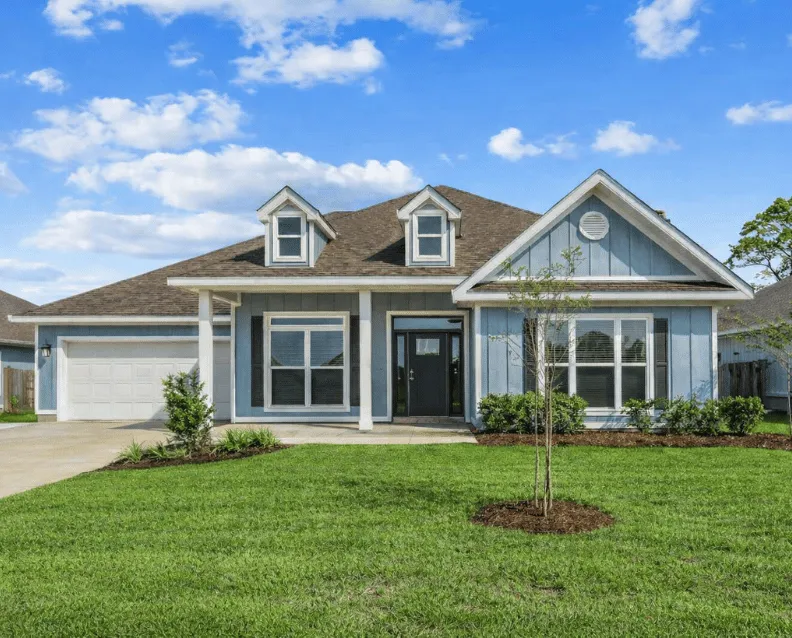
Here is a breakdown of the deal:
Projected Monthly Profit for Investor: $3,400
In the monthly cash flow after PITIA, platform fees, utilities, supplies, and a maintenance reserve
The borrower acquired a single-family home in Gulf Breeze at 80% LTV with no origination fee under Ridge Street’s DSCR Loan for Airbnb program.
Key Highlights:
- The loan was qualified using the AirDNA-supported STR projections for the Gulf Breeze market.
- The loan closed 31 days from the appraisal order to the close date.
- Ridge Street Capital provided the lowest rate after the borrower compared between 3 other lenders.
DSCR vs Conventional Financing for Airbnb Properties Comparison
Conventional investment loans are available for short-term rental properties, but they carry structural limitations that make them a poor fit for most Airbnb investors. Conventional lenders require documented rental history, typically 12–24 months, before including Airbnb income in the qualification calculation. Properties that have not been operating, or that lack a consistent booking history, do not qualify for income under conventional programs.
Conventional loans also require title in the borrower's personal name, which removes the liability protection of an LLC structure. Each new conventionally financed property reports against personal debt-to-income (DTI) and counts toward Fannie Mae's 10-property limit. Investors who plan to scale a short-term rental portfolio encounter that ceiling sooner than they expect.
DSCR loans qualify on the property's projected or actual income rather than the borrower's personal income. There is no operating history requirement, no personal DTI calculation, and no property count limit. Properties held in an LLC qualify without title transfer. For Airbnb investors, particularly those who are self-employed, manage multiple properties, or are acquiring a property before it has a rental history, the DSCR structure is the more practical path. For a full comparison, see the DSCR vs Conventional Loan guide.
Common Reasons DSCR Loans for Airbnb Get Denied
Even when projected Airbnb income appears to support a DSCR loan in preliminary review, some deals can still be denied. This typically happens when underwritten income, collateral value, or risk factors differ from the investor’s original assumptions.
Income Estimation Breakdowns
One of the most common reasons Airbnb DSCR loans get denied is overstating projected rental income. Many borrowers rely on unsubstantiated realtor estimates or pull top-line data from platforms like AirDNA without properly adjusting for the subject property. While AirDNA aggregates data based on location, bedroom count, and bathroom count, it does not account for critical property-specific factors such as condition, quality of finishes, interior design, and overall guest appeal.
As a result, the initial estimated income from AirDNA used to qualify the deal can be significantly higher than what the property can realistically generate.
This can become an issue during underwriting, as DSCR loans are based on the property’s as-is condition at the time of appraisal - not after renovations or upgrades. If the income assumptions don’t align with the appraiser’s analysis or market-supported data, the DSCR ratio can fall short, which often leads to reduced leverage.
Credit, Leverage, and Reserve Constraints
A property that passes the DSCR calculation still faces borrower-level review.
Lenders evaluate credit history, liquidity, and collateral independently and any one of these can change the loan outcome. Recent missed mortgage payments, debts in collections, or a credit score below the minimum requirements can trigger a decline even when the Airbnb property generates strong projected income.
In rare cases, the appraisal valuation can come in lower than the purchase price, which often results in the loan amount being reduced. The loan-to-value ratio is calculated against the appraised value, not the contract price, so a lower appraisal means less available financing.
Post-closing reserves add another layer: Ridge Street Capital’s DSCR program requires the borrower to hold 6 months of PITIA (Principal, Interest, Taxes, Insurance, and Association fees) in liquid accounts after closing, and investors who are stretched thin after the down payment can fall short of this requirement.
Property Type and Zoning Restrictions
Another common reason Airbnb DSCR loans get denied is due to property type or zoning issues. Most DSCR loan programs for short-term rentals are limited to 1–4 unit residential properties and do not allow commercial or mixed-use assets. Even if a deal meets DSCR requirements from an income standpoint, non-conforming asset classes can still get declined if the property falls outside of the eligible residential guidelines.
In addition, local zoning and short-term rental regulations play a critical role. If the property is located in an area with restrictions on Airbnb or short-term rentals, lenders may not be able to use projected STR income for qualification—or may decline the deal altogether. Before moving forward, it’s important to confirm both property eligibility and that short-term rentals are permitted in the subject market.
Finance Your Airbnb Property with Ridge Street Capital
Ridge Street Capital originates Airbnb loans across 35 states. STR income is evaluated using AirDNA-supported projections reconciled against appraisal data, so underwriting assumptions are set correctly before the term sheet is issued.
To get started, investors submit property details through Ridge Street’s online application. A loan officer reviews the deal, reconciles the STR income, and issues a term sheet within 2 business hours.
Prospective real estate investors can also get pre-approved for financing before submitting their offers, to make sure their properties and borrower profiles are qualified.
DSCR Loans for Airbnb Properties FAQ’s
Can you use a DSCR loan for an Airbnb with no rental history?
Yes, DSCR loans for Airbnb properties with no rental history are qualified using projected rental income. In these cases, Airbnb lenders evaluate the property’s income potential using third-party short-term rental data like AirDNA.
Do DSCR lenders always accept AirDNA projections for Airbnb loans?
AirDNA and similar tools are commonly used as supporting documentation, but they aren't accepted at face value, 100% of the time. DSCR lenders need to check the comparables used by AirDNA to include properties in similar condition with similar location, square footage, number of bedrooms, and bathrooms, and exclude the outliers.
Why do DSCR loans for short-term rentals get resized or denied after initial approval?
Resizes and denials usually occur when net operating income, property cash flow, appraisal value, credit, reserves, loan-to-value, or regulatory risk differ from initial assumptions. Even if the debt service coverage ratio initially supports the monthly mortgage payment, loans may be resized or denied if strict lending criteria or minimum credit score requirements are not met.
Are DSCR loans available for Airbnb properties owned in an LLC?
Yes. A DSCR mortgage is a business-purpose loan and is commonly originated in the name of an LLC. Unlike conventional loans, DSCR loans do not require personal income verification, pay stubs, or tax returns, making them well-suited for real estate investors financing investment properties.
Is a DSCR loan better than a conventional loan for an Airbnb property?
For most Airbnb investors, yes. Conventional investment loans require 12–24 months of documented rental history before counting short-term rental income toward qualification. This is a standard that rules out most Airbnb acquisitions and refinances where the property doesn't have that track record. DSCR loans qualify on projected or actual income from day one, support LLC ownership, and carry no property count limit. The trade-off is a DSCR rate premium of 0.5%–1.0% above conventional rates and a prepayment penalty structure on most programs. For investors financing an Airbnb without rental history, holding through an entity, or scaling past two to three properties, DSCR is typically the more practical and sustainable qualification path.
Can investors scale an Airbnb portfolio using DSCR loans?
Yes, and DSCR is the most practical structure for doing so. Each DSCR loan qualifies on the individual property’s rental income, independent of how many other properties the investor owns. There is no property count ceiling on most programs and it means that the constraint that limits conventional financing to 10 financed properties does not apply. Investors can add properties one at a time, each qualifying on its own cash flow, without the prior portfolio affecting approval. For investors managing multiple short-term rentals in an LLC, the same entity structure applies across every acquisition without requiring a title change at each step.
Zach Cohen is the Managing Partner of Ridge Street Capital, a direct private lender providing hard money and DSCR loans to real estate investors across 35 states. Under his leadership, the firm has funded nearly $100 million in investment property loans. He regularly works with real estate investors on rental property acquisitions, refinances, and fix-and-flip projects across the country.
Fix and Flip Loans
Funding For Purchase + Rehab
- $50,000 up to $3,000,000
- Interest Rate 10.5%-11.5%
- Origination Fee From 1.5%
- Up to 90% of Purchase and 100% of Rehab

DSCR Loans For Long Term Rentals
Perfect for first-time investors or experienced investors scaling their rental portfolio.
- Up to $2,000,000
- Interest Rates from 6.0%
- Origination Fee From 0%
- Up to 80% of LTV

DSCR Loans For Short Term Rentals
Designed for investors pursuing higher rents with a short term rental strategy.
- Up to $2,000,000
- Interest Rates from 6.25%
- Origination Fee From 0%
- Up to 80% LTV
Ready to Get Started?
.svg)