DSCR Loan Credit Score Requirements: How Your FICO Affects Rate
DSCR loans qualify on rental income, not personal income. See how credit score impacts rate, leverage, and payments with Ridge Street’s FICO tool.
nmin readReleased on:April 22, 2026Last updated on:September 21, 2026


Overview:
- DSCR loans remove income verification, not credit risk. Since the lender is not relying on W-2s or tax returns, the guarantor’s FICO score becomes a primary risk indicator. Ridge Street Capital’s minimum credit score for DSCR loans is 660.
- Credit score affects rate in 20-point tiers. A higher score signals lower personal default risk and can produce better pricing.
- Lower leverage can offset a weaker score. Borrowers near the 660 minimum may receive better pricing at 70% LTV than at maximum leverage.
DSCR loans are investment property loans that qualify based on the property’s rental income, not the borrower’s personal income. That qualification structure is what makes them effective for investors who are self-employed, hold multiple properties, or cannot document income through conventional channels.
Credit score, however, remains part of every DSCR underwriting decision. DSCR lenders set a minimum FICO threshold, and borrowers below that threshold do not qualify, regardless of how strong the property’s cash flow is. For borrowers above the minimum, the credit score determines the loan rate, the leverage available, and whether a deal passes the approval threshold. For a 30-year rental property loan, those differences can amount to tens of thousands of dollars over the holding period.
The sections below explain how lenders use credit score in DSCR underwriting and how each pricing tier affects the deal.
DSCR Loan FICO Score Calculator: Where Does Your Credit Score Place You?
To help investors understand how credit score affects loan pricing before they apply, Ridge Street Capital built a FICO score pricing tool. The calculator shows estimated rate pricing across five credit bands and translates those rate differences into monthly payment outcomes on a sample deal. The purpose is to give investors a picture of how their score positions them in the pricing structure, and how moving from one band to the next changes the economics of the same deal.
Two metrics are central to understanding the output.
- PITIA is the full monthly debt obligation on the property: principal, interest, taxes, insurance, and association dues.
- The DSCR, or Debt Service Coverage Ratio, measures the property’s monthly rental income against PITIA. A DSCR of 1.0 means the income fully covers the debt payment. Most programs require a minimum of 1.0 for approval.
For the calculator, the property value is set at $200,000 with a $150,000 loan at 75% LTV and $2,200 in monthly rent. These figures are held constant so the effect of credit score on rate and monthly payment is isolated. Move the slider to your estimated FICO score and switch between the Rate and Monthly P&I tabs to see how pricing shifts across tiers.
For informational purposes only. Rates shown are estimates based on current market conditions and do not constitute a loan offer, rate lock, or commitment to lend. Final pricing depends on the complete loan profile, including DSCR ratio, LTV, property type, and loan structure.
Real estate investors who want pricing on a specific deal can submit through Ridge Street’s online application. A term sheet is issued within 2 business hours.
Why Credit Score Still Matters on a DSCR Loan
Every loan Ridge Street originates carries two dimensions of risk.
- The first is property performance: whether the rental income can service the debt under normal operating conditions. The DSCR ratio addresses that directly.
- The second is borrower reliability: whether the individual behind the guarantee will manage the property responsibly and, if things go wrong, honor the personal guarantee they signed at closing. That second dimension is what a credit score measures.
Conventional lenders address borrower reliability through income documentation: W-2s, tax returns, and debt-to-income calculations. That documentation tells the lender how consistently the borrower earns income and whether they can service debt from personal cash flow.
DSCR loans remove all of that from qualification. The borrower’s income is not reviewed. Without that documentation, the credit report becomes the primary standardized measure of how the borrower has historically managed financial obligations.
The FICO score translates that history into a pricing variable: a higher score signals lower personal default risk, and lenders price that with a lower rate. A lower score signals higher risk, and lenders price that with a higher rate to reflect the additional exposure they carry.
This is why DSCR programs set minimum credit score requirements, often higher than expected. Removing income verification does not reduce risk. It changes how risk is measured. The credit score replaces income documentation as the primary risk indicator.
Minimum Credit Score for a DSCR Loan: Ridge Street Capital’s Requirements
Ridge Street Capital’s minimum credit score requirements are fixed by program. An investor below the program minimum does not qualify, regardless of how strong the property’s cash flow is.
• Long-term rentals, 1–4 unit residential: 660 minimum
• Long-term rentals, multifamily, 5–10 units: 700 minimum
• Short-term rentals, 1–4 unit residential: 700 minimum
Investors below 660 are not eligible for Ridge Street’s programs. The 660 floor for long-term rentals reflects the baseline risk threshold for a stabilized, income-producing property. The 700 floor for short-term rentals and 5-10 units multifamily reflects the additional income variability and experience risk those programs carry.
Investors evaluating DSCR programs across the market will find lenders with lower published minimums. Before selecting a program on that basis, investors should evaluate the full cost of a lower credit tier. Lenders that approve lower scores generally price that additional risk into the loan through a higher rate, a reduced maximum LTV that requires a larger down payment, and in some cases, stricter post-closing reserve requirements.
Each of those adjustments affects the property's monthly PITIA, the DSCR ratio it produces, and the cash flow available after debt service. A program that approves a lower score is not necessarily the better deal
For all other DSCR qualification standards, see the detailed DSCR loan requirements guide.
Can a Larger Down Payment Offset a Lower Credit Score?
A 30–35% down payment, or 65–70% LTV, improves rate pricing regardless of credit tier. For an investor near the 660 floor, reducing leverage to 70% LTV moves the loan into better pricing than maximum leverage at the same score. The combined effect of lower LTV and a stronger credit tier can reduce monthly PITIA and raise the DSCR ratio on a deal that is marginal at 80% LTV.
The tradeoff is capital deployment. A lower down payment preserves capital for additional property acquisitions, but carries a higher interest rate. A higher down payment reduces monthly PITIA and strengthens the DSCR ratio, but ties up capital that could fund the next investment acquisition. Neither structure is correct without modeling both scenarios against the specific deal and the investor’s strategy.
Get Pre-Approved for a DSCR Loan
Ridge Street Capital provides DSCR loans to real estate investors across 36 states for long-term rentals, short-term rentals, and multifamily properties up to 10 units. Minimum credit score of 660 for standard long-term rental programs. Minimum 700 for short-term rentals and 5-10 residential properties. No income documentation required. Term sheets are issued within 2 business hours.
DSCR Loan Credit Score Requirements FAQs
Does applying for a DSCR loan require a hard credit inquiry?
No, it is not required. Most lenders use a hard credit inquiry, but Ridge Street uses a soft pull. A hard inquiry may reduce the score by up to 10 points and typically returns to baseline within 6 to 12 months.
Does a DSCR loan appear on the borrower’s personal credit report?
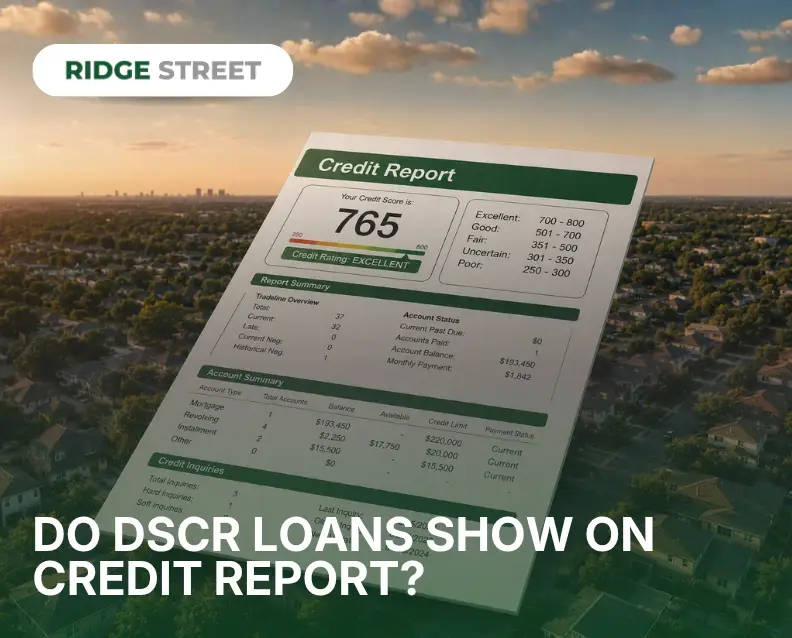
No. Ridge Street Capital is a private direct lender and does not report loans to the personal consumer credit bureaus. The monthly payment history on a DSCR loan does not appear on the borrower's personal credit file and does not affect the borrower's personal debt-to-income ratio. If a hard credit inquiry is used during the underwriting process, it is typically the only interaction with the credit bureaus. It may reduce the score by 3 to 5 points and usually returns to baseline within 6 to 12 months.
Does an LLC have a credit score, or does Ridge Street use the guarantor’s personal score?
Ridge Street uses the personal credit score of the guarantor. DSCR loans made to an LLC still require a personal guarantee from any member holding 20% or more ownership interest. The underwriting credit score is the guarantor’s personal middle FICO, regardless of the LLC’s operating history or financial profile.
If a score sits exactly at a tier boundary, which pricing tier applies?
The lower tier applies. A score of exactly 700 prices at the 700 band. A score of 699 prices at the 680 band. Investors at 695 to 699 benefit most from targeted score improvement before application. A 5-point increase at that position produces a full tier pricing improvement on the same deal.
Is it worth waiting to improve a credit score before applying for a DSCR loan?
It depends on proximity to a tier boundary. An investor at 695–699 or 715–719 can often cross a threshold in a single reporting cycle by paying revolving balances below 10% utilization or disputing bureau errors. Before deciding to wait, investors should verify that the DSCR loan rate environment does not move against the deal during the improvement period - a tier crossing saves less if rates rise in the meantime. Ridge Street can model current pricing against a projected improved score to determine whether the delay produces a net benefit.
Zach Cohen is the Managing Partner of Ridge Street Capital, a direct private lender providing hard money and DSCR loans to real estate investors across 36 states. Under his leadership, the firm has funded nearly $100 million in investment property loans. He regularly works with real estate investors on rental property acquisitions, refinances, and fix-and-flip projects across the country.
Fix and Flip Loans
Funding For Purchase + Rehab
- $50,000 up to $3,000,000
- Interest Rate 10.5%-11.5%
- Origination Fee From 1.5%
- Up to 90% of Purchase and 100% of Rehab

DSCR Loans For Long Term Rentals
Perfect for first-time investors or experienced investors scaling their rental portfolio.
- Up to $2,000,000
- Interest Rates from 6.0%
- Origination Fee From 0%
- Up to 80% of LTV

DSCR Loans For Short Term Rentals
Designed for investors pursuing higher rents with a short term rental strategy.
- Up to $2,000,000
- Interest Rates from 6.25%
- Origination Fee From 0%
- Up to 80% LTV
Ready to Get Started?
.svg)