Top 7 DSCR Lenders in 2026: A Complete Review For Real Estate Investors
Compare the Top 7 DSCR lenders in 2026 by loan requirements, terms, and investor fit. Find the right DSCR loan for your rental property.
nmin readReleased on:January 12, 2025Last updated on:August 28, 2026


Overview:
- There is no single best DSCR lender. Programs vary by credit score minimum, property type, loan size, and state coverage. A deal that fits one lender’s guidelines may be declined by another.
- Certainty of execution matters more than the quoted rate. A lower rate only helps if the lender holds the terms and closes on time. If terms change late or the loan fails to fund, the rate is irrelevant.
- The lender has to match the deal. DSCR loan amounts can range from roughly $55,000 to $5 million, and program coverage varies for short-term rentals, condotels, mixed-use properties, and 5- to 10-unit multifamily buildings.
There is no single best DSCR lender for every investor or every property type. Each lender operates with a different set of guidelines, risk profiles, and investment property types — what works for one deal may not qualify for another. Selecting the right lender is about matching your financial profile to the lender's requirements.
Lender selection is also about the certainty of execution. A competitive rate means nothing if the lender changes terms before closing, creates last-minute friction, or can't fund on time. This guide evaluates the top 7 DSCR lenders so you can make the right match for your deal and your strategy.
Comparing the Best DSCR Lenders in 2026 - At a Glance
This list was built by evaluating the competitiveness of loan terms, rates, fees, closing times, and regional coverage of U.S.-based rental property lenders. It focuses specifically on DSCR loan programs. If you are looking for a broader comparison that includes hard money, bridge, and fix-and-flip lenders alongside DSCR, see our Best Investment Property Lenders guide.
This list is for investors who have identified a rental property and need the right long-term DSCR financing to close it.
Lender selection matters because a lower interest rate directly increases the DSCR and improves the investor's monthly return. The differences between lenders sit in requirements, property type coverage, closing speed, and loan size limits. Here is a closer look at each one.
The 7 Best DSCR Lenders in 2026
1. Ridge Street Capital (Editor's Pick — Best Overall for Rental Investors)
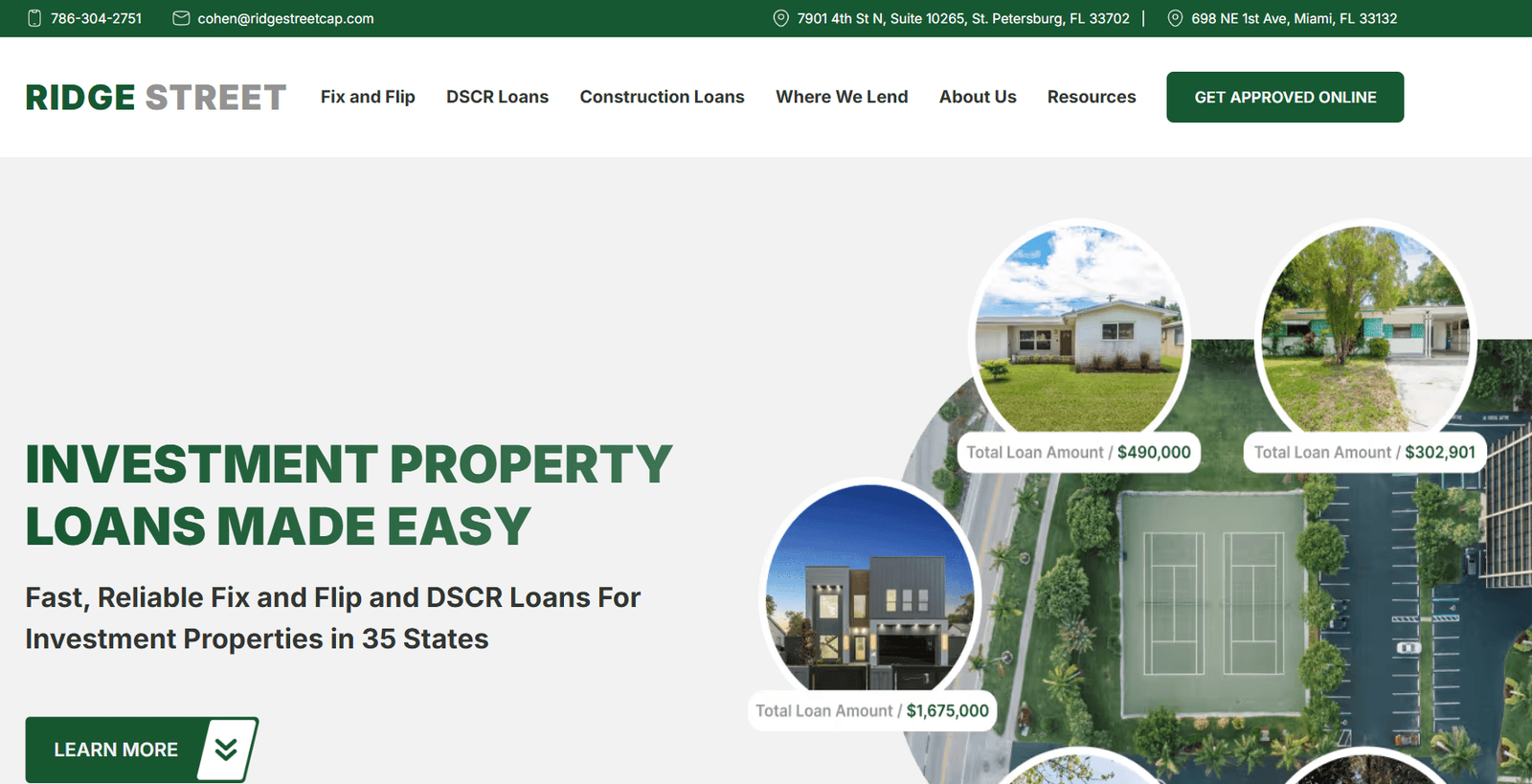
Ridge Street Capital is a private investment property lender built exclusively for real estate investors: no residential mortgages, no homebuyer programs, no generalist products. Based in Miami and lending in 35 states, Ridge Street focuses on DSCR rental loans, fix-and-flip, and ground-up construction for operators who need speed, flexibility, and a team that understands the needs of real estate investors.
What separates Ridge Street from most DSCR lenders is the combination of low fees and fast execution. DSCR origination starts at 0%, term sheets are issued within 2 business hours, and DSCR loans typically close in 10 to 21 days — consistently faster than most rental lenders.
Ridge Street also covers property types like single-family (1–4 units), small multifamily (2–4 units), and mid-sized multifamily 5-10 units. Ridge Street finances long-term rentals and specializes in Airbnb loans. For investors running a BRRRR strategy, Ridge Street handles both the fix-and-flip acquisition phase and the DSCR refinance -one lender for the full real estate investment cycle.
Qualification: Min 660 FICO. Down payment: 20%
Best For:
- Short-term rental investors (Airbnb/VRBO) seeking a competitive DSCR program
- Buy-and-hold investors who want fast closings and low fees
- Self-employed investors and LLC borrowers without W-2 income
Pros and Cons:
2. Park Place Finance

Park Place Finance is a private direct lender from Austin, TX, operating in 46 states with a DSCR rental program including Fully Amortized, I/O, No PPP loan options. Where most DSCR lenders draw a hard line at standard single-family and small multifamily, Park Place extends eligibility to condotels, non-warrantable condos, and 5–10 unit property portfolios — property types that routinely fall outside the scope of most private DSCR programs. Loan amounts run from $100K to $5M, with purchase LTVs up to 85% and cash-out refinance LTVs up to 75%.
Qualification: Min 660 FICO. 15-20% down.
Best for: Investors acquiring condotels, non-warrantable condos, or 5–10 unit portfolios that fall outside standard DSCR programs.
Pros and Cons:
3. Angel Oak Mortgage Solutions
Angel Oak Mortgage Solutions pioneered the non-QM lending category and brings one of the more flexible DSCR programs in the market. Their product accepts coverage ratios below 1.0 and includes a no-ratio option for qualified borrowers. Angel Oak offers instant rental income evaluation at the pre-qualification stage, giving investors rent estimates upfront without waiting on a traditional appraisal. STR income is underwritten using AirDNA data, with no operating history required. The program supports 5/6 ARM, 7/6 ARM, & 30 year fixed options and property types that include warrantable, non-warrantable, and condo hotels. The lender allows title to be vested in LLCs, S corps, C corps, and revocable trusts. Angel Oak originates through approved broker and lending partners, not directly with borrowers.
Qualification: 680 min credit FICO score. 20-25% down payment.
Best For: Investors working through a broker who need DSCR flexibility, STR financing, or complex entity structures.
Pros and Cons:
4. Griffin Funding
Griffin Funding is a national direct-to-consumer lender operating in all 50 states with the broadest non-QM product menu of any lender in this comparison. Their lineup covers DSCR loans, DSCR HELOANs, bank statement loans, asset-based loans, 1099 and P&L programs, VA loans, conventional mortgages, SOFR ARMs, and home equity products. For investors, the practical value is a lender that handles both the rental portfolio through DSCR and a personal mortgage. DSCR Loan amounts go up to $4.5M. It is one of the few programs that works for large-balance rentals.
Qualification: 620 credit FICO score. 15-20% down payment.
Best for: Self-employed investors, veterans, and borrowers who want DSCR and personal mortgage products under one lender.
Pros and Cons:
5. Easy Street Capital
Easy Street Capital is an Austin-based private lender built around accessibility and self-service. Their online term sheet tool lets investors generate preliminary loan terms before speaking to anyone which is useful for early-stage deal screening. The program covers long-term, medium-term, and short-term rentals, including vacation rentals, with no operating history required on STRs. Lender offers blanket portfolio loans for up to $5M.
Qualification: Min 640 FICO. 20% down payment.
Best for: Investors with properties that don't meet standard DSCR thresholds,
Pros and Cons:
6. Constitution Lending
Constitution Lending is a real estate credit fund based in Greenwich, Connecticut, that originates DSCR and fix-and-flip loans for investment properties. The company also manages investment properties. Their borrower portal offers automated loan pricing without requiring a call. Covers non-owner occupied single-family, 1-4 family, and 5-8 unit properties. The firm's focus is on working with experienced investors, particularly those running strategies involving both a construction phase and a DSCR refinance.
Qualification: Min 660 FICO. 20% down payment.
Best for: Experienced rental investors who want a lender familiar with both the construction and long-term rental sides of the same deal.
Pros and Cons:
7. Truss Financial Group
Truss Financial Group is a full-service mortgage broker with a product access spanning DSCR loans, fix-and-flip, hard money, bridge, conventional, FHA, VA, bank statement loans, asset depletion, reverse mortgages, and HELOC products. Their DSCR program covers 1 to 12 unit properties, including single-family homes, multifamily properties, and commercial real estate. Typical DSCR ratio is 1.2, but they can be flexible with lower rate. Because they work across multiple wholesale lenders, they can evaluate your deal against several underwriting guidelines simultaneously.
Qualification: Min 650 FICO. 20% down payment.
Best for: First-time investors who want guidance comparing loan types, high-loan-amount deals that exceed most lenders' caps.
Pros and Cons:
What is DSCR loan?
A DSCR loan is a type of investment property financing that qualifies the borrower based on the property’s cash flow. Unlike conventional financing, DSCR loans are underwritten based on the expected income from the property itself, not the borrower's personal finances. No income verification, no employment history, no tax returns, and no debt-to-income ratio calculation.
The Debt Service Coverage Ratio (DSCR) is calculated by dividing the property's monthly rent by the total debt service (principal and interest payments, taxes, and insurance).
DSCR = Rent / (Principal and Interest Payments, Taxes, and Insurance
If the property's potential earnings are greater than the sum of its debts, that property will have a DSCR ratio of 1.0 and above — indicating that the borrower can reliably make monthly payments using rental income alone. You can learn more about this loan in our full DSCR loan guide.
How to Choose a DSCR Lender that fits your investment goals
1. Know your DSCR floor requirement. The difference between a 1.0 and 1.1 minimum can determine whether your deal qualifies. If your property generates $2,000 per month in rent and your PITIA payment is $1,900, your DSCR is 1.05, that passes a 1.0 requirement but does not meet a 1.1 minimum. Calculate your ratio first and match it to the lender's minimum.
2. Find a lender that fits your investment strategy. A first-time investor or someone completing their first cash-out refinance will benefit from a lender that provides guidance and helps structure the right financing for their deal. An investor running multiple acquisitions and scaling a portfolio needs a more streamlined process with consistent, repeatable procedures. The best lender is not always the one with the lowest rate — it is the one whose process matches where you are in your investing journey.
3. Confirm property type coverage early. Not all lenders accept multifamily above four units, short-term rentals, or mixed-use properties. Confirming your property type upfront saves you time. Financing availability varies by lender, so investors should verify state coverage before pursuing opportunities in the best states to buy rental property.
4. Know your closing timeline. In competitive markets, the ability to close quickly can be the difference between winning and losing a deal. If you are under contract with a tight deadline, make sure your lender can actually execute within your required timeline.
5. Understand the prepayment penalty structure. Most DSCR loans carry a prepayment penalty, often structured as a step-down over three to five years. If you plan to refinance when rates drop or sell within a few years, a shorter penalty window or a lower penalty structure can save a meaningful amount.
How to Apply for a DSCR Loan
Step 1: Run your DSCR analysis before you apply. Use our DSCR Calculator to model your rent against projected debt service. Knowing your ratio upfront tells you which lenders you qualify with and what rate range to expect before you engage anyone.
Step 2: Know your credit position. Most DSCR lenders pull a tri-merge credit report, so your middle score is what matters. A score below 660 will narrow your options; a score above 720 generally unlocks better rates, higher LTV and lower origination fees.
Step 3: Check your property condition and type. The property is required to be rent-ready / turnkey and income-producing. A distressed property needs a hard money or fix-and-flip loan first. Putting a property that needs work into a DSCR program is the most common reason applications stall before underwriting.
Step 4: Confirm your down payment source. Lenders will ask where your down payment is coming from and how long it has been in your account. Funds need to be documented before underwriting — last-minute transfers raise flags and can delay or derail a closing.
Step 5: Get your loan terms in writing before authorizing the lender to proceed. Any reputable DSCR lender should issue a term sheet before you sign for an appraisal or pay any upfront fees.
Ready to Get Started?
Starting with Ridge Street Capital is straightforward. Submit a short inquiry form and our team will reach out shortly to learn about your property, understand your goals, and talk through your timing. Whether you are buying, refinancing, or still evaluating the deal, we are here to help you move forward with confidence and look forward to being your trusted lending partner along the way.
From there, Ridge Street Capital issues DSCR loan term sheets within 2 business hours and offers pre-approval letters to investors.
Frequently Asked Questions
How are DSCR loan rates different from conventional mortgage rates?
DSCR loans typically carry rates 0.5 to 1.0 percentage points above conventional investment property mortgage rates for comparable loan sizes and credit profiles. The gap exists because DSCR loans are not government-backed, carry more flexible underwriting, and are primarily financed through the private credit and securitization markets rather than Fannie Mae and Freddie Mac. Rates are indexed to long-term US Treasury yields and move with broader interest rate conditions. To see current DSCR rate context, visit our DSCR Loan Rates guide.
Who are DSCR loans designed for?
DSCR loans are purpose-built for real estate investors, not homebuyers. They work well for buy-and-hold investors with income-generating rentals, self-employed borrowers whose tax returns understate actual cash flow, LLC investors keeping investment debt separate from personal finances, and portfolio builders who have reached conventional loan limits.
They are not the right tool for house flippers, who need a short-term hard money or bridge product. Owner-occupants cannot use them. For more on whether your deal qualifies, see our DSCR Loan Requirements Guide.
What property types qualify for a DSCR loan?
Most DSCR lenders finance standard single-family properties from one to four units that covers the majority of buy-and-hold and BRRRR deals. Beyond that, dscr loan coverage varies significantly by lender. For example, dscr loans for multifamily properties from five to ten units are available through a smaller number of programs. Short-term rentals are a gap in most programs — many lenders either exclude them or require 12 months of documented platform income before underwriting.
Ridge Street provides Airbnb property financing and uses AirDNA data to project rental income during underwriting, with no operating history required from the borrower. Mixed-use and commercial components are generally outside the scope of standard DSCR programs.
Can I have multiple DSCR loans at the same time?
Yes, and this is one of the key reasons investors use DSCR loans to scale rental portfolios. Unlike conventional mortgages, which cap the number of financed properties a borrower can hold, most DSCR lenders evaluate each loan on the individual property's cash flow rather than the borrower's total debt load. That structure allows investors to add properties without the conventional financing ceiling becoming a barrier.
Do DSCR loans require tax returns or W-2s?
No. DSCR loans are underwritten based on the property's rental income and the resulting coverage ratio, not the borrower's personal income. There is no requirement for employment verification, W-2s, or personal tax returns. This makes them particularly useful for self-employed borrowers, business owners, and investors whose tax returns show significant deductions that reduce reportable income. You can read how DSCR loans are different from conventional loans in our article.
Can I use a DSCR loan for a short-term rental or Airbnb?
Some lenders accept short-term rental income, but many do not. Lenders that do may require 12 months of documented platform income before they will underwrite it. Ridge Street Capital offers DSCR loans for short-term rentals including Airbnb properties and can use projected STR income for properties without an established rental history. See our Airbnb Financing page for more details.
Zach Cohen is the Managing Partner of Ridge Street Capital, a direct private lender providing hard money and DSCR loans to real estate investors across 35 states. Under his leadership, the firm has funded nearly $100 million in investment property loans. He regularly works with real estate investors on rental property acquisitions, refinances, and fix-and-flip projects across the country.
Fix and Flip Loans
Funding For Purchase + Rehab
- $50,000 up to $3,000,000
- Interest Rate 10.5%-11.5%
- Origination Fee From 1.5%
- Up to 90% of Purchase and 100% of Rehab

DSCR Loans For Long Term Rentals
Perfect for first-time investors or experienced investors scaling their rental portfolio.
- Up to $2,000,000
- Interest Rates from 6.0%
- Origination Fee From 0%
- Up to 80% of LTV

DSCR Loans For Short Term Rentals
Designed for investors pursuing higher rents with a short term rental strategy.
- Up to $2,000,000
- Interest Rates from 6.25%
- Origination Fee From 0%
- Up to 80% LTV
Ready to Get Started?
.svg)