Best Airbnb Lenders of 2026: Which One Is Right for Your Deal
Compare the top 7 Airbnb lenders of 2026 by underwriting approach, loan terms, and close time, and learn how to choose the right lender for your STR strategy.
nmin readReleased on:November 23, 2025Last updated on:August 21, 2026


Overview:
- There is no universal best Airbnb lender for every investor or property. Lenders underwrite short-term rental income differently, set their own credit and leverage requirements, and vary by state coverage, property type, and investor profile.
- Conventional lenders underwrite an Airbnb on long-term lease assumptions, which understates what a working short-term rental earns. Many DSCR programs hit the same limit when a property has no booking history. Specialized lenders instead underwrite projected short-term rental income.
- Comparable listings are selected by unit type, bedroom count, property tier, and market radius, so the estimate reflects the specific property rather than the market average.Lender fit turns on thresholds and coverage.
There is no single best Airbnb lender for every investor or every property. Each lender evaluates short-term rental income differently, sets its own credit and leverage thresholds, and covers a different range of states and property types. What qualifies cleanly with one lender may get declined or underpriced by another, particularly for a new listing with no operating history.
Most conventional lenders still evaluate Airbnb properties on long-term lease assumptions, which understates the income a functioning short-term rental actually produces. Many DSCR programs face the same limitation when a property has no booking history at acquisition. Specialized Airbnb lenders solve this by underwriting on projected short-term rental income instead.
This guide reviews the seven best Airbnb lenders of 2026, comparing underwriting approach, loan programs, and investor fit, so investors can match their deal to the lender built to finance it.
Best Airbnb Lenders of 2026
Each lender below was evaluated on four criteria: how short-term rental income is underwritten, minimum qualification requirements, execution reliability based on publicly available borrower feedback, and the range of loan types available for different STR strategies. The table reflects how each lender positions itself across those dimensions. Use the table below to compare key parameters at a glance, then review the full profile for each lender.
Ridge Street Capital — Best Overall for Airbnb Investors
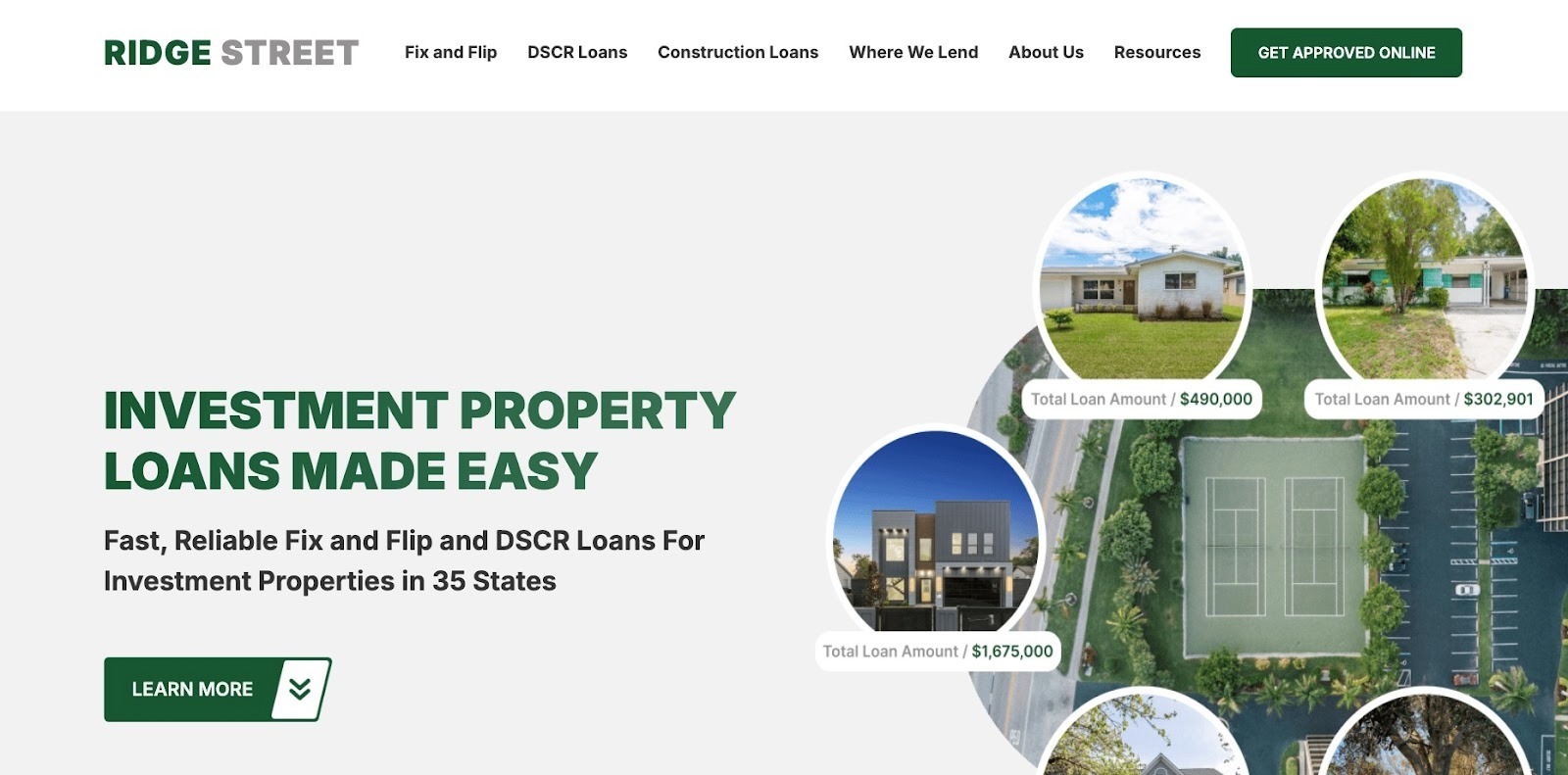
Ridge Street Capital is a direct private lender based in Florida, originating Airbnb Loans across 35 states. The DSCR program for Airbnb is built for short-term rental properties, including acquisitions with no operating history. Income is evaluated using AirDNA projections filtered to comparable properties by unit type, bedroom count, and property tier within a defined market radius.
Ridge Street originates both the hard money loan for the renovation and the DSCR refinance after the property is stabilized and listed.
Program Highlights: 700 minimum FICO for STR. 80% LTV purchase, 75% LTV cash-out refinance. 0% origination fee. Minimum DSCR 1.0. Loan amount: $55K to $2M.
Pros and Cons:
Investors can review program details on Ridge Street's Airbnb financing page or submit a deal through the online application. A term sheet is issued within 2 business hours.
Park Place Finance

Park Place Finance is a direct private lender from Austin, Texas, offering DSCR loans for Airbnb properties among other programs. Most DSCR lenders focus on single-family and small multifamily properties. Park Place also finances condo hotels, non-warrantable condos, which are often excluded by other lenders.
Program Highlights: 660 minimum FICO. 80% LTV on DSCR. 46 states. Loan amount: $100K to $5M.
Pros and Cons:
Easy Street

Based in Austin, Texas and lending nationally, Easy Street Capital operates the EasyRent DSCR program, which was one of the first in the market built specifically around Airbnb and vacation rental income. The program accepts STR income on properties without an operating history. The 640 FICO minimum is the lowest among dedicated STR lenders in this review. The flexibility comes with a cost. Borrowers at the lower end of the credit and DSCR range pay higher origination fees.
Program Highlights: Residential Investment Properties (1 – 10 Units), 640 minimum FICO. Nationwide except NV, ND, SD. Loan amount: $100K to $3.5M.
Pros and Cons:
Certain Lending

Certain Lending is a Seattle-based technology-driven private lender that uses a digital platform to deliver fast approvals. The platform is built for investors who want quick underwriting decisions without a documentation-heavy process. Certain Lending operates in 44 states and accommodates flexible credit overlays, including financing programs for foreign nationals at reduced LTV. While not an STR-specialized lender, the investor programs accommodate properties in transition, including acquisitions being repositioned from long-term to pay-per-night use.
Program Highlights: Single-family, townhomes, warrantable condos, 2-4 units, and 5-10 units. Loan terms: Up to 75% loan to value; 70% for cash-out. 44 states. Loan amount: $75K to $1.5M.
Pros and Cons:
Newfi Lending

Newfi Lending is a California-based mortgage lender that offers both DSCR investment loans and a full conventional product menu, including VA loans, FHA, and standard purchase and refinance programs. For investors who want to finance a STR through a DSCR program and still maintain a relationship with the same lender for personal mortgage needs, Newfi covers both sides of that equation. Lender also offers a 40-year DSCR loan term, which extends the amortization period beyond the 30-year standard and reduces the monthly debt service on the same loan amount.
Program Highlights: Property Types: 1–4 unit residential. 640 minimum FICO. Nationwide except NY. Loan amount: $150K to $3M.
Pros and Cons:
Rocket Mortgage
Rocket Mortgage is the largest retail mortgage lender in the United States and a pioneer in digital-first lending. Based in Detroit with offices across the country, Rocket built its reputation on a push-button mortgage experience: borrowers can complete the full application, upload documents, and receive an initial approval entirely online, without needing to speak to a loan officer. The second home program is the most relevant option for investors who plan to use a vacation property personally for part of the year and rent it out on Airbnb when not in use.
Program Highlights: Conventional, FHA, VA, Second Home, DSCR. Second home: 10% down, personal use permitted. DSCR: 680 minimum FICO, Nationwide, Loan amount: $100K to $3.5M.
Pros and Cons:
LendingOne

LendingOne is a national private lender offering DSCR rental loans, bridge financing, and fix-and-flip programs. The DSCR program operates nationwide with consistent underwriting and closes in 21 to 25 days. For investors managing multiple properties across different markets who want a single lender relationship with predictable execution, LendingOne provides scale and process consistency that smaller or regional lenders may not match.
Program Highlights: Single-family rentals, 2-4 unit properties, condominiums, and townhouses. 660 minimum FICO. Nationwide. Loan amount: $85K to $2M.
Pros and Cons:
How to Choose the Best STR Lenders
Airbnb Lenders' profiles above cover who each program serves. Not every Airbnb deal calls for the same loan structure, and the right product depends on whether the property is stabilized, distressed, or already financed, and whether the investor is holding or repositioning. For a full comparison of how these structures work across different STR investment strategies, see the short-term rental loans guide. The scenarios below identify which financing path applies to specific investor situations and what to look for in a lender for each one.
Buying a new Airbnb property with no operating history
Most general DSCR programs default to the appraiser's long-term market rent when a property has no booking history. That figure typically runs 30% to 50% below what the property would produce as a functioning Airbnb, which can push the qualifying DSCR below the program minimum or reduce available leverage.
Recommendation: Look for an Airbnb lender that accepts AirDNA projections or comparable STR market data as the qualifying income source without requiring operating history. Confirm how the lender adjusts the projected income figure, specifically what haircut they apply and whether they filter by comparable property type rather than using market averages.
Ridge Street Capital uses AirDNA income projections and supports STR income qualification on new listings without operating history. For a full breakdown of how DSCR qualification works for Airbnb income, see the DSCR loan for Airbnb guide.
Buying a distressed Airbnb property to renovate and list
A property that needs renovation before it can operate as an Airbnb will not qualify for DSCR financing, which requires the property to be rent-ready. The acquisition and renovation phase requires a hard money or bridge loan, and the DSCR refinance follows once the property is stabilized and listed.
Recommendation: Find Airbnb lenders that handle both the hard money loan and the subsequent DSCR refinance. Working with the same lender across both phases removes the re-qualification risk at the refinance stage and allows the exit underwriting to be confirmed before the renovation begins. Ridge Street Capital offers both hard money and DSCR programs.
Park Place Finance is another option for strong bridge loan options with low rates and fast closings.
Buying an Airbnb property with a low credit score
Most DSCR loan requirements for STR properties include a minimum FICO score of 700 or higher for borrowers. Borrowers in the 640 to 680 range have fewer options and will pay higher origination fees on the programs that will approve them.
Recommendation: Confirm FICO requirements before submitting an application. Easy Street Capital operates the lowest published FICO minimum among STR lenders at 640.
LendingOne accepts borrowers with a credit score of 660. Origination fees typically range from 2.0 to 2.5 points when the borrower’s FICO score falls below 680.
Refinancing an Airbnb property from a conventional mortgage or hard money loan
An investor who originally financed an Airbnb with a conventional mortgage, or who acquired it through hard money and needs long-term financing, can refinance into a DSCR loan. The refinance requalifies the property on current or projected STR income rather than personal income.
Recommendation: Look for Airbnb mortgage lenders that accept STR income structure and offer cash-out refinance programs. Most cash-out refinance programs require a 6-month seasoning period from the original purchase date.
Ridge Street Capital and Newfi Lending both handle DSCR refinances with STR income qualification.
Buying a vacation property for personal use and part-time rental
DSCR investment loans prohibit personal occupancy and require signing a Business Purpose and Non-Owner Occupancy affidavit at closing. An investor who plans to use the property personally for part of the year cannot use a DSCR loan. The right product is a second home loan, which allows personal occupancy, requires as little as 10% down, and permits rental activity up to 180 days per year. The trade-off is that qualification runs on personal income, not rental income.
Recommendation: If personal use is part of the plan, a second home loan is the right structure, not a DSCR loan. Rocket Mortgage and Newfi both offer conventional second-home programs. These loans require personal income qualification, allow occupancy, and permit rental activity up to 180 days per year. STR revenue does not count toward qualification on this path, so the deal must support itself on the borrower's personal income alone.
Some lenders also apply distance requirements between the second home and the borrower's primary residence, so confirm eligibility terms before applying.
Building a portfolio of Airbnb properties
DSCR loans carry no property count limit. Each acquisition qualifies based on the individual property's STR income, independent of what the investor already owns. Conventional financing caps at 10 financed properties under Fannie Mae guidelines and requires personal income to support each new loan. Find more information in our DSCR vs Conventional Loan guide.
Recommendation: Investors consolidating multiple STR properties into a single financing structure should look for Airbnb lenders that offer portfolio DSCR loans, where two or more properties close under one note with one monthly payment. Each property still qualifies on its own DSCR, but the portfolio structure reduces origination events and simplifies debt management as the portfolio scales.
LendingOne supports portfolio bundling of up to 20 properties under a single loan. Ridge Street Capital originates portfolio DSCR loans for Airbnb and VRBO properties.
Fund Your Next Airbnb with Ridge Street Capital
Ridge Street Capital lends exclusively on investment properties, with a dedicated STR program that evaluates Airbnb income on AirDNA projections rather than long-term rent assumptions. Investors submit property details through the online application. A loan officer reviews the deal and STR income and issues a term sheet within 2 business hours. If the numbers do not support the loan, the team provides a clear assessment of what would need to change. Full program details are on the Airbnb Loans page.
Frequently Asked Questions
Does using a dedicated STR lender actually change the qualifying income figure?
Yes, in most cases. General DSCR lenders default to the appraiser's long-term market rent when no operating history exists, which typically runs 30% to 50% below what the property would produce as a functioning Airbnb. A lender that accepts AirDNA projections or comparable STR market data as the qualifying income source can support a higher loan amount on the same property. For investors buying in markets where STR income materially exceeds long-term rent, the choice of lender directly affects available leverage.
What happens if the AirDNA projection does not support a 1.0 DSCR at the proposed loan amount?
The options are to reduce the loan amount until the income figure supports the payment, increase the down payment to bring LTV and the associated payment down, or select an Airbnb mortgage lender that approves sub-1.0 DSCR with compensating factors. Increasing the down payment is the most straightforward path. A 5% increase in down payment on a $500,000 property reduces the loan by $25,000, which at a 7% rate reduces the monthly payment by roughly $167 and can move a 0.95 DSCR above the 1.0 floor. Make sure to run comprehensive investment analysis before committing capital.
Can the same Airbnb mortgage lender handle both the initial acquisition and a future cash-out refinance?
Yes, and using the same lender for both transactions reduces re-qualification friction. The cash-out refinance requalifies the property on its current STR income, which by the time of refinancing should include trailing booking revenue rather than projections. Ridge Street handles both purchase and refinance transactions on STR DSCR loans. The cash-out refinance cap is 75% LTV, and a 6-month seasoning period from the original purchase date applies before a cash-out refinance is available.
Zach Cohen is the Managing Partner of Ridge Street Capital, a direct private lender providing hard money and DSCR loans to real estate investors across 36 states. Under his leadership, the firm has funded nearly $100 million in investment property loans. He regularly works with real estate investors on rental property acquisitions, refinances, and fix-and-flip projects across the country.
Fix and Flip Loans
Funding For Purchase + Rehab
- $50,000 up to $3,000,000
- Interest Rate 10.5%-11.5%
- Origination Fee From 1.5%
- Up to 90% of Purchase and 100% of Rehab

DSCR Loans For Long Term Rentals
Perfect for first-time investors or experienced investors scaling their rental portfolio.
- Up to $2,000,000
- Interest Rates from 6.0%
- Origination Fee From 0%
- Up to 80% of LTV

DSCR Loans For Short Term Rentals
Designed for investors pursuing higher rents with a short term rental strategy.
- Up to $2,000,000
- Interest Rates from 6.25%
- Origination Fee From 0%
- Up to 80% LTV
Ready to Get Started?
.svg)