Rental Property Loans: Types, Requirements, and How to Qualify


December 6, 2025
A rental property loan is investment property financing used to buy or refinance a property that generates rental income. Unlike a primary residence mortgage, lenders evaluate approval primarily on the property's ability to cover its debt service obligation with rental income rather than on the borrower's personal income or employment history.
This guide covers the three main loan types investors use in 2026, what each requires to qualify, and how to match the right product to your deal.
The main differences from a standard mortgage come down to five things:
- Down payment: Rental property loans require a minimum of 20-25% down, compared to as little as 5% on a conventional primary residence mortgage
- Rate premium: Investment property rates run approximately 0.5-1% above primary residence rates
- Occupancy requirement: Primary residence mortgages require the borrower to live in the property. Rental property loans are for non-owner-occupied properties.
- Income documentation: Documentation requirements vary by loan type: DSCR loans require no personal income verification, while conventional investment loans require W-2s and tax returns
- LLC vesting: Whether a loan can be held in an LLC depends on the product: DSCR and hard money loans allow entity vesting; conventional investment loans require personal-name vesting.
Investment property lenders apply stricter qualification standards because rental properties generally present higher risk than owner-occupied homes. In a financial downturn, borrowers are more likely to prioritize housing payments on their primary residence, which increases the perceived risk of default on investment properties. That additional risk is reflected in both pricing and down payment requirements.
The way a lender evaluates a rental property depends on the financing product.
- For DSCR loans (Debt Service Coverage Ratio loans), lenders focus primarily on property cash flow, comparing rental income to monthly housing expenses, including principal, interest, taxes, insurance, and HOA dues (PITIA).
- For conventional investment property loans, lenders evaluate both the borrower's personal finances and the property's income potential.
- For hard money loans, lenders focus primarily on the asset itself, including its current value, renovation plan, and projected after-repair value (ARV). The financing product ultimately determines the underwriting process and the requirements an investor must satisfy to qualify.
Types of Rental Property Loans
Real estate investors use different loan products at different stages of the acquisition and hold cycle. The table below covers the three main loan types for rental properties and when each applies.
DSCR Loans - Prevailing Choice For Rental Property Financing
A DSCR loan is a non-QM (non-qualified mortgage) product that qualifies borrowers based on the property's rental income rather than the investor's personal income. The lender divides the gross monthly rent by the PITIA payment to calculate the debt service coverage ratio. A DSCR of 1.0 means rental income exactly covers the payment. Most lenders require a minimum DSCR of 1.0, with better pricing available at 1.25 and above.
DSCR loans do not require W-2s, tax returns, or personal income verification because qualification is based primarily on property cash flow. Most programs offer 30-year fixed or adjustable-rate terms, typically require a 20% to 25% down payment, and often allow investors to hold the property in an LLC rather than in their personal name. Unlike conventional financing, DSCR programs generally do not impose limits on the number of financed properties, making them a common tool for investors scaling rental portfolios.
For vacation rental properties, many DSCR lenders use projected income from AirDNA or similar market data sources rather than relying solely on long-term lease comparables. Because projected guest-rental revenue is often higher than traditional market rent, this approach can allow the property to support a larger loan amount than conventional rent-based underwriting.
Conventional Investment Property Loans
Conventional investment loans follow Fannie Mae and Freddie Mac guidelines and are issued by banks, credit unions, and traditional mortgage lenders. Approval is based on the borrower's personal income, credit profile, and debt-to-income ratio, with the property's projected rental income playing a secondary role.
Current investment property mortgage rates on conventional loans typically run 0.5% to 0.75% above primary residence mortgage rates. Down payment requirements start at 15% for a single-family property and increase to 25% for multi-unit properties. Fannie Mae caps the number of conventional investment loans a single borrower can carry at ten, which limits this product for investors actively scaling a portfolio.
For W-2 borrowers with strong credit who are purchasing their first investment property or second home, conventional financing often offers lower rates than DSCR loans. However, investors with significant tax write-offs, self-employment income, or variable earnings frequently find that conventional underwriting reduces the income available for qualification, making DSCR financing the more practical option. that conventional underwriting limits their borrowing capacity, making DSCR financing a better fit. See our guide on DSCR loan vs conventional loan for more information.
Hard Money and Bridge Loans
Hard money loans (also called bridge loans or rehab loans) are short-term, asset-based loans used for property acquisitions that require renovation, including fix and flip projects and properties not yet generating rental income. Hard money lenders evaluate the deal on the current property value and the after-repair-value (ARV) rather than on the borrower's credit profile or rental income.
Hard money loans typically carry 6- to 18-month terms with interest-only payments and a balloon payment at maturity. Interest rates generally range from 10% to 13%, reflecting both the short loan duration and the renovation risk involved. Because these loans often close in as little as 7 to 10 days, they are commonly used to acquire distressed properties in competitive situations.
Investors commonly use a fix-and-flip loan to acquire and renovate a property, then refinance a hard money loan into long-term DSCR financing once the property is stabilized and producing rental income. That two-stage structure is the financing backbone of the BRRRR strategy (Buy, Rehab, Rent, Refinance, Repeat).
Rental Property Loan Qualification Requirements
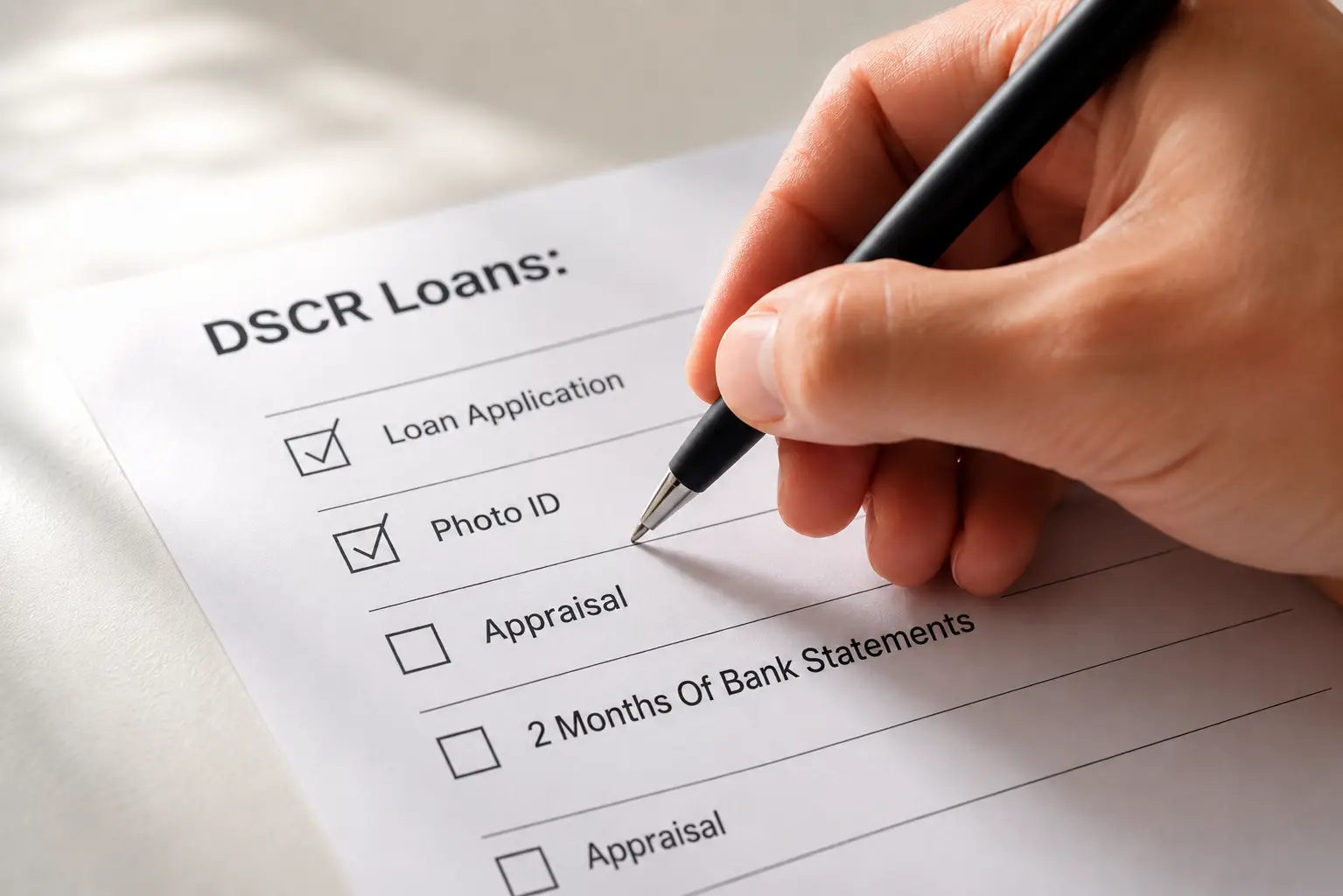
Across loan types, lenders evaluate the same core criteria, though the specific thresholds vary by product:
- Credit score: DSCR and hard money loans at Ridge Street require a minimum of 660 FICO, with pricing improvements at 700 and above. Private lenders who accept scores below 660 typically offset the risk with higher rates or reduced LTV. Conventional investment loans have similar minimums, with the most competitive rates reserved for borrowers above 700.
- Down Payment: The required DSCR loan down payment is typically 20% to 25%, which is generally in line with conventional investment financing. Hard money programs are structured differently and may finance up to 90% of acquisition costs and 100% of rehabilitation expenses, depending on the borrower and project.
- Cash Reserves: DSCR loans typically require six months of PITIA in liquid reserves after closing. Conventional investment loans generally require two to six months. Hard money lenders place greater emphasis on available equity, renovation budget, and the borrower's exit strategy than on maintaining a specific reserve balance after closing.
- LLC vesting: DSCR and hard money loans can be held in an LLC or corporation. Conventional loans require personal-name vesting.
- Property condition: DSCR and conventional investment loans require the property to be leased or rent-ready. Hard money loans are designed for properties that are not yet habitable or income-producing.
Which Rental Property Loan Fits Your Situation?

The fastest way to identify the right rental property loan is to look at two things: the property's current condition and whether the lender needs to see the borrower's income. Those two variables determine the financial product.
- Buying a turnkey long-term rental without personal income verification.
Recommendation: Use a DSCR loan. The property's rent covers the PITIA, no W-2s are required, and the loan can close in 21-25 days. This is the standard path for experienced investors and self-employed borrowers.
- Buying or refinancing a short-term rental (Airbnb or VRBO).
Recommendation: Use a DSCR loan that underwrites projected short-term rental income. Lenders offering this program typically rely on AirDNA projections rather than long-term lease comparables, allowing the property's income potential to be evaluated based on local guest-rental performance. Check Ridge Street's DSCR loan for Airbnb guide for program specifics.
- Acquiring a distressed property to renovate and hold (BRRRR).
Recommendation: Use a hard money loan for the acquisition and renovation, then refinance into a DSCR loan once the property is leased and stabilized. The hard money loan funds the purchase and rehab; the DSCR refinance replaces it with long-term fixed-rate financing after the property is income-producing. See the BRRRR Loans guide for how the two-loan sequence works.
- First rental purchase with W-2 income and a standard credit profile.
Recommendation: A conventional investment loan may offer a lower rate than DSCR, particularly for borrowers with a 700+ FICO and a DTI below 40%. The trade-off is full income documentation and the 10-property cap on conventional financing going forward.
- Refinancing an existing rental to pull out equity.
Recommendation: DSCR cash-out refinance allows investors to access equity from a stabilized rental using the property's income, with no personal income documentation required. Most lenders cap cash-out refinances at 75% LTV.
How Rental Property Loans Work with an LLC
Another factor to consider is ownership structure. Many experienced investors prefer to buy rental properties in an LLC because it helps separate liabilities and cash flow from other assets and projects. Not every loan program accommodates that structure.
A DSCR loan for LLC investors is specifically designed for investment properties and routinely closes in the name of an LLC or corporation. Hard money loans generally offer the same flexibility. Conventional investment mortgages, by contrast, typically require individual borrower ownership because the underwriting framework is based on the same consumer mortgage standards used for primary residences.
From a financing standpoint, LLC ownership becomes more important as a rental portfolio grows. DSCR and hard money lenders routinely originate loans to legal entities, while conventional lenders generally require individual ownership. That difference is one of the reasons many investors move toward DSCR financing as they acquire additional properties.
Rental Property Loan Case Study
The case study below is an example of a real DSCR rental property loan in Alabama that Ridge Street Capital provided to a first time real estate investor.
Rental Property Loan Overview:

|
|
|---|---|
| Borrower Experience | 0 |
| Borrower Credit Score | 764 |
| Property Purchase Price | $305,000 |
| Loan Amount | $244,000 (80%) |
| Interest Rate | 6.70% |
| Origination Fee | 0% |
| Monthly P&I Payment | $1,574.84 |
| DSCR Ratio | 1.27 |
| Days to Close | 24 Days |
How to Get Pre-Approved for a Rental Property Loan
The process typically begins with a short application that captures basic borrower and property information. After an initial review, lenders issue a term sheet and pre-approval outlining the proposed loan structure, pricing, and conditions.
If the terms are accepted, the borrower provides the supporting documentation required for the loan program. Once the file is complete, the appraisal is ordered and typically completed within 2 to 7 days. Most DSCR loans close within 21 to 25 days, while hard money loans are often funded in as little as 7 to 14 days from application.
Rental Property Loans Frequently Asked Questions
Can rental income from the property be used to qualify before closing?
For DSCR loans, lenders use projected market rent or AirDNA projections rather than actual collected rent, which means a property does not need an established rental history at closing. For a purchase, the lender orders a rent schedule from the appraiser or uses STR data to determine qualifying income. Conventional lenders typically require 12-24 months of documented rental history before counting that income toward qualification.
Do rental property loans have prepayment penalties?
DSCR loans commonly include step-down prepayment penalties, typically structured as 5-4-3-2-1 over the first five years. Paying off or refinancing the loan within that window triggers a penalty equal to the remaining step-down percentage applied to the outstanding balance. Conventional investment loans do not typically carry prepayment penalties. Hard money loans often have a minimum interest period of three to six months rather than a step-down structure.
What determines rental property loan rates?
Five variables drive pricing: DSCR ratio, LTV, credit score, property type, and the broader rate environment. DSCR loan rates are indexed to US Treasury yields and move with broader market conditions, which means any rate published in an article can be outdated within weeks. A DSCR of 1.25 or higher and an LTV at or below 75% produce the best pricing. Credit score improvements at 680 and 700 move rates meaningfully. For current rate ranges across loan types, see Ridge Street's Investment Property Mortgage Rates guide.
How does the 75% rental income credit work?
When lenders count rental income toward qualification on a conventional loan, they apply a 75% vacancy discount to the gross projected rent. On a property renting for $2,000 per month, the lender credits $1,500 toward qualifying income. The 25% discount accounts for expected vacancy periods and maintenance costs. DSCR lenders calculate the ratio on full gross rent against the full PITIA payment, so the vacancy discount does not apply in the same way.
What is seasoning and why does it affect rental property loan eligibility?
Seasoning refers to the length of time an investor has owned a property before refinancing. Most DSCR lenders require a minimum of three to six months of ownership before a cash-out refinance, and some require 12 months if the investor wants the refinance to be based on a new appraised value rather than the original purchase price.
What are some common reasons for denial of a rental loan?
Denials are highly predictable: insufficient reserves, weak credit score, a property that fails the rent-ready appraisal, or a low DSCR (for DSCR loans) or high DTI (for conventional loans).
What are the best states to buy rental property?
The answer depends on the investor's strategy. A cash-flow investor prioritizes states with low entry prices, landlord-favorable law, and strong rent-to-price ratios. An appreciation-focused investor weights population growth and home price momentum more heavily. Either way, state selection directly affects DSCR outcomes — insurance costs, vacancy rates, and rent trends all feed into the coverage ratio a lender calculates at underwriting. Ridge Street Capital evaluated ten states across seven criteria including gross yield, rental vacancy, rent growth, home appreciation, insurance cost, and real estate cycle position. The full ranked analysis is available in our Best States to Buy Rental Property guide.

Funding For Purchase + Rehab

$50,000 up to $3,000,000
Interest Rate 10.5%-11.5%
Origination Fee From 1.5%
Up to 90% of Purchase and 100% of Rehab



Perfect for first-time investors or experienced investors scaling their rental portfolio.


.png)
.png)
Designed for investors pursuing higher rents with a short term rental strategy.
.svg)