DSCR Loan for Multifamily Property: A Guide for Real Estate Investors
A 5-unit building is underwritten differently than a fourplex. Learn how DSCR lenders calculate income, value the property, and size the loan.
nmin readReleased on:March 12, 2025Last updated on:September 1, 2026


Overview:
- Lenders change the income definition at five units. Below that they divide gross rent by the full monthly payment. At five units and above they subtract operating expenses first, including management, maintenance, and utilities, so the ratio comes in lower.
- Appraisers switch methods at the same boundary. Owner-occupants buy two- to four-unit buildings, so those appraise against comparable sales. Investors buy larger buildings and price them on net operating income against the local cap rate.
- Ridge Street Capital requires multifamily files to have a minimum ratio of 1.15 rather than 1.00, cap leverage at 75% on purchase and 70% on cash-out, and requires prior experience. They finance stabilized buildings only, so a property mid-renovation needs bridge financing first.
Can You Use a DSCR Loan on a Multifamily Property?
Yes. Ridge Street Capital and most other DSCR lenders write these loans on buildings with two to ten units, and the loan an investor receives at five units works differently from the one they used at four.
Investors tend to reach this question at a predictable point. Someone who has financed one- to four-unit rentals through conventional mortgages finds that the first five-unit purchase is where that path ends. The building can cash flow, appraise cleanly, and still get declined, because conventional residential financing covers properties with one to four units and stops there.
Private lenders finance those buildings with multifamily DSCR loans. A DSCR lender approves the loan on the property's rental income rather than the borrower's personal tax returns.
DSCR stands for debt service coverage ratio, which compares the property's income to its annual debt payments. Borrowers who take that route close in an LLC, skip the W-2 and tax return package, and move past the personal debt-to-income limits that restrict conventional financing as a portfolio grows.
Which Multifamily Properties Qualify for a DSCR Loan?
DSCR programs cover 2- to 10-unit residential buildings and some mixed-use properties. Underwriting splits into three tiers by unit count, and each tier applies a different appraisal method and a different DSCR calculation.
One condition applies across all three tiers. DSCR lenders finance stabilized properties, which means buildings that are leased or immediately leasable with no outstanding repairs. A property mid-renovation needs fix-and-flip financing first, followed by a DSCR refinance once the rent roll stabilizes.
Why a 5-10 Unit Building Gets Valued Differently
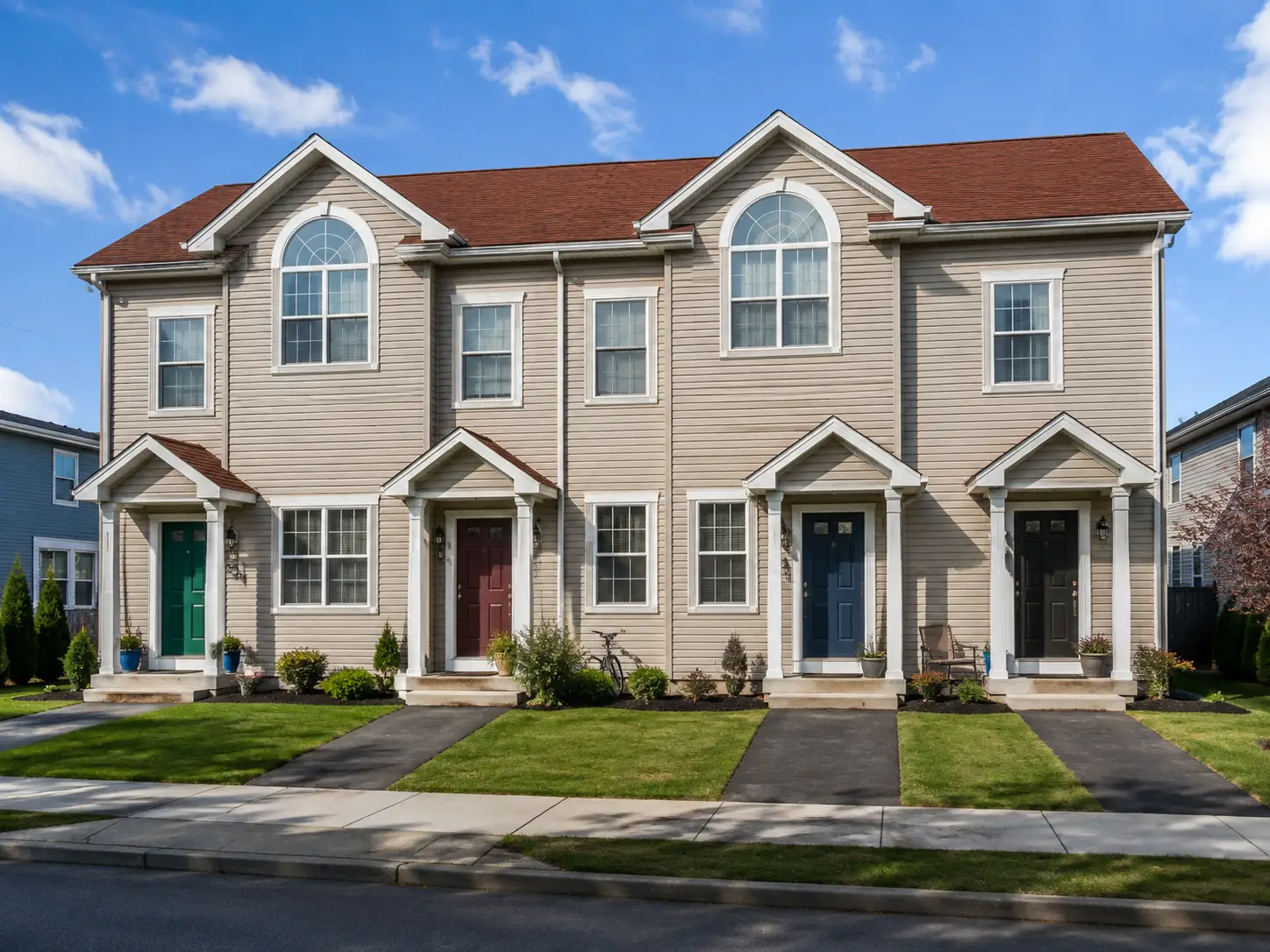
“Multifamily” can refer to any property with two or more residential units, but lenders do not evaluate every multifamily property the same way. The buyer pool often determines the appraisal method, and the appraisal method affects how income is counted for loan origination.
2- to 4-unit properties still attract many owner-occupant buyers. These properties are typically categorized as residential properties and evaluated similarly to single-family homes. Because of that, appraisers usually value them through comparable sales.
For a fourplex, the appraiser looks at recent fourplex sales in the area, then adjusts for condition, size, and location. Rent affects the investor’s return, but it usually does not drive the appraised value.
5- to 10-unit buildings are different. They are considered commercial multifamily properties and are often evaluated using income-based appraisal methods rather than comparable sales alone. These buildings are bought mainly by investors, and investors price them based on income. Appraisers focus on net operating income and the local cap rate.
Net operating income is the rent left after the owner pays the property’s operating expenses. It is always lower than gross rent.
A cap rate is the annual return investors expect from a stabilized building in that market. Appraisers estimate it from recent sales of comparable income-producing properties.
Cap Rate = (Net Operating Income ÷ Property Value)
A building producing $150,000 of net operating income in a market where similar properties trade at a 7.5% cap rate appraises near $2,000,000.
Comparable sales still matter for 5+ unit multifamily valuation, but they may carry less influence because small apartment buildings trade less often and each one has a different rent roll. As a result, two similar buildings on the same block can appraise differently if their income is different.
Lenders follow the same basis as the appraiser. A multifamily DSCR lender measures income as net operating income rather than gross rent, because underwriting on gross rent would size the loan against income the appraised value does not reflect.
How Lenders Calculate DSCR on a 5-10 Unit Building
Both loan types divide property income by the same denominator: principal, interest, taxes, insurance, and any association dues. What counts as income is what changes. Residential DSCR lenders on one to four unit properties use gross rent. To estimate DSCR for Multifamily buildings, lenders subtract what it costs to operate the property.
Residential DSCR loans, 1-4 units:
DSCR = Gross Rent / (Principal & Interest + Taxes + Insurance + HOA)
For one- to four-unit DSCR loans, the income number is usually the lower of two figures: the appraiser’s market rent schedule or the in-place leases. The lender divides that rent by the property’s full monthly payment.
Management, repairs, and maintenance are not deducted before DSCR is calculated.
Multifamily DSCR loans, 5-10 units:
DSCR = (Rent − Operating Expenses*) / (Principal & Interest + Taxes + Insurance + HOA)
*Operating expenses in this calculation cover property management, non-tenant-paid utilities, and general maintenance. Taxes and insurance are not deducted here, because they appear in the denominator.
Multifamily DSCR Loan Requirements
Ridge Street Capital applies the following DSCR loan requirements on 5- to 10-unit files:
- Minimum DSCR of 1.15. Residential DSCR loans on 1- to 4-unit properties often accept 1.00. Multifamily files need 1.15.
- Maximum LTV of 75% on purchases. Single-family and two- to four-unit DSCR loans may reach 80% LTV. 5- to 10-unit multifamily properties are typically capped at 75% LTV. Cash-out refinances are capped at 70% LTV.
- Credit score above 700: When the borrowing entity has multiple partners, Ridge Street Capital prices the loan using the stronger credit profile.
- Reserves of 6 months of the full monthly payment, held in liquid accounts.
- Investor experience. Entry-level investors qualify for 1-4 unit DSCR loans with no prior investment history. Multifamily DSCR loans on 5+ unit properties require either one previous 5+ unit property or three completed 1-4 unit investments.
- Vacancy limit: No more than 2 units may be vacant at closing.
Document requirements also expand at five units. A fourplex file can usually close with leases and a rent comparable schedule. A 5- to 10-unit file requires a full rent roll, all current leases, and trailing operating statements for the prior 12 months.
Rates often follow a 30-year Treasury + 3.5% pricing model, which gives long-term investors a clearer way to estimate the loan payment. Ridge Street Capital currently prices these loans with interest rates from 7.0% to 8.25%. For more information on loan rates, check our guide on investment property mortgage rates.
Where 5-10 Unit DSCR Deals Fall Apart
Most 5- to 10-unit loan files are typically resized or declined for one of four reasons.
- Using pro forma rents instead of in-place rents: Listing packages often show what the building could produce after renovation, turnover, or rent increases. Underwriters use signed leases and the appraiser’s rent schedule. If two month-to-month tenants are paying below-market rent, the file is underwritten to those current rents.
- Leaving out property management: Investors who self-manage often budget nothing for management. Underwriters still apply a management expense, often 7% to 8% of effective gross income. On a $95,000 rent roll, that can remove roughly $7,000 from NOI.
- Missing operating history: Long-term owners may not have clean trailing operating statements. When the seller cannot document the prior 12 months, the underwriter applies conservative expense assumptions. That lowers NOI and can reduce the loan amount.
- Income-based appraisal below contract price: Some sellers price small multifamily buildings like residential properties. But once the appraisal relies on income, the value has to be supported by NOI and cap rate. If the income approach comes in below the contract price, the appraised value caps the loan.
Investing in multifamily property requires stricter underwriting and more due diligence. With a single-family rental, much of the basic property and sales information is usually available through the MLS, Zillow, or public records.
A multifamily acquisition requires deeper verification. The buyer has to review the offering memorandum, rent roll, leases, operating statements, and seller-provided documents to confirm that the income and expenses are accurate.
Funded Deal: 5-Unit Cash-Out Refinance in New York City
Ridge Street Capital funded a $1,550,000 cash-out refinance on a five-unit multifamily property in New York City valued at $2,650,000. The borrower had held the property for several years and wanted to pull equity out while lowering the payment after a rate increase on the existing mortgage.

- Loan amount: $1,550,000
- Property valuation: $2,650,000
- LTV: 58.5%
- Interest rate: 7.375%
- Amortization: 30 years
- DSCR: 1.16
- Property status: Fully leased and stabilized
Two structural issues shaped the file. New York City charges a mortgage recording tax of 1.8% to 2.2% depending on loan size, so Ridge Street Capital structured the transaction as a Consolidation, Extension, and Modification Agreement. The borrower assigned the existing mortgage instead of recording a new one and paid the tax only on the cash-out proceeds, which saved over $25,000. The ownership entity also held two 50/50 partners, and the loan priced off the higher of the two credit scores.
Full terms and structure appear in the complete case study.
How to Finance a Multifamily Property with Ridge Street Capital
Ridge Street Capital underwrites multifamily properties up to 10 units in 36 states. Send the property address and an underwriter reviews the deal, runs the numbers on the actual leases, and identifies the financing that fits the deal. Submit the property and borrower details through our Quick Application to receive a Term Sheet and Pre-Approval Letter.
Frequently Asked Questions
Why do lenders treat five units differently than four?
Four units is the boundary in every major federal framework. Fannie Mae's residential eligibility runs from one to four units, Freddie Mac's multifamily definition begins at five, and HUD's Section 223(f) program requires a project to contain at least five units. Two of those frameworks define the top of residential lending and one defines the bottom of multifamily lending, and all three land on the same number.
Why is my DSCR lower than the number I calculated?
Most investors calculate DSCR on gross rent, which is correct for one to four unit properties. On five-plus unit properties, the lender deducts vacancy, management, maintenance, replacement reserves, and common area utilities first. The same building can show 1.39 on gross rent and 1.12 on net operating income.
Can I get a DSCR loan on a building that needs renovation?
No. DSCR lenders finance stabilized properties that are leased or immediately leasable. A building with significant vacancy or deferred maintenance needs a fix and flip or bridge loan first, then a DSCR refinance once it is leased and operating.
Should I use a bank loan instead of a DSCR loan?
Bank and agency loans generally price below a DSCR loan, and each asks for something in return. Agency small-loan programs start around $1 million, so a five to ten unit purchase financed below that amount does not qualify. Bank portfolio loans require full personal financial disclosure, usually carry recourse, and leave the balance due in three to ten years, so the borrower refinances at whatever rates exist on that date. A multifamily DSCR loan suits an investor buying below agency minimums, holding title in an LLC, or working against a contract deadline.
Which states are best for multifamily rental investing?
Multifamily opportunities exist across the country, though certain markets consistently produce stronger returns for investors financing 5- to 10-unit buildings. Ridge Street Capital ranks the best states to buy rental property across eight factors including rent-to-price ratio, vacancy, property taxes, insurance costs, and market cycle position.
- New York, specifically Upstate and Long Island, carries lower operating costs than downstate markets.
- Georgia combines steady population growth with economic expansion that supports rental demand.
- Texas markets including Dallas, Austin, and Houston hold strong rental demand alongside landlord-friendly tenant laws.
- North Carolina draws sustained in-migration to Charlotte and the Research Triangle, where banking and technology employment supports multi-unit rental demand.
- Massachusetts pairs stable rental demand with property appreciation.
Zach Cohen is the Managing Partner of Ridge Street Capital, a direct private lender providing hard money and DSCR loans to real estate investors across 35 states. Under his leadership, the firm has funded nearly $100 million in investment property loans. He regularly works with real estate investors on rental property acquisitions, refinances, and fix-and-flip projects across the country.
Fix and Flip Loans
Funding For Purchase + Rehab
- $50,000 up to $3,000,000
- Interest Rate 10.5%-11.5%
- Origination Fee From 1.5%
- Up to 90% of Purchase and 100% of Rehab

DSCR Loans For Long Term Rentals
Perfect for first-time investors or experienced investors scaling their rental portfolio.
- Up to $2,000,000
- Interest Rates from 6.0%
- Origination Fee From 0%
- Up to 80% of LTV

DSCR Loans For Short Term Rentals
Designed for investors pursuing higher rents with a short term rental strategy.
- Up to $2,000,000
- Interest Rates from 6.25%
- Origination Fee From 0%
- Up to 80% LTV
Ready to Get Started?
.svg)