Proforma for Rental Property: What It Includes and How to Stress-Test the Numbers
Build a rental property proforma that tests seller assumptions on income, vacancy, expenses, debt service, and reserves before making an offer.
nmin readReleased on:August 24, 2026Last updated on:October 9, 2026


Overview:
- A pro forma projects one property's income, expenses, and returns before purchase, in a fixed order. Gross rent minus vacancy gives effective gross income, minus operating expenses gives net operating income, minus debt service gives cash flow.
- Operating expenses exclude the mortgage, which is why net operating income and cash flow are separate numbers. Seller and buyer versions use the same line items and differ on assumptions.
- A lender's test is not a cash flow test. A DSCR loan divides gross rent by PITIA and ignores management, maintenance, and reserves, so a property can clear the minimum and still return very little.
A pro forma for a rental property is a projection of a single property's income, expenses, and returns, built before you own it. An operating statement records what a property has already produced. A pro forma estimates what it should produce next year under a specific set of assumptions about rent, vacancy, expenses, and financing.
At Ridge Street, we review these projections every day. Investors send us a property address and their numbers, then we underwrite the deal using verified rent, expenses, taxes, insurance, and financing terms. To make a deal pencil, qualify for financing, and remain profitable after closing, those inputs need to be realistic from the start.
Rent needs to be supported by the market, expenses need to be complete, and the financing assumptions need to match the rental property loan the investor can actually get.
This guide covers the line items a complete projection includes, how to calculate each one, and how to tell whether the pro forma sitting in front of you is realistic or built to sell a deal.
Ridge Street also built a Rental Property Pro Forma Excel template that you can download for free and use it to run your own deal analysis as you move through the guide.
What Is a Rental Property Pro Forma?
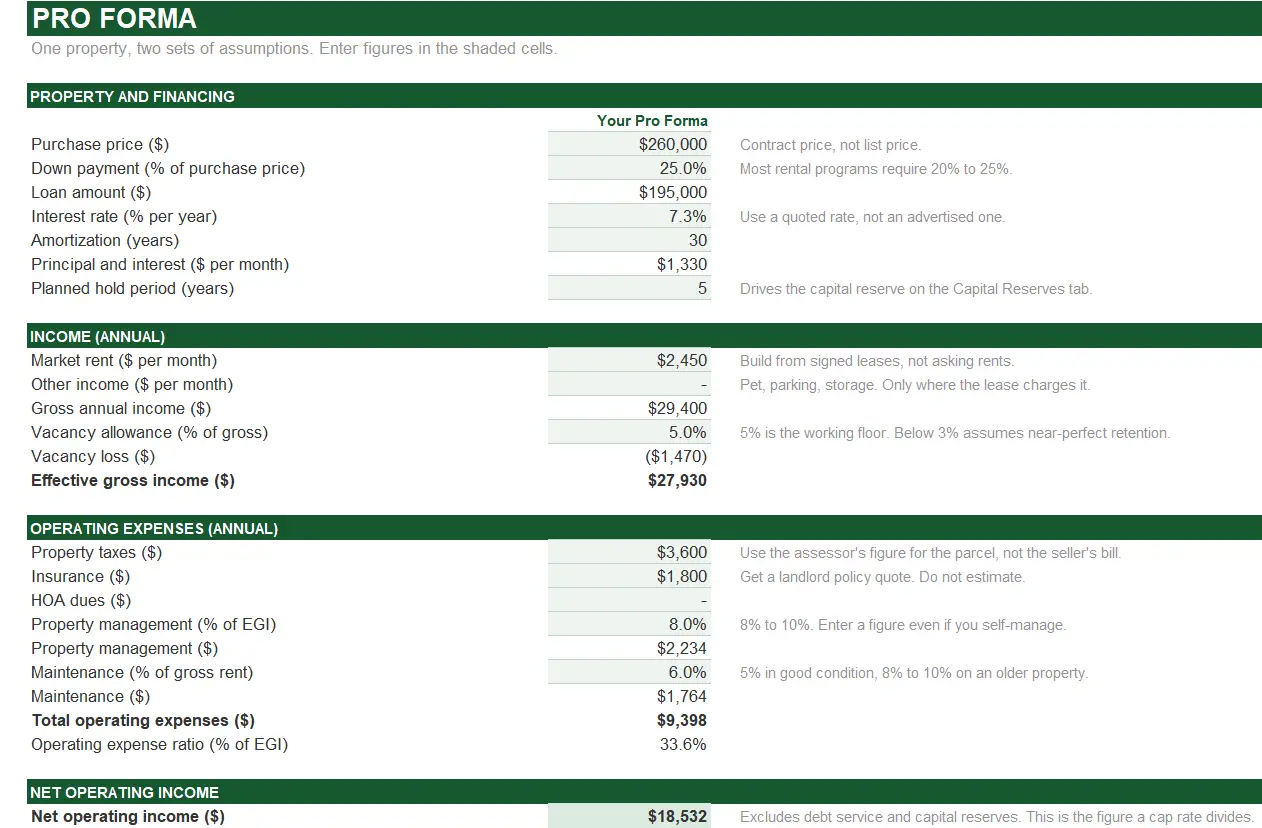
A rental property pro forma is a forward-looking financial projection for one property. In most deals, two versions exist.
The seller or listing broker prepares a marketing version that shows what the property could produce. The buyer prepares an underwriting version that shows what the property is more likely to produce. The line items are usually the same, but the assumptions differ..
The seller’s version almost always shows higher net operating income than the property’s actual operating history. That gap usually comes from optimistic rent, low vacancy, missing management expenses, or reserves that never made it into the projection.
Most residential investors only need to model year one. Twelve months is enough to evaluate rent, vacancy, operating costs, debt service, and cash flow. Longer projections can be useful for value-add deals, but each added year depends more heavily on rent growth and expense inflation assumptions.
Proforma For Rental Property: The Income Block
The income block establishes every dollar the property is expected to collect before any cost comes out.
Gross rental income
Gross rental income is monthly market rent multiplied by twelve. Market rent comes from comparable rentals within roughly one mile, matched on bedroom count, square footage, and property condition.
For a quick first pass, tools like Zillow Rent Estimator and Rentometer can help investors estimate market rent. But lenders do not use those platforms to underwrite the loan.
On a DSCR loan, the appraiser’s Form 1007 rent schedule usually determines the rent used in underwriting. That number can come in higher or lower than the online estimate.
Other income
Other income covers pet rent, parking, storage, laundry, and late fees. On a single-family rental this line is usually small or zero. On a small multifamily property, laundry and parking can add a few hundred dollars a month and belong in the projection.
Vacancy allowance
The vacancy allowance subtracts rent the property is not expected to collect during turnover. For single-family rentals, 5% is a common working standard, equal to roughly 2 to 3 weeks of vacancy per year. A projection using 2% or 3% assumes near-perfect tenant retention and should be treated carefully.
The right vacancy assumption still depends on the local rental market. In softer markets with more available rentals, turnover may take longer and vacancy should be modeled more conservatively. For a broader market-level view, see our review of the best states to buy rental property.
Effective gross income
Effective gross income is gross rental income plus other income, minus the vacancy allowance. Every calculation below this line runs off effective gross income rather than gross rent. If you apply your expense percentages to gross rent instead, you overstate income by the full vacancy amount.
Short-term rental income
For short-term rentals specifically, nightly rate and occupancy replace monthly rent, and both move by season. Ridge Street Capital underwrites short-term rental loans using AirDNA projections rather than appraiser market rent, because long-term rent on a vacation property rarely reflects what the property actually earns.
Proforma For Rental Property: The Expense Block
Operating expenses cover everything required to run the property, with one exception: the mortgage payment stays out. That exclusion is deliberate, and it is what makes net operating income comparable across properties financed on different terms.
Property taxes and insurance
Property taxes and insurance are two of the largest fixed costs in a rental property pro forma, and they are often copied from the seller’s numbers without verification.
Taxes can reassess after a sale, especially if the seller owned the property for many years. The current tax bill may also reflect a homestead exemption that will not apply once the property becomes a rental. That means the buyer’s tax bill can be materially higher than the seller’s.
Pull the current assessment, millage rate, and exemption status from county records instead of relying on the listing or seller’s pro forma.
Insurance deserves a real quote, not a rough estimate. In coastal Florida, Gulf Coast Texas, and parts of Louisiana, premiums have moved far enough from national averages that a percentage-of-value shortcut can mislead the entire pro forma.
Before the quote arrives, 1% of the purchase price per year can work as a placeholder in many markets, but it should not stay in the final underwriting. The investor should also check whether the property sits in a FEMA flood zone, since flood insurance may be required on top of standard homeowners insurance.
That check needs to be property-specific. Flood zones can vary even within the same area. We have seen a client compare two nearby properties where one was in a flood zone and required flood insurance, while the other did not.
Property management
Professional property management typically costs 8% to 10% of collected rent on single-family rentals. Include this line even if you plan to self-manage.
A pro forma without a management fee only works while the owner keeps doing the work. If the property is handed to a manager later, the expense appears anyway and the projected cash flow falls.
Maintenance reserves
Maintenance reserves cover routine repairs, such as a failed water heater element, a broken garage door opener, or annual HVAC service. A common range is 5% to 8% of gross rent, depending on the property’s age and condition.
A newer or recently renovated property with updated systems may support a reserve closer to 5%. An older property with aging appliances, older plumbing, or deferred maintenance should usually be modeled higher. Even careful tenants cannot prevent systems from wearing out, and routine repairs still need to be funded in the pro forma.
HOA fees and utilities
Association dues apply on a minority of single-family rentals and on most condominium units, and the full monthly amount belongs in the projection. Utilities belong there too whenever the owner pays them rather than the tenant, which is common on older small multifamily properties running a single meter.
How to Calculate Pro Forma NOI
Pro forma net operating income equals effective gross income minus total operating expenses, with debt service excluded.
Net operating income measures what the property earns as an asset, independent of how you paid for it. Two investors can buy the identical property, one with 20% down and one in cash, and both calculate the same net operating income. Their cash flow will differ.
The importance of NOI depends on unit count. For properties with five or more units, appraisers usually rely more on the income approach. They divide NOI by a market cap rate, so the NOI directly affects the property’s value.
Single-family homes and two- to four-unit properties are usually valued through comparable sales instead. Rental income is reviewed separately through the appraiser’s rent schedule. On those properties, your pro forma NOI drives your buy decision, while the appraiser determines value another way.
Below the NOI Line: Debt Service, Reserves, and Cash Flow
Debt service and capital reserves come out below net operating income. This is where your financing structure and your planned hold period matter, and where two investors buying the identical property end up with different outcomes.
Principal and interest
Annual debt service is the monthly principal and interest payment multiplied by twelve. Taxes and insurance already appear as operating expenses, so using the full PITIA payment here would double-count them.
If you are working from a lender’s PITIA quote, remove taxes, insurance, and association dues first. The debt service line should include principal and interest only.
How loan structure changes the projection
The same property can produce different cash flow depending on how it is financed. A conventional investment property mortgage typically prices 0.5% to 1% below a comparable DSCR loan for a borrower with strong W-2 income and few financed properties. That rate difference flows directly into annual debt service.
A DSCR loan works differently. It qualifies the property based on rent rather than the borrower’s personal income. That can make financing available for LLC purchases, self-employed borrowers, and investors who no longer fit conventional guidelines. The trade-off is that the pro forma has to absorb the DSCR rate premium. Read our full guide to compare DSCR loans vs. conventional loans.
Interest-only structures also change the projection because the monthly payment is lower with no principal being repaid during that period. The rate may be slightly higher to reflect the added risk.
Prepayment penalties should be included whenever the expected exit falls inside the penalty window. Most DSCR loans have a step-down structure, commonly 5-4-3-2-1. A payoff in year one costs 5% of the outstanding balance, and the charge drops by one point each year. If you plan to sell in year two on a $195,000 loan, a 4% penalty equals $7,800 that needs to be modeled before closing.
Capital expenditure reserves
Capital expenditure reserves cover large, infrequent replacements: roof, HVAC, water heater, appliances, flooring, pool and etc. Keep them separate from routine maintenance. Maintenance covers smaller repairs. CapEx covers bigger items that cost more and happen less often.
In many residential pro formas, CapEx reserves are shown below net operating income, not inside operating expenses. That matters because NOI drives cap rate. Cap rate is calculated by dividing NOI by purchase price.
If you put CapEx inside operating expenses, you lower NOI and reduce the cap rate. That can make the property look weaker than comparable listings that calculate cap rate the standard way.
Some rental calculators still include CapEx inside expenses. That is acceptable as long as the convention is clearly labeled. The same property can show a 6.56% cap rate or a 7.13% cap rate depending on where CapEx is placed, and that difference needs to be clear to any partner, lender, or investor reviewing the deal.
How to size reserves against your hold period
A flat percentage of rent is a weak shortcut for CapEx reserves. Replacement costs do not move with rent. A roof may cost roughly the same in Charlotte and Seattle, but 5% of rent funds very different amounts in each market. The percentage also misses the two inputs that matter most: component age and planned hold period.
Build the reserve from the property instead. Use the inspection to check the age of the roof, HVAC system, water heater, appliances, and other major items. Compare each item to its typical useful life, then reserve for the replacements likely to occur during your hold period.
On a five-year hold, the same $260,000 property at $2,450 per month can require very different reserves. The 5% rule may work for a middle-case property, but it can over-reserve on a newer home and badly under-reserve on an older one. On a 2024 build, you may be setting aside cash for replacements the next owner will handle. On a 1978 property, you may underfund the real exposure and pay the shortfall out of pocket.
Return Metrics a Pro Forma Should Produce
A completed projection produces three numbers you use to compare deals, and each one answers a different question.
Cash-on-cash return
Cash-on-cash return is annual cash flow divided by total cash invested, where total cash invested includes the down payment, closing costs, and any make-ready work. A property generating $1,100 a year on $71,500 of invested capital returns 1.5%.
The metric measures how hard your capital works, which is what you need when two properties require different amounts of cash at closing. Use our Rental Property Profit Calculator to run numbers for a deal that you analyze.
Cap rate
Cap rate divides net operating income by purchase price. Because the calculation ignores financing entirely, it puts two properties on equal footing regardless of how each buyer plans to pay.
That makes it useful for ranking your own shortlist. It does not set value on a single-family rental, because the appraiser reaches that number through comparable sales. Cap rate becomes a valuation input at multifamily with five units and above.
Debt service coverage ratio
Debt service coverage ratio measures how far rent exceeds the debt payment. We calculate it as gross monthly rent divided by PITIA, meaning principal, interest, taxes, insurance, and association dues. A ratio of 1.0 means rent exactly covers the payment.
Ridge Street requires 1.0 as the floor on our DSCR programs, and pricing improves as the ratio climbs. Run your property through our DSCR calculator before you go under contract.
Proforma For Rental Property: Worked Example
Both columns use the same core deal assumptions: a $260,000 purchase price, $2,450 in monthly rent, a 7.25% rate, a $195,000 loan at 75% LTV, and $5,400 in annual taxes and insurance. The property has no association dues.
Only four assumptions change: vacancy, management, maintenance, and capital expenditure reserves.
Key takeaway: Four line changes moved monthly cash flow from $621 to $92 and cap rate from 9.00% to 6.56%. Nothing physical about the property changed. The rent is identical, the price is identical, and the loan is identical.
Download the Rental Property Pro Forma Template
The worked example above uses a spreadsheet built around the same sequence this guide follows. Enter the seller’s numbers in one column and your own assumptions in the other. The model compares both projections using the same property and loan terms, so the difference comes down to the assumptions.
Capital reserves are calculated from component age and planned hold period, not a flat percentage of rent. A red flag tab also checks five common assumptions and shows how much the gap between the two columns costs per month.
Five Things to Check on a Seller's Pro Forma
Five patterns account for most inflated projections, and each one is worth checking before making next steps with a deal.
1. Rent above comparable listings. Every downstream number inflates when the rent assumption is too high. Pull three active comparable rentals within a mile before accepting the figure. If the pro forma shows $1,500 and similar homes are listed at $1,350, every return metric might be overstated.
2. Vacancy below 5%. A 2% or 3% vacancy allowance assumes almost no turnover. For single-family rentals, 5% is a practical floor, and even that assumes strong tenant demand in the submarket.
3. No management fee. Removing this line adds 8% to 10% of collected rent directly to the bottom line. It also removes the owner’s option to stop self-managing later without reducing cash flow.
4. Missing maintenance or CapEx reserves. A projection without reserves assumes nothing breaks. That is not a safe assumption.
5. Taxes carried at the seller’s assessed value. Reassessment after sale can raise the annual tax bill, especially on a long-held property. County records show the current assessment, millage rate, and exemptions, so this is quick to verify.
Sellers rarely fabricate numbers outright. The more common issue is expense suppression. The owner defers repairs or limits discretionary spending for 6 to 12 months before listing, creating a low expense history that may be real but unlikely to repeat under new ownership.
How Lenders Read Proforma For Rental Property
Lenders underwrite a DSCR loan by dividing gross monthly rent by PITIA: principal, interest, taxes, insurance, and association dues. That calculation excludes property management, maintenance, and capital reserves because it measures whether rent covers the debt, not whether the investor keeps a margin. Everything depends on the rent figure at the top of the calculation.
That rent figure comes from the appraiser, not the lender or the seller’s pro forma. The appraiser also determines the property’s value, and the valuation method depends on unit count. For single-family homes and two- to four-unit properties, value is based on comparable sales, while market rent is reported separately on a Form 1007 rent schedule. For five- to ten-unit properties, the appraiser relies more on income by dividing net operating income by a market cap rate.
Together, the lender sizes the loan and the appraiser supports the value. Neither one is testing whether the property will actually produce positive cash flow after management, maintenance, vacancy, and reserves. A property can pass the lender’s DSCR test and still produce weak or negative monthly cash flow.
Your projection is the document that answers the investor question: whether a rental property is a good investment at the price you are paying. Run it before going under contract, not after the term sheet arrives.
Financing a Rental Property With Ridge Street Capital
Ridge Street Capital is a direct private lender financing investment property only, across 36 states. Our DSCR rental loans program cover single-family homes, 2- to 4-unit residential properties, 5- to 10-unit multifamily buildings, long-term rentals, and short-term rentals including Airbnb and VRBO. Origination fees start at 0%, and we close in 21 to 25 days.
To get a quote, submit your property and borrower details through our online application. A loan officer reviews the deal, runs the numbers against your projection, and issues a term sheet or pre-approval letter within 2 business hours.
Frequently Asked Questions
How many years should a rental property pro forma cover?
One year is enough for a buy decision on a stabilized rental. Value-add deals justify three years, because the projection needs to show the property before renovation, during lease-up, and after stabilization. Beyond five years, compounding rent growth and expense assumptions produce an output that reflects your assumptions more than the property.
What cash-on-cash return should I expect on a rental property in 2026?
Conservatively underwritten single-family rentals in most growth markets return 1% to 5% cash-on-cash at current loan rates and 20% to 25% down. Returns above 8% usually come from a below-market purchase, a renovation that raised rent, or a projection missing reserves. Cash flow is one of four return components alongside principal paydown, appreciation, and tax treatment.
Does a pro forma include income taxes and depreciation?
No. A standard projection stops at pre-tax cash flow, because depreciation schedules and tax treatment depend on your entity structure, income level, and filing position rather than on the property. Have your accountant model the after-tax picture separately once your holding structure is settled.
Should a pro forma include appreciation?
Keep appreciation outside the cash flow projection. Annual appreciation assumptions of 3% to 5% inflate total return figures without affecting a single line of monthly cash flow, and you cannot spend or bank the number. Treat it as an outcome the deal may produce rather than an input the projection depends on.
How to build a pro forma for short term rental?
Start with expenses, because this is where short-term rental projections diverge most from long-term rentals. The owner usually pays for cleaning, utilities, internet, supplies, platform fees, and higher management costs. STR management often runs 20% to 30% of revenue, compared with 8% to 10% for a long-term rental.
Furnishing should not be treated as an operating expense. It belongs in total cash invested, alongside the down payment, closing costs, and any make-ready work.
Revenue also needs a different build. Do not rely on one annual average. Model the income month by month using Airdna data so seasonality, occupancy, and nightly rates are visible.
Our guide to Airbnb investment analysis walks through the full process.
Zach Cohen is the Managing Partner of Ridge Street Capital, a direct private lender providing hard money and DSCR loans to real estate investors across 36 states. Under his leadership, the firm has funded nearly $100 million in investment property loans. He regularly works with real estate investors on rental property acquisitions, refinances, and fix-and-flip projects across the country.
Fix and Flip Loans
Funding For Purchase + Rehab
- $50,000 up to $3,000,000
- Interest Rate 10.5%-11.5%
- Origination Fee From 1.5%
- Up to 90% of Purchase and 100% of Rehab

DSCR Loans For Long Term Rentals
Perfect for first-time investors or experienced investors scaling their rental portfolio.
- Up to $2,000,000
- Interest Rates from 6.0%
- Origination Fee From 0%
- Up to 80% of LTV

DSCR Loans For Short Term Rentals
Designed for investors pursuing higher rents with a short term rental strategy.
- Up to $2,000,000
- Interest Rates from 6.25%
- Origination Fee From 0%
- Up to 80% LTV
Ready to Get Started?
.svg)