Overview:
- Rental property cash flow is the rent left after every recurring cost, including costs that never arrive as a monthly bill. The formula rarely fails; the inputs do. Rent taken from a listing rather than a signed lease is the most common error.
- Setting capital reserves as a percentage of rent understates them, because replacement costs do not move with rent. Estimating each major system's replacement cost, divided by its remaining useful life, produces a defensible monthly figure.
- Buying a rental takes more cash than the down payment. Lender fees, title, escrow deposits, and prepaid interest come due at closing, and lenders separately require several months of the full payment held in a documented account.
Rental property cash flow measures how much rent remains after vacancy, operating expenses, reserves, and the mortgage payment are accounted for.
The formula is simple: market rent minus vacancy, minus operating expenses, minus the mortgage payment. Most cash flow mistakes do not come from the formula, but from the inputs.
Three inputs cause most cash flow mistakes: overstated rent, missing reserves, and underestimated cash needed to close.
- The first is rent copied from a listing instead of confirmed by a signed lease or real rent comps.
- The second is a capital reserve estimated as a flat percentage of rent instead of based on actual replacement costs.
- The third is closing cash treated as the down payment only, while reserves, lender fees, escrows, and closing costs are left out.
A property can also pass a lender’s debt service coverage test and still lose money each month. That happens because some DSCR calculations focus on rent versus the full loan payment, taxes and insurance, but often do not fully account for management, maintenance, vacancy, or capital reserves.
If you want to run the numbers on a specific address while you read, download our free Excel Cash Flow model or use our rental property profit calculator, which handles the math. This guide explains where each input should come from.
How to Estimate Rental Property Cash Flow: Start With the Rent
Market rent net of vacancy is your starting figure, not the rent a listing advertises and not the rent a seller quotes you.
Every number after that depends on this input. If rent is overstated by $150 per month, the annual cash flow estimate is already off by $1,800 before any expenses are counted.
How to Build a Rent Comp
Pull at least 3 comparable leases signed within the last 6 months, in the same neighborhood, with the same bedroom count. From there, adjust for square footage, condition, and finish level.
A renovated three-bedroom does not rent for the same figure as an old house with an identical floor plan.
How Much to Deduct for Vacancy
A vacancy allowance of 5% to 8% of gross rent typically covers normal turnover in a balanced long-term rental market. At 5%, you are budgeting for roughly three weeks of vacancy over the course of a year, which is reasonable for a well-located property that turns over every two or three years.
Local supply can change that assumption. In markets with higher rental vacancy, the allowance should be adjusted upward. For example, if vacancy is around 9% in Indiana and 11% in Texas, using an 8% to 10% vacancy allowance may be more realistic.
Our guide to the best states to buy rental property shows vacancy and supply conditions if you want to check your market.
Lastly, do not model 0% vacancy on a property that came with a tenant. That lease has an end date and it’s unlikely that a new tenant can move in immediately.
Other Income Worth Counting
Some investors include pet fees, parking, and storage (if applicable), so it can form additional income. For a 2- to 4-unit property, they may generate an additional $50 to $150 per month.
At the same time, you should leave late fees out of the projection. Income that depends on a tenant paying late should not be treated as reliable recurring income.
Rental Property Cash Flow: Subtract Every Operating Expense
Operating expenses on a long-term rental property typically run 45% to 55% of gross rent before the mortgage payment. When investors underestimate that range, they usually do so for the same reason: monthly bills are easy to account for, while expenses that come once every 2 or 5 years are easy to forget. Our guide to building a rental property pro forma works through each line item and shows how to check a seller's version against it.
Fixed Costs: Taxes, Insurance, and HOA
Pull property taxes from the county assessor’s actual bill for the parcel, but do not rely on the seller’s current tax bill alone. Many states reassess property after a transfer, and a seller with a homestead exemption may be paying a rate you will not receive.
Effective property tax rates can vary significantly by state, from roughly 0.5% of property value in South Carolina to around 1.4% in Texas, so the difference can materially affect cash flow.
Insurance should be based on an actual quote, not an estimate. A landlord insurance policy is priced differently from a standard homeowners policy, and coastal wind or flood coverage can significantly increase the premium.
In Florida, annual insurance costs on a mid-priced home can exceed $7,000. It is also important to check the property’s FEMA flood zone and understand whether flood insurance may be required.
We have seen insurance costs turn a deal from profitable to unworkable more than once, which is why we ask for a real quote before finalizing a term sheet.
Variable Costs: Management, Maintenance, and Turnover
Third-party property management typically costs 8% to 10% of collected rent. On top of that, tenant placement usually costs about one month’s rent each time the unit turns over. A property manager may charge this as a leasing or tenant placement fee, commonly 50% to 100% of the first month’s rent.
If you self-manage but hire a real estate agent to fill the vacancy, the commission is often 1-2 months of rent.
Either way, the owner usually absorbs that cost, so it should be included in the projection rather than treated as an occasional extra.
Capital Reserves: Why a Percentage of Rent Gives You the Wrong Number
Capital expenditures cover major replacements such as the roof, furnace, air conditioner, water heater, flooring, windows, appliances, and siding. Many cash flow guides suggest reserving a fixed percentage of rent for these items, but that can produce misleading results.
Replacement costs do not move in proportion to rent. A furnace may cost roughly the same in Houston as in Jacksonville, even though rents are different.
A better approach is to build the reserve from the components themselves. Estimate the replacement cost of each major system, divide it by its remaining useful life in years, then divide by 12. Add those amounts together to get a more realistic monthly capital reserve.
Here is an example of a calculation:
On a property renting for $1,600 per month, an investor using the percentage method would set aside only $80 per month, while the component-based calculation puts the reserve at $214. That $134 gap can be the difference between a property that generates cash flow and one that eats into it.
Remaining useful life matters just as much as replacement cost. If a roof is already 19 years old and has an expected life of 25 years, you have about six years to fund its replacement, not 25. Use the ages and condition of major systems from the inspection report to build the reserve.
How to Estimate Rental Property Cash Flow After the Mortgage Payment
When you estimate rental property cash flow, start with rental income after vacancy. Subtract operating expenses to calculate net operating income. Then subtract the monthly principal and interest payment to calculate cash flow before income taxes. Taxes are worth a separate look, because deductions such as depreciation and mortgage interest often leave a rental’s taxable income well below its cash flow, as the guide to the tax benefits of rental property explains.
Two details often cause mistakes here. Property taxes and insurance are already part of operating expenses, so if your lender escrows them, do not count them again as part of the mortgage payment.
DSCR loan calculations work differently. DSCR lenders commonly divide gross rental income by PITIA: principal, interest, taxes, insurance, and HOA dues. If you are comparing your cash flow estimate with a lender’s DSCR calculation, do not mix the two methods or count taxes and insurance twice.
Mortgage insurance is also uncommon for rental property loans, since most programs require 20% to 25% down.
How to Estimate Rental Property Cash Flow: A Worked Example
Take a three-bedroom single-family rental at $175,000 with 25% down, financed on a 30-year fixed DSCR loan at 7.0%. Market rent from signed comparable leases is $1,600. Annual property taxes run $1,400, insurance is $2,000, and there is no HOA. Principal and interest come to $873 a month, and the full payment including escrowed taxes and insurance reaches $1,157.
The same property gives you three different answers depending on how carefully you build the estimate.
- Pass 1 is the quick calculation many investors run before buying a rental. Rent comes in. The mortgage payment, taxes, insurance, and a maintenance allowance go out. The result looks like $363 a month. The problem is not the math. It is what the calculation leaves out: vacancy, property management, capital reserves, and tenant placement costs. On this property, those four lines total $494 a month.
- Pass 2 adds vacancy, management, and a capital reserve set at 5% of rent, which is the standard advice in many cash flow guides. That version lands close to breakeven.
- Pass 3 replaces the percentage-based reserve with a component-based reserve of $214 per month and adds $72 per month for leasing and turnover, spread across a three-year tenancy. At that point, the deal turns negative.
The result also lines up with the 50% rule. Half of $1,600 is $800. Subtract the $873 mortgage payment, and the rule estimates negative cash flow of $73 per month. That is only $58 better than the fully underwritten result of negative $131.
In this case, operating expenses equal 53.6% of gross rent, not 50%. Even so, the quick rule of thumb comes much closer than the simplified calculation. The 50% rule misses by $58. The calculation many investors rely on misses by $494.
Negative $131 is the answer, and no single adjustment fixes it. At a closer look, a 30% down payment improves cash flow, but only to negative $73. In this scenario, it costs $8,750 in additional capital to acquire the property.
Buying at $165,000 gets to negative $81. Only a combination clears the break-even point: $160,000 with 30% down lands at roughly zero, and $160,000 with a rate bought down to 6.25% turns cash flow to slightly positive.
That is the useful output. Break-even on this property sits at a purchase price near $148,800 or rent near $1,764, against a $175,000 asking price and $1,600 in market rent. The deal needs a 15% price concession or a 10% rent increase to work, which tells you whether to negotiate or walk. Running these numbers takes twenty minutes and happens before the offer, not after the inspection.
Download the Rental Property Cash Flow Model
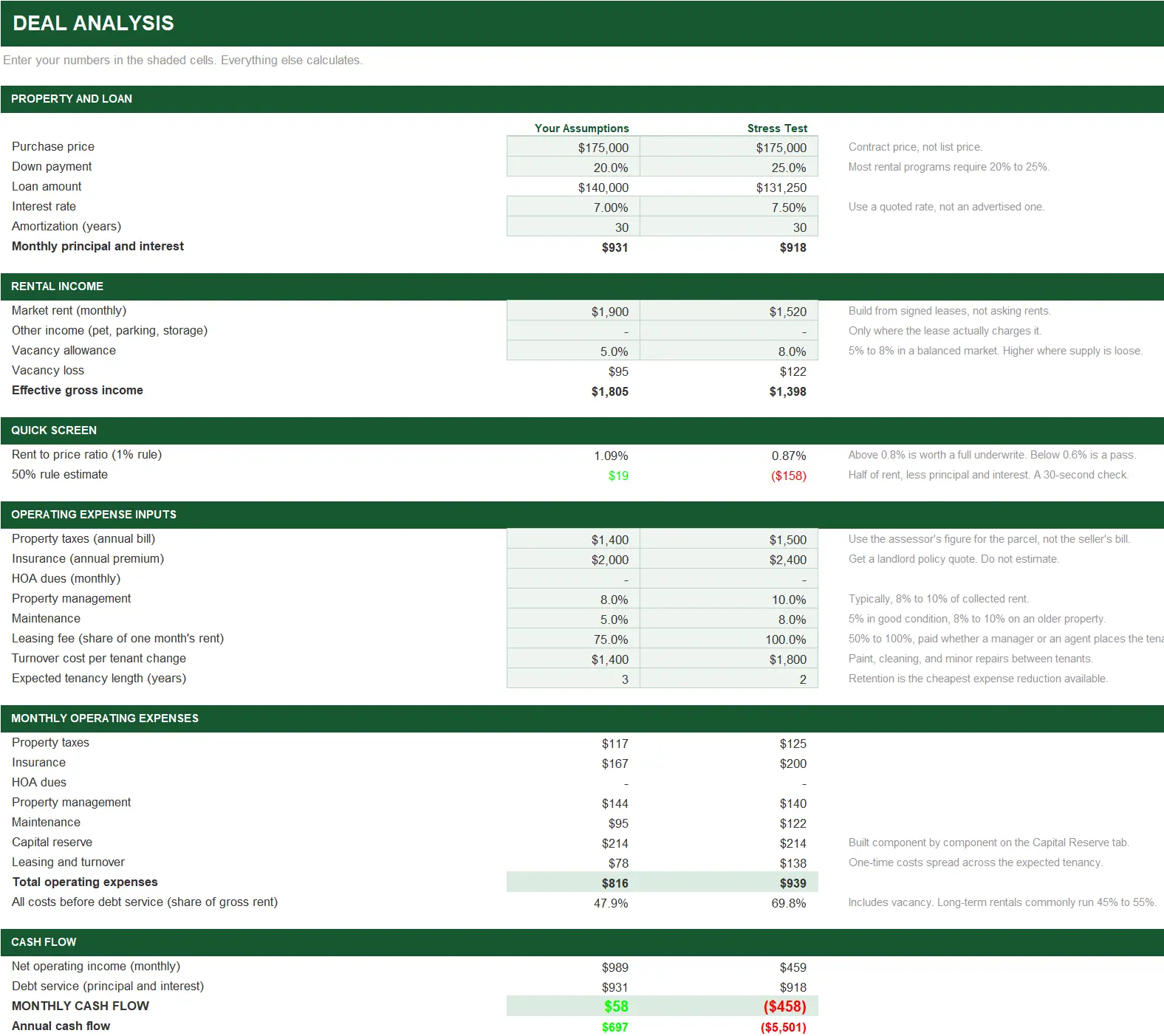
We built the spreadsheet that produced the worked example above, and you can run your own deal through it. Enter the purchase price, rent, loan terms, and operating costs, and the model returns monthly cash flow, net operating income, cash at closing, total liquidity required, and DSCR.
It differs from most templates in two places. C
- Capital reserves come from replacement cost and remaining useful life for each major system.
- Cash at closing is calculated in full, including lender fees, title, the escrow deposit, prepaid interest, and the liquidity reserve underwriting will ask you to document.
The model also reports where the deal breaks even.
How Much Cash Do You Need to Close on a Rental Property?
Monthly cash flow and the cash required to buy the property are two different numbers. The down payment is only part of the upfront cost. In the example above, the down payment is $43,750, but the total cash needed to close is just under $60,000.
What You Actually Pay at the Closing Table
Six categories make up the cash due at closing on a rental property purchase.
- Down payment: 20% to 25% of purchase price on most rental programs.
- Lender fees: an origination fee quoted as a percentage of the loan amount, plus flat underwriting, legal, and document fees.
- Title, escrow, and recording: third-party costs that vary by state and county.
- First-year insurance premium: paid in full at closing rather than monthly on many rental loans.
- Tax and insurance escrow deposit: commonly three to six months of taxes and insurance, funded upfront to seed the escrow account.
- Prepaid interest: interest from your closing date to your first payment date, which runs higher when you close early in the month.
Cash at closing comes in 21% above the down payment alone. This is why we put a full cash-to-close breakdown on every term sheet we issue.
The Reserve Requirement Nobody Budgets For
Rental property lenders also require documented liquidity reserves, commonly equal to six months of the full monthly payment (PITIA). These funds must be held in a verifiable account at loan origination and confirmed during underwriting. Reserves are never spent, which makes them separate from cash at close.
Six months of the $1,157 payment adds $6,942, bringing total liquidity to $59,694. Measured against the $43,750 down payment, this deal needs 36% more cash than the down payment suggests.
Again, since the reserve is a documentation requirement rather than a cost, investors routinely leave it out of their planning and then discover it at underwriting with a contract already signed.
Our DSCR loan requirements guide lists the full documentation checklist if you want to see what underwriting will ask for.
How to Screen a Deal Before You Underwrite It
Full underwriting takes twenty minutes per property, so if you are reviewing dozens of listings you need a faster filter first. Two rules of thumb do that job, and neither one replaces the estimate.
- The 1% rule asks whether monthly rent reaches 1% of the purchase price. Our $175,000 example at $1,600 rent returns 0.91%, which falls short.
In 2026, very few markets outside the Midwest and the lower-priced South produce 1% deals at all, so if you apply it as a hard cutoff, you will find nothing to buy. Treat anything above 0.8% as worth ten more minutes and anything below 0.6% as a pass.
- The 50% rule assumes operating expenses eat half of gross rent before the mortgage payment. Half of rent minus your principal and interest payment gives you a cash flow estimate in about thirty seconds.
After all, the rule exists because expense ratios cluster tightly across most long-term rentals. A deal that fails it before financing will almost certainly produce negative cash flow after.
Financing Your Rental Property With Ridge Street Capital
Ridge Street Capital is a direct private lender providing long-term DSCR and Airbnb loans to real estate investors across 36 states. Get a pre-approval letter for your purchase or rental property refinance by completing a quick 2-minute form.
When you submit a property address, a loan officer will review the numbers with you, confirm the DSCR calculation, and send a term sheet showing the rate, monthly payment, cash required at closing, and liquidity requirement.
Frequently Asked Questions
Should I count the principal portion of my mortgage payment as an expense?
Yes, for cash flow analysis. Principal still leaves the bank account each month, so the full mortgage payment should be included when measuring cash available today.
Some investors exclude principal because it builds equity instead of disappearing as an expense. That approach can make sense when measuring total return of rental property. But cash flow measures monthly liquidity, so principal and interest both belong in the calculation.
How do I estimate cash flow on a property that has never been rented?
Build the rent figure from a signed lease on the subject property or from at least three comparable rentals within roughly one mile. If the property is vacant, use the higher end of the vacancy range, such as 8% instead of 5%, to account for lease-up risk.
A newly listed rental can sit 30 to 60 days before a tenant signs. During that period, the investor still pays the mortgage, taxes, insurance, utilities, and other carrying costs. Treat that lease-up cost as additional cash needed at closing, not as a normal annual expense spread across the first year.
How often should I re-run the estimate after closing?
Re-run the cash flow at least once a year, and again after any insurance renewal or tax reassessment.
Property taxes can reset after a transfer in many states, and landlord insurance premiums have risen sharply in coastal markets. An annual review helps owners catch weakening cash flow early, while a rent increase, expense adjustment, or refinance may still have time to fix it.
What should I do when my estimate lands within $50 of breakeven?
Test the three variables that move first: down payment, purchase price, and capital reserve. An extra 5% down typically improves monthly cash flow by $50 to $70 on a loan this size, and a property with newer systems cuts the reserve by $80 to $130.
A breakeven deal with a five-year-old roof and furnace is a very different proposition from a breakeven deal with a twenty-year-old roof.
Does rental property cash flow estimation change for a short-term rental?
Yes. The structure stays the same, but the inputs change significantly.
Short-term rentals have expense lines that long-term rentals usually do not, including cleaning, supplies, utilities, platform fees, and furnishings. Revenue also does not arrive as a fixed monthly rent figure. It changes by season, occupancy, and nightly rate.
For short-term rentals, occupancy replaces vacancy as the key revenue variable. Operating expenses can also run much higher, often reaching 55% to 70% of gross revenue.
Financing is different too. Short-term rental loans may underwrite income using AirDNA projections with a vacancy or revenue discount, rather than relying only on appraised long-term market rent. For a full breakdown, read our guide to Airbnb investment analysis.
Do I need to keep six months of reserves after the loan closes?
No. Lenders verify reserves during underwriting, typically through two months of bank statements or a brokerage account statement, since stocks and other liquid assets usually count toward the requirement.

Zach Cohen is the Managing Partner of Ridge Street Capital, a direct private lender providing hard money and DSCR loans to real estate investors across 36 states. Under his leadership, the firm has funded nearly $100 million in investment property loans. He regularly works with real estate investors on rental property acquisitions, refinances, and fix-and-flip projects across the country.
Fix and Flip Loans
Funding For Purchase + Rehab
- $50,000 up to $3,000,000
- Interest Rate 10.5%-11.5%
- Origination Fee From 1.5%
- Up to 90% of Purchase and 100% of Rehab

DSCR Loans For Long Term Rentals
Perfect for first-time investors or experienced investors scaling their rental portfolio.
- Up to $2,000,000
- Interest Rates from 6.0%
- Origination Fee From 0%
- Up to 80% of LTV

DSCR Loans For Short Term Rentals
Designed for investors pursuing higher rents with a short term rental strategy.
- Up to $2,000,000
- Interest Rates from 6.25%
- Origination Fee From 0%
- Up to 80% LTV
Ready to Get Started?
.svg)