BRRRR Calculator
Use the free BRRRR Calculator to estimate cash flow, DSCR, refinance proceeds, and total project costs for your next Buy Rehab Rent Refinance Repeat deal.
nmin readReleased on:August 13, 2026Last updated on:November 9, 2026
This free BRRRR calculator checks whether a deal works before you buy and renovate a distressed property. The BRRRR method depends on two results at the refinance:
- The refinance covers the full project cost. The new loan, after fees, repays the purchase, rehab and carrying costs, so the investor gets the cash invested back.
- The property cash flows on the new loan. The debt service coverage ratio (DSCR) is 1.0 or higher, meaning the rent covers PITIA on the DSCR loan.
The calculator also shows the total project cost, monthly cash flow and the cash left in the deal. The same model is available as an Excel spreadsheet you can download at no cost.
Our guide to BRRRR loans explains how the acquisition loan and the DSCR cash-out refinance are structured.
BRRRR Calculator Excel Spreadsheet (Free Download)
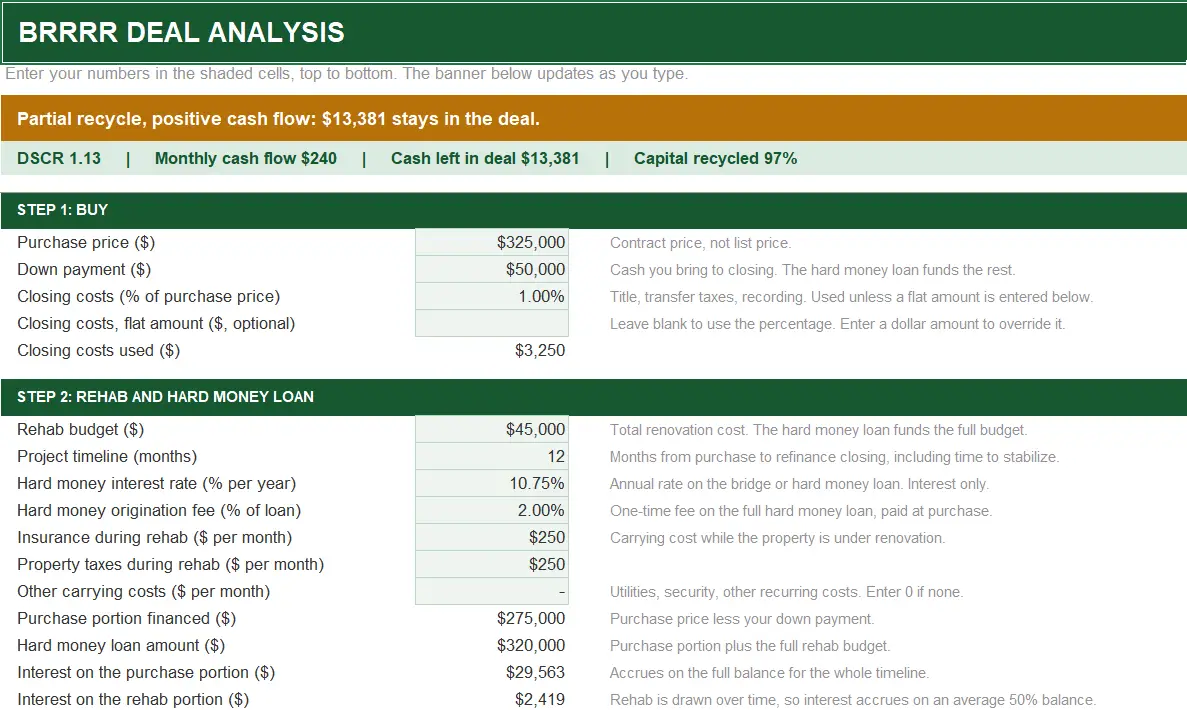
The Excel version of the BRRRR calculator uses the same inputs and formulas as the online tool, so a deal returns the same results in both. The spreadsheet lets investors save several scenarios for one property, share a deal with a partner or lender, and work offline.
A summary bar at the top of the Deal Analysis tab shows DSCR, monthly cash flow, cash left in the deal and capital recycled, and it updates as you enter numbers.
How to Use the BRRRR Calculator
The calculator runs two sequential analyses: the acquisition and rehab phase, then the refinance. Fill in each section in order. Results update in real time as inputs change.
Step 1: Buy (Acquisition)
Three inputs define the cost basis at closing.
- Purchase Price: The contract price paid for the property.
- Down Payment: The cash brought to closing. The short-term loan covers the remainder of the purchase price plus the full rehab budget.
- Closing Costs: Title fees, transfer taxes and recording fees at acquisition, entered as a percentage of the purchase price or as a flat dollar amount.
Step 2: Rehab (Renovation and Hard Money Financing)
The rehab inputs set the interest and holding costs for the renovation period.
- Rehab Budget: Total renovation cost, including materials and labor.
- Project Timeline: Months from acquisition closing to refinance closing. Each additional month adds interest carry and holding costs to the total project cost.
- Hard Money Loan Rate: Annual rate on hard money or rehab loan. Interest on the acquisition portion accrues from day one. Rehab draws accrue on a non-Dutch basis, meaning interest accrues only on funds actually disbursed, not on the full committed rehab amount.
- Origination Fee: One-time lender fee at acquisition closing, as a percentage of the hard money loan.
- Monthly Carrying Costs: Insurance, property taxes, and any other recurring costs during the rehab period.
Step 3: Rent (Income and PITIA)
The rent inputs go into the DSCR calculation for the refinance loan.
- Monthly Gross Rent: Full monthly rent at 100% occupancy after renovations are complete, supported by a lease or rent comps. Enter rent before any vacancy discount, because the calculator applies vacancy separately through the Vacancy Rate input.
- Vacancy Rate: Expected vacancy as a percentage of the year. The calculator applies the vacancy rate to monthly cash flow only, because DSCR lenders calculate DSCR on gross rent.
- Monthly PITIA Costs: Insurance, property taxes, and HOA, where applicable, on the stabilized rental. These combine with the refinance P&I to form the DSCR denominator.
Step 4: Refinance (DSCR Loan Terms)
The refinance inputs show how much cash the refinance returns and whether the DSCR loan qualifies.
- After Repair Value (ARV):The appraised market value after renovation. The refinance loan is calculated as a percentage of ARV, so an ARV set too high overstates the cash the refinance can return.
- Refinance LTV: The loan-to-value on the DSCR cash-out refinance. Higher LTV extracts more capital but raises monthly debt service and lowers DSCR.
- Refinance Rate: Annual rate on the DSCR refinance loan.
- Origination Fee: One-time lender fee at refinance closing, deducted from net proceeds.
- Payment Type: 30-year fixed builds equity each month. Interest-only carries a lower payment, which directly improves DSCR on the same rent.
How the BRRRR Method Calculator Works
The BRRRR calculator evaluates two key conditions: whether the refinance can recover the investor's capital and whether rental income can cover the new mortgage payment. Five calculations determine the results.
1. Total Project Cost = Purchase Price + Rehab Budget + Hard Money Interest + Origination Fee + Closing Costs + Carrying Costs
As a general rule, investors should aim to keep total project costs below 75% of the property's after-repair value (ARV) to leave room for refinancing costs and capital recovery.
2. Refinance Loan = ARV × Refinance LTV
3. Cash Back (or Cash Left in the Deal) = Refinance Loan − Refinance Origination Fee − Total Project Cost
4. DSCR = Gross Monthly Rent ÷ PITIA (Principal, Interest, Taxes, Insurance, and HOA Fees)
5. Monthly Cash Flow = Gross Monthly Rent × (1 − Vacancy Rate) − PITIA
The investor recovers all invested capital when the cash-back result is zero or positive. A negative result represents capital remaining in the property. Meanwhile, the refinance generally requires a DSCR of at least 1.0, meaning rental income covers the new mortgage payment.
Keep in mind that the monthly cash flow calculation excludes maintenance, property management, and other operating expenses.
Our guide to the BRRRR method explains each stage of the strategy. Here, we focus on the calculations investors need to evaluate a deal before purchasing.
What Your Results Mean
The results panel updates on every input change. Investors use five outputs to judge whether a BRRRR deal works:
- DSCR: A ratio of 1.0 means the property's qualifying rental income covers its monthly mortgage payment (PITIA). Ridge Street Capital requires a minimum DSCR of 1.0 for eligible refinances, while ratios of 1.20 or higher generally qualify for better pricing.
- Net Cash Returned: The amount remaining after the refinance covers total project costs and refinancing fees. A positive result indicates full capital recovery, while a negative figure shows how much capital remains invested in the property.
- Capital Recycled: The percentage of total project costs recovered through refinancing. At 100% or higher, the investor has recovered the full project cost and can reinvest that capital in the next deal.
- Break-Even Rent: The minimum gross monthly rent needed to reach a 1.0 DSCR, accounting for the calculator's vacancy assumption. Below this amount, the property may not support the planned refinance.
- Cash-on-Cash Return: Annual cash flow divided by capital remaining invested in the property. When all capital is recovered, the calculator displays ∞, indicating no remaining cash investment.
Real BRRRR Deal: Orlando, FL
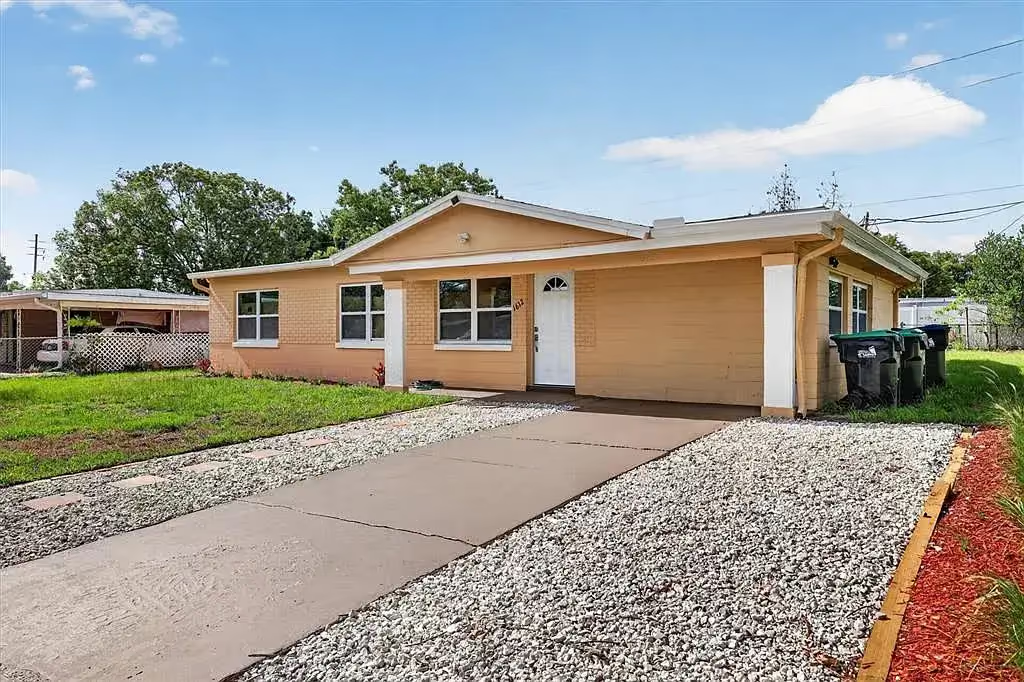
Ridge Street Capital funded both loans on this Orlando BRRRR, from the acquisition with a rehab holdback to the cash-out refinance six months later.
The full Orlando BRRRR case study walks through each stage of the deal.
Finance Your BRRRR Deal With Ridge Street Capital
Ridge Street Capital is a direct private lender financing both phases of the BRRRR strategy across 36 states. Investors can purchase and renovate properties with a fix-and-flip loan that includes a rehab holdback, then refinance into a long-term DSCR rental loan once the property is renovated and leased.
Our team reviews the same key figures you've entered into the calculator. Submit the property address, purchase price, rehab budget, ARV, and expected rent through our Quick Application, and answer a few follow-up questions by email. Once we have the necessary details, we can provide a preliminary term sheet and pre-approval letter within two business hours, subject to initial review.
BRRRR Calculator FAQs
How much cash do I need to execute BRRRR?
The cash requirement at acquisition closing is the down payment plus origination fees, closing costs, and any carrying costs not covered by the loan. With 80% to 90% acquisition financing and 100% rehab financing from a hard money lender, out-of-pocket capital at closing is typically 10% to 20% of the purchase price plus fees. The goal of the BRRRR cycle is to recover that initial cash through the refinance. When net proceeds exceed total project cost, the investor recycles capital to fund the next acquisition.
Investors who pre-qualify with a BRRRR lender before buying know the refinance terms before they commit to the purchase.
How much cash will I leave in a BRRRR deal?
Cash left in the deal equals the total project cost minus the refinance loan after fees. To recover all of the cash invested at a 75% LTV refinance, investors need a total project cost below 75% of ARV, with enough room left to cover the refinance fees.
What is the 70% rule in the BRRRR strategy?
The 70% rule sets a maximum total project cost threshold: total acquisition and rehab costs should not exceed 70% to 75% of the after-repair value. At that level, the refinance loan, typically capped at 75% to 80% of ARV, is likely to cover the full project cost and return the investor's capital. When the total project cost exceeds 75% of ARV, the refinance produces a partial recycle or no recycle at the standard LTV limits. The calculator's total project cost output flags this directly.
How does the refinance step affect returns?
The refinance converts a short-term, high-rate hard money loan into long-term DSCR financing at a lower rate and longer amortization. Monthly carrying costs drop, cash flow improves, and the capital deployed in the deal is returned to the investor in the form of net proceeds. When the refinance fully recycles capital, the investor holds a cash-flowing rental property with no remaining equity tied up. The cash-on-cash return becomes a function of cash flow on a zero-equity position.

Zach Cohen is the Managing Partner of Ridge Street Capital, a direct private lender providing hard money and DSCR loans to real estate investors across 36 states. Under his leadership, the firm has funded nearly $90 million in investment property loans. He regularly works with real estate investors on rental property acquisitions, refinances, and fix-and-flip projects across the country.
Fix and Flip Loans
Funding For Purchase + Rehab
- $50,000 up to $3,000,000
- Interest Rate 10.5%-11.5%
- Origination Fee From 1.5%
- Up to 90% of Purchase and 100% of Rehab

DSCR Loans For Long Term Rentals
Perfect for first-time investors or experienced investors scaling their rental portfolio.
- Up to $2,000,000
- Interest Rates from 6.0%
- Origination Fee From 0%
- Up to 80% of LTV

DSCR Loans For Short Term Rentals
Designed for investors pursuing higher rents with a short term rental strategy.
- Up to $2,000,000
- Interest Rates from 6.25%
- Origination Fee From 0%
- Up to 80% LTV
Ready to Get Started?