Overview:
- After-repair value is the expected resale value after renovation. Renovated sold comps set ARV, not the rehab budget, and it is not verified until appraisal or sale.
- Adding the rehab budget to current value can miss in either direction. Price per square foot misses layout, finishes, and lot position. The adjusted sales comparison method is what lenders rely on.
- Weak comps create weak ARV. Use closed, renovated sales inside the same market boundary, since freeways and school district lines can separate demand. Read the result as a range and underwrite the low end.
ARV, or after-repair value, is the price a property is expected to sell for after renovations are complete. The investor's rehab budget does not determine that number. Recently sold comparable homes do.
The most reliable method is the approach appraisers use: review three to six renovated comps that sold in the last three to six months, adjust each one for its differences from the subject property, and read the range they produce.
Two faster ARV formulas circulate as screening tools, and on one recent appraisal the shortcut version missed the appraiser's figure by 19% of ARV. The adjustment step is where most of that gap opens. At resale or refinance, the appraiser has the final say, not the investor's estimate.
What ARV Means
Market value describes what a property is worth in its current condition, and an appraiser can verify that figure today. ARV is a projection, and nobody can confirm it until the work is finished and the property is appraised, refinanced, or sold.
The projection rests on a specific standard: what buyers in that neighborhood are already paying for finished homes. A rehab that overshoots that standard does not lift ARV, and one that falls short of it does not reach the ARV the comps implied.
Investors use ARV at three points in a deal: setting the maximum offer, sizing a hard money loan, and estimating the value a BRRRR refinance depends on. The first runs through the 70% rule, which caps the offer at 70% of ARV minus repair costs.
The Three ARV Formulas, and Which One Holds Up
Three ARV formulas are commonly used, but they do not produce the same number. That difference matters because the final value has to hold up at resale, refinance, or appraisal.
The additive method adds the planned renovation budget to the property’s current value. It can work as a quick sanity check, but it should not be treated as the final ARV.
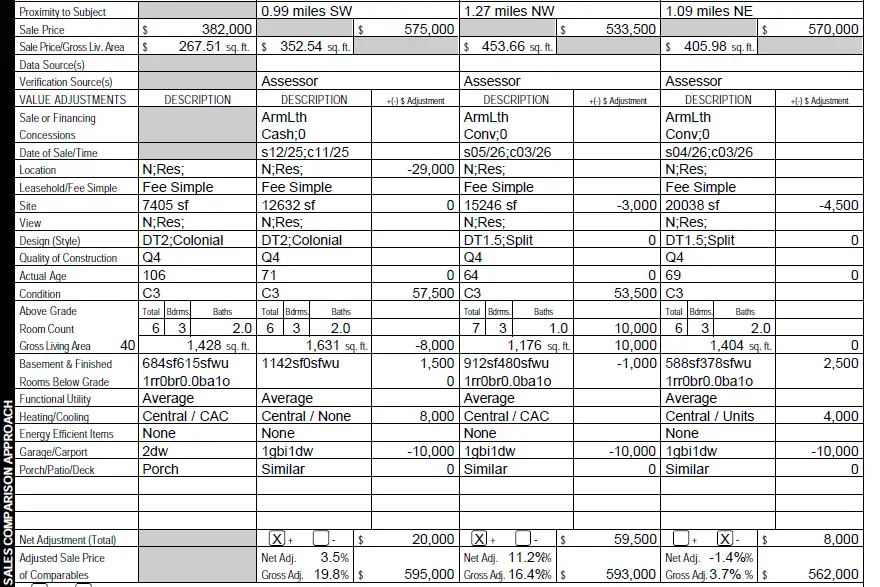
The problem is the assumption behind it: that a $100,000 renovation automatically adds $100,000 in value. A recent fix-and-flip appraisal in the deal that Ridge Street Capital funded in Connecticut shows how far that math can miss. The appraiser valued the property at $382,000 in as-is condition, and the approved renovation budget was $100,000. Additive math would produce a $482,000 ARV.
The comps-based after-repair value came in at $595,000. That was $113,000 higher than the additive estimate, or about 19% of ARV.
The direction of the error matters. Investors often worry that the additive method will overstate ARV, and it can when the neighborhood ceiling limits resale value. But it can also understate ARV by a wide margin. In that case, an investor may walk away from a deal that works, or offer far less than the property could support.
The price-per-square-foot method averages price per square foot across comparable sales, then applies that number to the subject property’s square footage. It is useful for quick screening when the comps are very similar. The problem is that square footage does not capture layout, finish level, lot position, garage, pool, or buyer preference. A 1,500-square-foot ranch and a 1,500-square-foot two-story home in the same subdivision may sell for very different prices.
The adjusted sales comparison method starts with renovated sold comps, then adjusts each sale up or down based on how it differs from the subject property. This is the method appraisers use, which is why it carries the most weight with lenders and underwriters.
The first two methods can help screen a deal. The adjusted sales comparison method is the one most likely to support the value when the property is appraised, refinanced, or sold.
How to Calculate ARV From Comps
The method runs in three steps. The first step matters most because a weak comp set produces a weak ARV before any adjustment is made.
Pull three to six sold, renovated comps
Use closed sales, not active listings. The comps should also be renovated to a standard similar to the planned finished product.
The most common ARV mistake is comparing a post-renovation estimate to unrenovated homes. That gives the investor the wrong value before the analysis even starts.
Use these filters first:
- Recency: Sold within the last three to six months.
- Size: Within 15% to 20% of the subject property’s square footage.
- Sale type: Traditional sales only. Exclude foreclosures, REO sales, auctions, and seller-financed deals unless distressed sales dominate that market.
- Condition: Renovated to a similar standard.
- Bed and bath count: Important, but usually the first filter to loosen if the comp set is too thin.
Distance deserves separate attention. Start with the tightest comp set possible, then widen in steps: a quarter mile, a half mile, and up to one mile, while staying inside the same neighborhood whenever possible.
Map distance alone does not define the market. A property three streets away may still be a poor comp if it sits across a freeway, outside the school district, or on the other side of a major arterial road. Those boundaries can separate buyer demand, even when two homes look similar on paper.
These filters are a starting point, not rules that appraisers never break. In the appraisal referenced above, the appraiser used comps from 0.19 to 1.27 miles away, included sales older than three months, and used properties outside the 20% living-area guideline. Each deviation was disclosed in the report.
That is the right approach when the comp set is thin. A distant but relevant comp is often better than a nearby comp that does not belong. The key is to widen the criteria carefully and explain why, rather than force a bad comp into the analysis.
Adjust for Differences
Each comp adjusts up or down against the subject: square footage, an extra bathroom, a finished basement, a garage, condition of the finishes, position on the block.
Investors are often told to adjust square footage by multiplying the difference by the market's price per square foot. That math produces adjustments an order of magnitude larger than appraisers apply.
One certified appraisal states its method directly: $40 per square foot for living-area differences above 100 square feet, rounded to the nearest $500. The comps in that same report sold between $334 and $454 per square foot. Running the naive calculation against the adjustment actually applied:
Appraisers adjust for the value difference a buyer is likely to recognize, not for raw square footage alone. A buyer comparing a 1,450-square-foot house to a 1,610-square-foot house on the same street usually will not pay the full market price per square foot for that extra space.
Some adjustments are made as percentages rather than fixed dollar amounts. In the appraisal referenced above, the appraiser adjusted two comps upward by 10% for inferior condition and adjusted one comp downward by 5% for a superior waterfront location. The same report used a stated $15,000 per acre adjustment for lot size differences.
The exact adjustment method depends on the market, property type, and appraiser. What matters is consistency. Each adjustment should follow a stated method, be applied across the comp set, and be supported clearly in the analysis.
Set a range, not a number
The comp set tells the investor how much confidence to place in the ARV.
When several strong comps cluster inside a narrow range, the ARV is easier to defend. If four renovated sales land within a $10,000 band, a value near the middle of that range is usually supportable. If the same comps spread across $40,000, the investor should underwrite closer to the low end unless a tighter comp set supports a higher number.
An ARV built on one strong sale is not reliable. Many deals fail because the model depends on a single top-of-market comp. If that comp does not hold during appraisal, refinance, or resale, the profit margin can disappear quickly.
Optimistic ARVs help win contracts. Conservative ARVs protect profit after the contract is signed.
The discipline is simple: underwrite the lower end of the supported range. If the deal only works at the top, the margin is too thin.
Where the As-Is Value Fits
A fix and flip appraisal produces two values: the as-is value and the after-repair value. Each value relies on a separate comp set.
The as-is value uses comps that reflect the property's condition before renovation. The after-repair value uses renovated comps that reflect the finished product the rehab is expected to deliver. Same property, same appraisal, two separate analyses.
The appraisal referenced earlier shows the distinction clearly. Its as-is comps sold between $379,500 and $400,000, supporting an as-is value of $382,000. Its original after-repair comps sold between $533,500 and $575,000, and after adjustments, the report supported an ARV of $595,000.
That structure is the strongest argument for the renovated-comps rule. An investor who uses one comp set for both values is answering a different question than the one their exit depends on.
Worked Example
A 1,450 square foot three-bedroom house needs a full cosmetic rehab. Four renovated comps sold within the last four months inside the same neighborhood.
The adjustment basis: $20 per square foot for living-area differences above 100 square feet, 10% for condition, 5% for location, $15,000 per acre for lot size, rounded to the nearest $500.
Comps A, C, and D fall within the 100-square-foot threshold, so they do not require a size adjustment. Comp B is 150 square feet larger than the subject and receives a $3,000 adjustment.
Using basic price-per-square-foot math on the same 150-square-foot difference would produce a $26,062 adjustment, roughly nine times higher than the stated method supports.
After adjustments, the four comp values range from $258,500 to $267,000, an $8,500 spread. That tight range gives the ARV more support.
The number to underwrite is $258,500. The deal should work at that value without relying on the upside above it.
Where ARV Estimates Go Wrong
Five common mistakes lead to bad ARV estimates. Most are not math errors. They come from using the wrong assumptions.
- Anchoring to the highest comp: Investors often focus on the highest sale because it makes the deal work. The problem is that the analysis then starts with the answer they want, and the comp review becomes an attempt to defend it.
- Pricing in future appreciation: ARV should be based on the market at purchase, not on where the investor hopes the market will be after the rehab. If the deal only works because prices keep rising, the margin is too thin.
- Crossing a market boundary: Nearby homes are not always true comps. Freeways, school district lines, major roads, and neighborhood boundaries can separate buyer demand and pricing, even when the properties look close on a map.
- Shrinking the repair budget to close a gap: If the investor is $5,000 apart from the seller, the answer is not to quietly cut $5,000 from the rehab budget. The repair scope should stay realistic. The investor should negotiate the price down or walk away.
- Adjusting comps without a clear method: Adjustments made by feel are hard to defend. A reliable ARV uses a stated adjustment method, applies it consistently across the comp set, and explains the basis for each adjustment.
How Lenders Use ARV
Lenders size fix and flip loans against ARV, and the appraiser's determination governs, not the investor's estimate. The investor’s ARV estimate is only a starting point. If the appraisal comes in lower, the loan amount may shrink. At that point, the investor may need to bring more cash to closing, renegotiate the purchase price, or walk away.
Nothing revalues the property during construction. Rehab loans release funds in draws against completed work, and a final inspection confirms the rehab matched the approved scope. Neither step is a new opinion of value.
The next valuation risk comes at the exit. If the investor sells to a financed buyer, that buyer’s lender will order its own appraisal. If the appraisal comes in below the contract price, the buyer’s loan may be capped at the lower value. That can force a price renegotiation, require more cash from the buyer, or kill the sale. A BRRRR method investor refinancing a hard money loan into a rental faces the same issue through the refinance appraisal.
A low appraisal is not always final. A reconsideration of value asks the appraiser to review specific comparable sales or property details that may have been missed. In one appraisal reviewed for this article, the appraiser accepted two additional comps, revisited the condition rating on two original comps, and issued an amended value nine days later.
A reconsideration works when it provides better evidence. It does not work when it simply argues with the appraiser’s conclusion.
Finance Your Fix and Flip Project with Ridge Street Capital
Ridge Street Capital reviews the comps behind your ARV, the scope of work, and the exit math before issuing terms. If the value does not support the loan, we say so before the investor is committed.
Submit the property and borrower details to receive a term sheet with the maximum loan amount, rehab advance, rate, and next steps. Get a term sheet or see fix and flip loan terms.
Frequently Asked Questions
What is the difference between ARV and market value?
Market value is what a property is worth today, in its current condition, and an appraiser can verify it now. ARV is a projection of what the same property will be worth after renovation, and nobody can verify it until the work is done and the property sells. A hard money lender orders appraisals for both.
Can I calculate ARV from just an address?
Automated tools return a number from an address, and that number screens a lead in under a minute. It cannot see the property's condition, the scope of the planned rehab, or which comps an appraiser will accept. Use address-based estimates to decide whether a property deserves a full analysis, never to set an offer.
What if there are no comparable sales in my area?
Widen the radius in steps, staying inside the same market boundary, and extend the timeframe to six months before loosening any other filter. Appraisers facing the same problem exceed the standard distance and size guidelines and disclose the deviation in the report. Thin comp data is itself a signal: properties in markets without recent sales are harder to exit and harder to finance.
Does ARV apply to rental properties and BRRRR deals?
Yes. ARV applies to BRRRR deals, but at a different point in the strategy. A flip uses ARV to estimate the resale price. A BRRRR investor uses ARV to estimate the refinance appraisal after the renovation is complete.
That refinance value determines how much equity remains in the property and how much capital the investor may be able to pull back out. The ARV calculation is the same, but the outcome is different: in a flip, ARV supports the sale price; in a BRRRR deal, ARV supports the refinance. Use our free BRRRR calculator to run your numbers.
Can an ARV appraisal be challenged?
Yes, through a reconsideration of value. The request has to supply specific comparable sales the appraiser did not consider, with addresses, sale dates, and prices. An appraiser who accepts the comps issues an amended report, and the amended value governs. Disagreeing with the conclusion without supplying new comps does not move the number.
Who determines the final ARV on a financed deal?
The appraiser. A fix and flip lender underwrites to the appraised value, not to the investor's estimate, and that holds across both main paths for financing for flipping houses. The investor's analysis decides whether the deal is worth pursuing at all. Investors whose ARV work matches appraiser methodology encounter fewer surprises at closing.

Zach Cohen is the Managing Partner of Ridge Street Capital, a direct private lender providing hard money and DSCR loans to real estate investors across 35 states. Under his leadership, the firm has funded nearly $100 million in investment property loans. He regularly works with real estate investors on rental property acquisitions, refinances, and fix-and-flip projects across the country.
Fix and Flip Loans
Funding For Purchase + Rehab
- $50,000 up to $3,000,000
- Interest Rate 10.5%-11.5%
- Origination Fee From 1.5%
- Up to 90% of Purchase and 100% of Rehab

DSCR Loans For Long Term Rentals
Perfect for first-time investors or experienced investors scaling their rental portfolio.
- Up to $2,000,000
- Interest Rates from 6.0%
- Origination Fee From 0%
- Up to 80% of LTV

DSCR Loans For Short Term Rentals
Designed for investors pursuing higher rents with a short term rental strategy.
- Up to $2,000,000
- Interest Rates from 6.25%
- Origination Fee From 0%
- Up to 80% LTV
Ready to Get Started?
.svg)