The Best Fix and Flip Lenders of 2026: A Complete Review For Investors
The best fix and flip lenders for real estate investors in 2026 — leverage, closing speed, and which lender fits your deal based on experience level.
nmin readReleased on:March 25, 2026Last updated on:September 18, 2026


Overview:
- The lowest advertised rate does not make a loan the cheapest. Leverage, fees, and how a lender handles draws all change what the project costs.
- Credit minimums, loan size limits, and state coverage vary widely between lenders. These decide whether a deal qualifies at all, before rate matters.
- Match the lender to the deal profile. A borrower with a weaker credit score needs a program with a lower minimum, and a first-time investor needs a lender that funds beginner flippers, since some require completed projects.
Most fix-and-flip lender comparisons list names and rates. That is not the hard part. The hard part is knowing which lender closes fast enough to win a competitive deal, which one funds heavy rehab without stalling on the draw process, and which one will still execute when the project gets complicated. This guide answers those questions.
The top 6 lenders in 2026 reviewed here were selected based on flexibility of loan structure, qualification requirements, geographic reach, and customer reviews. Each profile includes specific terms, a clear differentiation statement, and an honest account of where the program falls short.
Best Fix and Flip Lenders in 2026
Use the table below to compare key program parameters at a glance, then review the full profile for each lender.
How We Selected These Lenders
Every lender on this list is a direct lender with a documented funding history and published program terms. The criteria: minimum credit requirements, LTC and ARV limits, rehab funding mechanics, closing timelines, draw process structure, and geographic coverage. Lenders operating primarily through brokers without published terms were excluded.
1. Ridge Street Capital — Editor's Pick: Best Overall
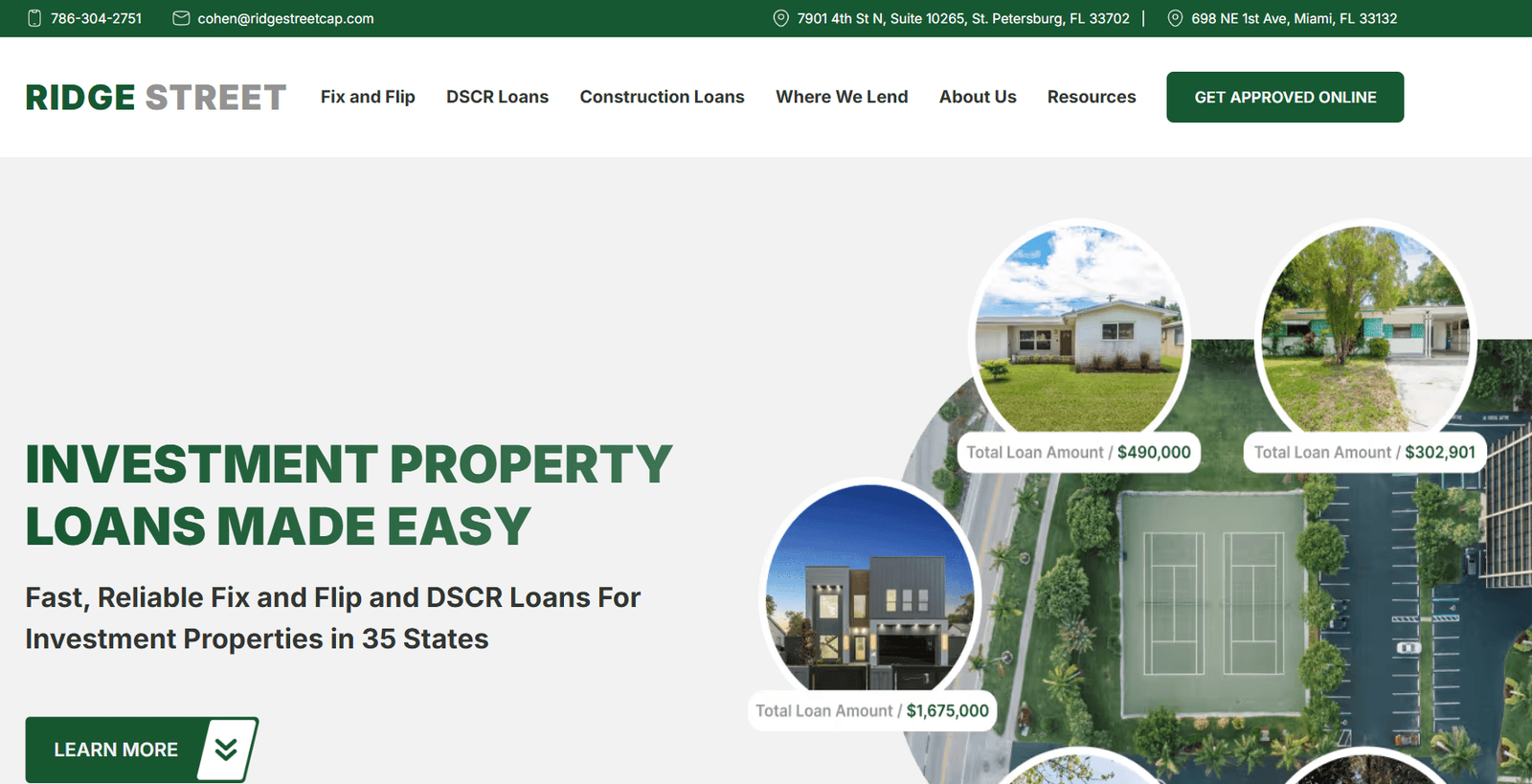
Based in Florida and lending in 35 states, Ridge Street Capital funds fix and flip loans from its own balance sheet with no broker layer and no third-party approval between underwriting and closing. The program is structured around three things that matter in an active property rehab project: speed, draw efficiency, and competitive rates.
The draw process is built around the investor's timeline, not the lender's inspection schedule. Draws are processed through a virtual portal: the borrower submits photos documenting completed work, Ridge Street verifies remotely, and the wire clears within 48 hours with no on-site inspector and no scheduling delay. Interest accrues only on disbursed funds — not the full committed loan balance, including unreleased rehab holdback. That non-Dutch interest structure lowers the effective carry cost on every project compared to lenders charging from day one on the full amount.
Program Highlights: Up to 90% LTC with 100% rehab coverage. ARV cap is 75%. Minimum credit score 660. 7–10 day close, 2-hour term sheets. 35 states.
Pros and Cons:
2. Easy Street Capital
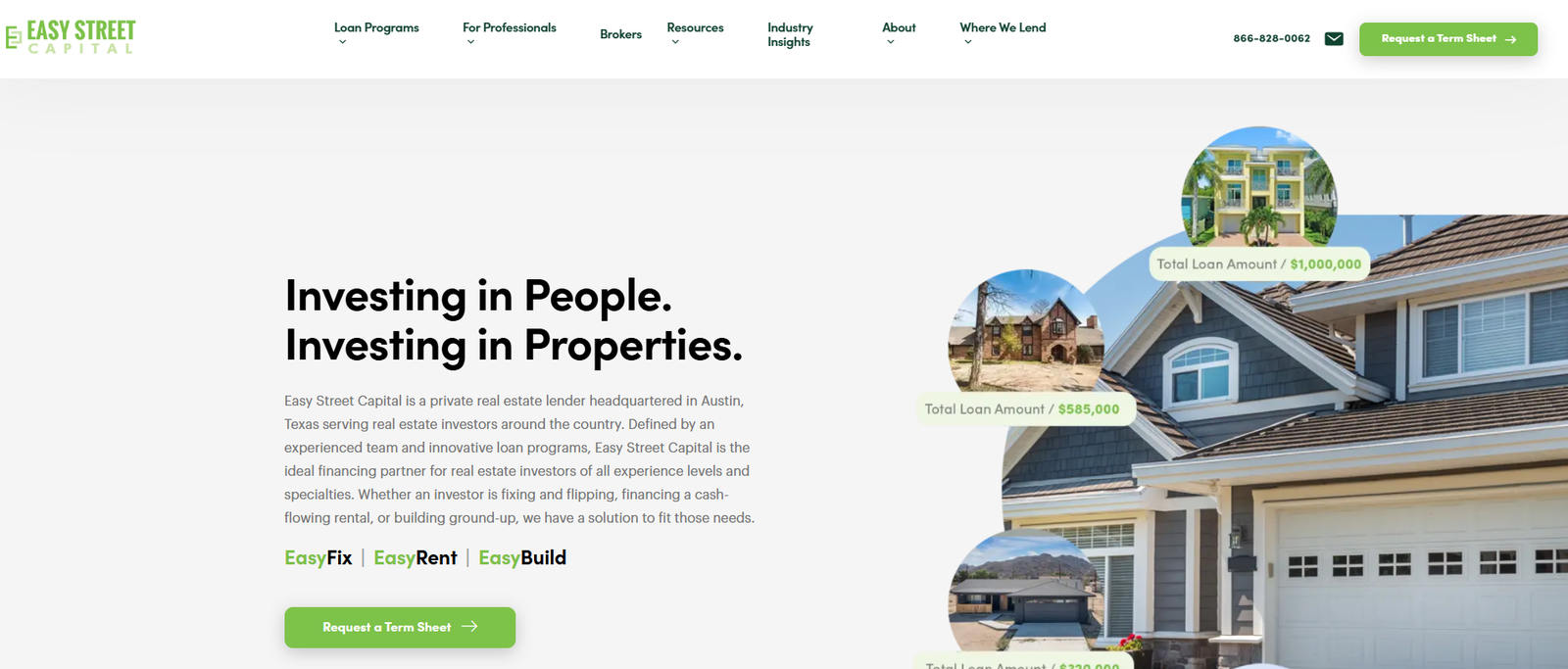
Based in Austin and lending nationally, Easy Street Capital is a private lender built around a self-service application process. Investors can generate preliminary loan terms online before speaking to a loan officer, which speeds up early-stage deal screening. The EasyFix program has one of the lowest credit score minimums on the market and requires no appraisal. Loan sizes extend past $5 million with multifamily coverage up to 20 units.
Program Highlights: Up to 93% LTC, 70% ARV. Minimum credit score 600. No appraisal. Loan sizes up to $5M+, multifamily up to 20 units. Nationwide.
Pros and Cons:
3. New Silver

New Silver is a fintech-backed private lender founded in 2018 and operating in 39 states. The platform is built for investors managing multiple deals simultaneously — the application is fully digital, term sheets are generated instantly, and there is no hard credit pull at application. The Advantage Program provides improved pricing for repeat borrowers, which compounds the value for investors running a consistent deal volume. Loan amounts reach $5 million.
Program Highlights: Up to 90% LTC, 75% ARV, 100% construction coverage. Minimum credit 650. Loans $100K–$5M.
Pros and Cons:
4. Park Place Finance

Park Place Finance structures its Renovation Loan Program for investors who want high leverage and term flexibility without a documentation-heavy process. No tax returns, no income verification, no debt ratio calculations. Loans close in seven to twenty-one business days.
Park Place Finance is a direct lender operating in 47 states with a Renovation Loan Program suited to experienced investors running larger or more complex projects. The program offers up to 24-month terms, longer than the 12-month standard, which gives investors the runway needed for heavy rehab scopes and extended stabilization periods. Loan sizes reach $4 million.
Program Highlights: Up to 93% LTC, 75% ARV. Minimum credit 660. Loans $125K–$4M. 12–24 month terms.
5. Rehab Financial Group

Rehab Financial Group is a regional fix and flip lender operating in 18 states with a focus on smaller residential rehab projects. The program suits investors working within a moderate loan range on straightforward renovation deals. The base term is nine months — shorter than most programs — with an optional three-month extension. Loan sizes top out at $1.25 million. ARV limits scale with credit score, which means borrowers at the lower credit tier will see a tighter leverage ceiling. Liquidity Requirements: $15,000 or 25% of rehab budget, whichever is greater. Plus closing costs.
Program Highlights: ARV cap 65%–75% based on credit. Minimum credit 650. Loans $100K–$1.25M. Nine-month term with a three-month extension.
Pros and Cons:
6. Express Capital Financing

Based in New York and lending nationally, Express Capital Financing covers fix and flip, DSCR, ground-up construction, multifamily bridge, and commercial mortgage products under one roof. The program suits investors managing multiple deal types or property categories simultaneously, with loan sizes up to $5 million and bridge loan options for multifamily and mixed-use assets.
Program Highlights: Loans up to $5M. Loan terms: 12-36 Months. Minimum Credit Score: 600 (Lower is case-by-case). Those Who Qualify: US Citizens, Foreign Nationals, Permanent Resident Alien
Pros and Cons:
How to Choose the Right Fix and Flip Lender for Your Deal
The variables that control the decision differ by situation. Below is a quick reference guide that we created for investors in different scenarios, matching the lender to the deal type, experience level, and project requirements.
If you're a first-time investor
Prior flip experience is not a universal requirement. Lenders like Ridge Street Capital approve beginner investors with no track record. Others require at least one or two completed projects before unlocking full leverage. Credit score determines which tier you enter at. Most programs floor at 660, but borrowers at 720 and above access meaningfully better leverage and pricing.
Recommendation: Ridge Street's High FICO / High Leverage Program is built specifically for first-time fix and flip investors with a 740+ credit score - up to 80% LTC plus 100% of renovation costs with no prior flip experience required.
If closing speed is the constraint
Advertised timelines and actual timelines diverge when deal volume is high or the appraisal pipeline backs up. Ask the lender directly how many days they averaged on their last ten closings. A lender that controls valuation in-house closes faster than one relying on third-party appraisers.
Recommendation: Confirm the lender is a direct balance sheet lender — not a broker placing loans with a third party. Every intermediary step adds time.
If the rehab is heavy
Some programs restrict heavy structural work, full gut renovations, or projects with significant MEP (mechanical, electrical, plumbing) scope. Ridge Street Capital allows heavy rehabs for experienced real estate investors.
Recommendation: Confirm the lender allows your full renovation scope before applying. Then confirm how draw requests are submitted and how long releases take
If you're taking title in an LLC
Holding title in an LLC is standard practice for investment property loans. It separates investment debt from personal finances, keeps liability contained to the entity, and keeps active loan balances off personal credit. Personal guarantees are standard regardless of structure. If the plan is to hold the property in an LLC and refinance into a DSCR loan after renovation, closing in the LLC from day one is the cleaner path — transferring title from personal name into an entity after closing triggers real estate transfer tax in most states. States like Massachusetts, New York, Pennsylvania and some others require properties to be held in an LLC for a DSCR loan.
Recommendation: Close in the LLC at acquisition.
If you want the option to hold rather than sell
Analyze and structure the deal as a BRRRR (Buy, Rehab, Rent, Refinance, Repeat) from the start. Once the renovation is complete and the property is leased, a DSCR cash-out refinance replaces the hard money loan with 30-year fixed financing — and in well-structured deals, returns most or all of the invested capital.
Recommendation: Confirm the lender supports the fix to rent exit before closing, and confirm whether they waive the standard 6-month seasoning requirement for borrowers who financed both phases with the same lender.
Get Your Next Fix and Flip Loan With Ridge Street
Most lenders on this list do one thing well. Ridge Street Capital is the only lender in this comparison that funds first-time investors at high leverage, closes in 7 to 10 days, and combines non-Dutch interest with a virtual draw process that wires within 48 hours. These advantages matter most in best markets for house flipping where deal timelines are tight, including Florida, Texas, Georgia, North Carolina, South Carolina, and Indiana.
Term sheets are issued within 2 business hours. Complete our 2-minute application to get a quote or a pre-approval letter.
Frequently Asked Questions
What is the difference between LTC and ARV, and which one limits my loan?
Every fix and flip loan is sized against two separate limits. The lender calculates both, and whichever produces the smaller number sets the maximum loan amount.
LTC (loan-to-cost) measures the loan against what the investor spends. There are two versions. Initial LTC applies to the purchase price only. Total LTC applies to the full project cost — purchase price plus renovation budget combined. When a lender advertises "90% LTC," they mean 90% of total project spend. On a $200,000 purchase with $50,000 in renovation costs, the total project cost is $250,000. At 90% LTC, the maximum loan is $225,000.
ARV (after-repair value) measures the loan against what the property will be worth after the renovation is complete. A 75% ARV cap means the loan cannot exceed 75% of that projected value. On the same deal, if the ARV is $325,000, the ARV ceiling is $243,750.
The lender runs both calculations and funds the lower number. In this example, $225,000 from the LTC calculation is lower than $243,750 from the ARV calculation, so $225,000 is the maximum loan. The ARV ceiling did not bind here — but if the projected ARV were lower, it would.
Do I need an LLC to get a fix and flip loan?
Fix and flip loans are available to individual borrowers and LLC borrowers alike.
That said, most experienced investors close in an LLC. A fix and flip project involves contractors, subcontractors, and third parties working on a property you own. If something goes wrong — a contractor injury, a dispute, a liability claim — and title is in your personal name, your personal assets are exposed. An LLC contains that risk at the entity level. Personal guarantees are still required by most lenders regardless of structure, but the guarantee covers the loan, not every liability that can arise from the project itself.
The structure decision also matters at exit. If the plan is a sale, personal name or LLC, both close cleanly. If the plan is to hold and refinance into a DSCR rental loan, having the LLC in place from day one is the cleaner path — moving title from personal name into an entity after closing requires a new deed, which triggers real estate transfer tax in most states.
How do rehab draws work and why does it matter?
The rehab budget is held in escrow at closing and released in draws as renovation work is completed. The process varies significantly by lender, and the difference directly affects contractor performance and project timelines.
Most lenders require a third-party on-site inspection before each draw release, which adds scheduling time between completed work and funded disbursement. Ridge Street uses a virtual draw process: the borrower submits photos through the portal documenting completed work, Ridge Street's team reviews remotely, and the net wire clears within 48 hours. Draws are broken down by category — demolition, exterior, interior, MEP, appliances, and site work — and each line item is verified against the original scope before disbursement.
What happens if the project runs longer than the loan term?
Most lenders offer extensions at 1% of the outstanding balance per extension period, with terms of 3 to 6 months, depending on the lender. Extension availability is subject to lender approval at that time and is not guaranteed. A project that materially overruns the original scope in cost or timeline may not qualify under the original terms. Plan the renovation timeline conservatively, add a 30-day buffer to the expected completion date, and confirm the extension policy and fee structure before closing.
Zach Cohen is the Managing Partner of Ridge Street Capital, a direct private lender providing hard money and DSCR loans to real estate investors across 35 states. Under his leadership, the firm has funded nearly $100 million in investment property loans. He regularly works with real estate investors on rental property acquisitions, refinances, and fix-and-flip projects across the country.
Fix and Flip Loans
Funding For Purchase + Rehab
- $50,000 up to $3,000,000
- Interest Rate 10.5%-11.5%
- Origination Fee From 1.5%
- Up to 90% of Purchase and 100% of Rehab

DSCR Loans For Long Term Rentals
Perfect for first-time investors or experienced investors scaling their rental portfolio.
- Up to $2,000,000
- Interest Rates from 6.0%
- Origination Fee From 0%
- Up to 80% of LTV

DSCR Loans For Short Term Rentals
Designed for investors pursuing higher rents with a short term rental strategy.
- Up to $2,000,000
- Interest Rates from 6.25%
- Origination Fee From 0%
- Up to 80% LTV
Ready to Get Started?
.svg)