The BRRRR Method: How It Works, When It Fails, and How to Execute It
BRRRR method explained with real numbers. Learn how the four stages work, where deals fail, and what a full BRRRR cycle looks like start to finish.
nmin readReleased on:December 30, 2025Last updated on:September 23, 2026


Overview:
- BRRRR stands for Buy, Rehab, Rent, Refinance, Repeat. An investor buys a distressed property with short-term financing, renovates it to a planned after-repair value, leases it, then refinances into long-term debt and puts the recovered capital into the next deal.l.
- The strategy recovers capital rather than avoiding it. The refinance recapitalizes the equity position while the investor keeps the property, so the cash only comes back if the new loan covers the original purchase, the renovation, and the carry costs.
- Cash-out refinances cap near 75% of appraised value, so total project cost has to land well below the after-repair value and the rent has to clear a ratio above 1.0 at the new loan.
The BRRRR real estate method was popularized by BiggerPockets as a powerful strategy for investors to recycle capital while scaling rental property portfolios. It's designed to help investors acquire, improve, and refinance an investment property, enabling them to build a real estate portfolio while preserving their capital to serially pursue opportunities in the real estate market.
The appeal is simple: acquire a distressed property, create value through renovation, and use a cash-out refinance to pull capital back out and fund the next investment property purchase.
This guide focuses on how the BRRRR strategy works in real transactions, explaining how investors evaluate properties, manage project costs, stabilize rents, and determine whether the refinancing stage will allow for a cash-out refinance.
What Is the BRRRR Method?
BRRRR stands for Buy, Rehab, Rent, Refinance, Repeat. An investor acquires a distressed property, renovates it to achieve a planned After Repair Value (ARV), stabilizes the property as a rental with long term tenants or as an airbnb, and then refinances the newly renovated property based on the new value and cashflow into long-term (low interest) debt.
This strategy is not designed to eliminate capital invested. It is designed to help investors recapitalize their equity position in a value-add real estate investment with long term financing while maintaining ownership of cash flowing real estate assets.
As we dive deeper into how the BRRRR works, it is essential to remember that the BRRRR Method only works when you can refinance your hard money loan plus equity position from the initial purchase + renovation. As such, it is essential to make conservative assumptions when projecting after repair value and exit market rents.
How Does the BRRRR Method Work? (Step-by-Step)
The BRRRR Method is a four step process which is presented below as an execution pipeline. To work, it needs every step to be built around “refinance viability” which relies on the following parameters: ARV (After-Repair Value), DSCR Cash-Out LTV (Loan-to-Value), DSCR Loan Seasoning Requirements, Debt-Service Coverage Ratio (aka cashflow at project exit), and acheivable market rents.
How the Buy Rehab Rent Refinance Method Works in Practice
Buy: Finding a True BRRRR Deal
A real BRRRR deal starts with buying well below after-repair value.
Most cash-out loans cap leverage at 75% of appraised value. That means total project cost, including purchase, rehab, holding, and refinance costs, needs to be less than 75% of the appraised after repair valuation,
Project margins are created at purchase (overpaying can't be fixed later). Viable BRRRR deals are typically sourced off-market through wholesalers, probate, or estate sales, foreclosure auctions, and bank short sales.
Distressed purchases are usually funded with a short-term acquisition loan that also covers renovation costs. How that two-loan structure works, and what each phase requires, is covered in our guide to BRRRR loans.
Rehab: Creating Forced Appreciation Through Renovation
In this stage, investors complete renovations that will maximize value while being conscious of the renovation costs.
High-impact improvements include kitchens, bathrooms, and major mechanical systems. It is important to emphasize that on budget execution matters: written bids from contractors before closing, a defined scope of work, and a 5%-10% contingency are best practices for success.
Lastly, it is important to emphasize that investors must pursue renovations that increase value in ways residential real estate appraisers can assess. It is extremely common for real estate investors to add additional bedrooms and bathrooms in basements, convert garages into play rooms (common in Airbnbs), and “over-finish” interiors with materials and quality of finishes consistent with sold comps.
Rent: Stabilizing the Property and Generating Rental Income
The BRRRR method requires that the recently flipping properties become stabilized by the cash flow from tenants. Properties must have a DSCR above 1.0 to be based on actual rents to be eligible for a DSCR cash out refinance.
Screening potential tenants carefully to ensure you attract high-quality renters with good credit is key. Missed payments and turnover delay can create short term cash flow deficits that burden landlords. Hiring a property manager can help efficiently manage the rental unit(s).
Refinance: The Cash Out Refinance Make-or-Break Step
When the property's increased value is confirmed through an appraisal, investors can secure a DSCR loan as long as the debt-service-coverage ratio remains above one.
Most lenders cap the cash-out at 75% of appraised value and impose a seasoning window before the refinance can close, and both of those constraints decide whether the capital actually comes back.
The mechanics of that refinance, including seasoning rules, how lenders size the new loan, and what the refinance costs, are covered in full in our guide to BRRRR loans.
Repeat: Scaling the Strategy
Repeating means recycling capital by investing in new BRRRR projects when the financials are supported by investment analysis. By repeating the entire process, investors can steadily grow their property portfolios and maximize both equity and rental income.
Each cycle increases portfolio leverage and operational complexity. Scaling limits appear through DSCR thresholds, portfolio exposure caps, and liquidity requirements. This said, most investors don’t need to worry about the maximum portfolio leverage limitations set by lenders. Most sophisticated DSCR lenders, like Ridge Street Capital, set “credit exposure limit” reviews at $10M+.
Long-term success comes from conservative ARV assumptions, realistic rent projections, financing terms that hold up at exit, and consistent BRRRR calculations.
Typical BRRRR Timeline
Most BRRRR deals take 4-8 months from purchase to refinance. This includes acquisition, renovation, lease-up, and refinancing. Heavier rehabs or time-to-lease in slower rental markets can lead to longer turn arounds. Underwriting and deal evaluation should assume the longer end of the range.
What a BRRRR Deal Looks Like with Real Numbers
This example shows a realistic BRRRR deal, using conservative assumptions, standard lender constraints, and typical costs.
Deal Overview
Stage 1: Buy
- Purchase price: $200,000
- Hard Money Loan Costs: $6,000
- Title Fees:$2,000
- Appraisal Fee: $695
- Insurance: $2,000
Total Purchase Cost: $210,695
Stage 2: Rehab
- Rehab Budget: $55,000
- Interest Payments (6 Months): $11,500
Total Rehab Cost: $66,500
Stage 3: Rent
- Realtor Fee: $2,000
Total Cost To Rent: $2,000
Stage 4: Refinance
After Repair Value: $380,000
Loan Amount (75% LTV): $285,000
- Refinance Title Fees: $2,000
- Insurance: $2,000
- Unpaid Taxes: $1,200
- Taxes and Insurance Escrow (2 Months): $600
- Appraisal: $695
Total Refinance Costs: $6,495
Result: Capital Recycled
The final total project cost amounts to:
Total Project Cost = Purchase Cost + Rehab Cost + Cost To Rent + Refinance Cost
Total Project Cost = $210,695 + $66,500 + $2,000 + $6,495
Total Project Cost = $285,695 ≅ $285,000
With a cash-out refinance loan amount of $285,000, the refinance loan covers almost the full project cost returning the initial equity invested in the project back to the investor.
Small changes in ARV, rent, or project cost can materially change this result. This is why disciplined underwriting and modeling conservative scenarios is essential for success with the BRRRR Method.
BRRRR Case study in Orlando, FL
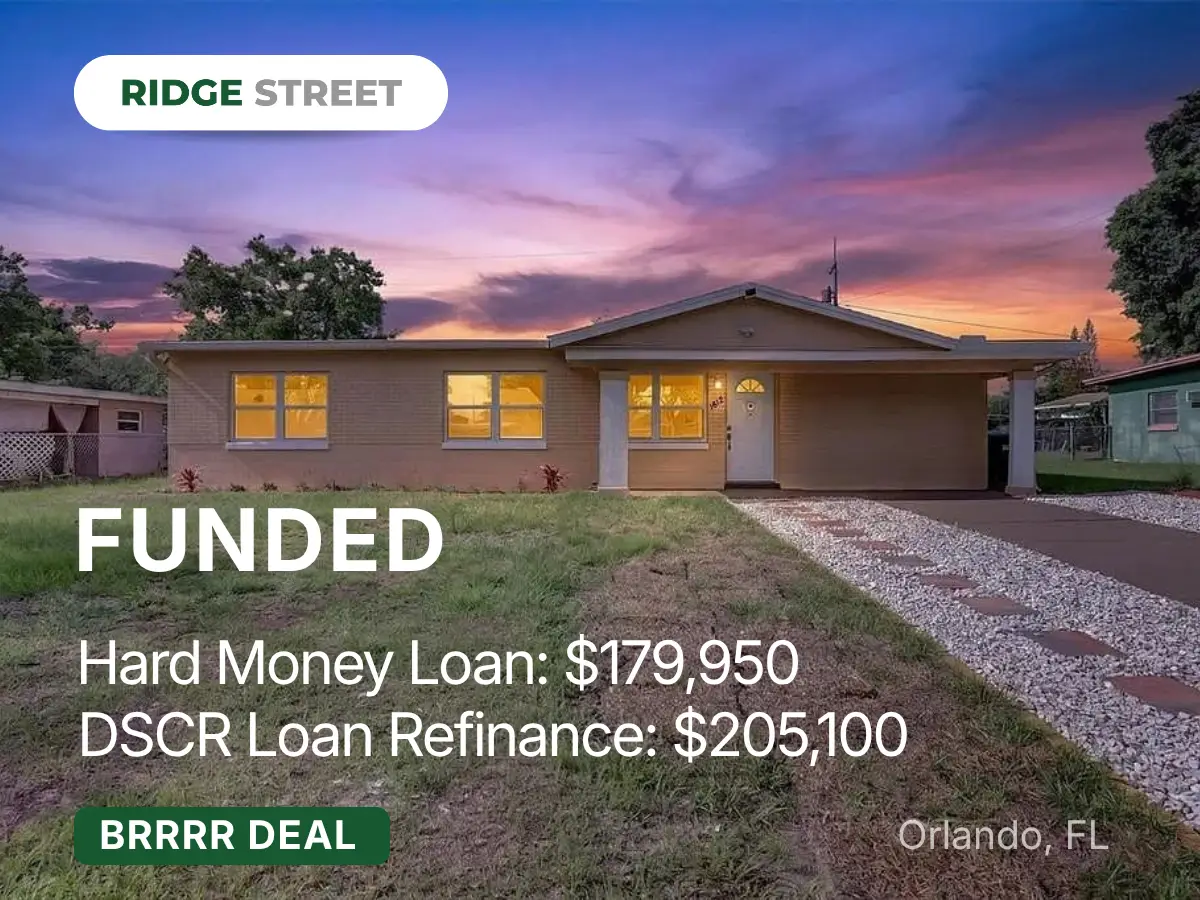
In February 2026, an investor acquired a four-bedroom single-family home in Orlando's Rio Grande Terrace for $170,000 with a full BRRRR strategy in place. Ridge Street Capital financed the purchase with a hard money loan that included a $43,950 rehab holdback, covering the full renovation from floors to HVAC with no additional capital from the borrower. Six months later, the property appraised at $293,000. Ridge Street Capital issued the DSCR cash-out refinance at 70% LTV, returning 82% of the investor's deployed capital. See the full Orlando BRRRR case study.
The Result
The completed BRRRR returned 82.2% of total deployed capital and left the investor with a cash-flowing Orlando rental and $87,900 in built equity.
- Phase 1, Hard Money Loan: $179,950 (12-Month Term, 80% LTV, 10.99%)
- Phase 2, DSCR Cash-Out Refinance: $205,100 (30-Year Fixed, 70% LTV, 6.875%)
- Post-Rehab Appraised Value: $293,000
- DSCR: 1.20x
- Capital Recycled: 82.2%
- Cash-on-Cash Return: 6.7%
BRRRR Spreadsheet and Deal Analysis Tools
BRRRR deals are won or lost with investment analysis. Because the strategy is constrained by ARV, LTV, rent, and costs, BRRRR deals can't be evaluated with back-of-the-napkin math.
A proper spreadsheet forces you to underwrite the deal the way a BRRRR lender will.
What a BRRRR Spreadsheet Needs to Model
There are several factors that need to be included in a BRRRR Investment Model SpreadSheet, including:
- All project costs including: title fees, mortgage tax, transfer tax, purchase costs, rehab costs, holding costs, property taxes, insurance, and lender fees.
- Detailed rehab budget with contingency
- Feasibility check of the DSCR refinance
At Ridge Street, we created this integrated BRRRR Calculator that considers the necessary costs, metrics, loan rates, and project timelines for real estate investors to run accurate analysis.
Why Some BRRRR Deals Fail
BRRRR deals fail when investors treat the process like a formula instead of a controlled business operation. Failing to achieve positive cash flow can undermine the entire BRRRR strategy.
1. Poor Deal Sourcing
Most retail-priced properties don't work for BRRRR. They leave no margin to stay inside the 70–75% ARV constraint after costs. Consistent BRRRR deals are sourced off-market through distress or landlord networks.
2. Underestimating Costs and Delays
Cost overruns are normal, and time becomes expensive when bridge loans accrue interest. Failing to pad budgets with a 5%–10% contingency is how deals exceed expected refinance limits.
3. Refinance and Underwriting Misalignment
Most BRRRR failures are realized at the time of refinancing due to misaligned expectations. Conservative appraisals and incorrect analysis from project onset can leave 20–40%+ of equity on the table. The fix is pre-qualifying with a BRRRR lender before you buy, and structuring deals that still work if the appraisal underperforms.
Is the BRRRR Method Right for You?
- Who BRRRR works best for: Active investors who are comfortable managing contractors and financing, possess strong local market knowledge (realistic ARVs/rents), and treat the process like an operating business.
- Who BRRRR is a poor fit for: Hands-off investors or those with thin capital reserves. BRRRR rewards discipline and patience. It punishes optimism and undercapitalization.
When executed correctly, the BRRRR method can help investors generate steady income by creating reliable cash flow from rental properties.
Market-Specific Considerations
States Where BRRRR Often Works More Consistently
Certain states tend to support cleaner BRRRR execution due to lower entry prices, stronger rent-to-price ratios, and active investor lending markets.
Here are a few examples:
- Georgia – Lower median home prices in secondary markets combined with stable rental demand make it easier to stay within 70–75% ARV while still qualifying for a refinance. Investor-focused lenders and hard money programs are widely available across major and secondary markets.
- Indiana – Strong rent coverage relative to purchase price supports DSCR-based refinances. Many BRRRR deals here use short-term acquisition or rehab financing before transitioning into long-term rental loans.
- South Carolina – BRRRR works best outside core metro pricing. Investors often rely on off-market acquisitions paired with bridge or hard money loans before refinancing into long term debt.
- North Carolina – More consistent BRRRR results are typically found in secondary and tertiary markets, where purchase prices remain reasonable and rental demand supports DSCR refinance requirements.
These states are where investors most often move quickly on discounted properties, because entry prices leave room for the numbers to work.
States Where BRRRR Requires More Capital and Tighter Execution
Higher-priced states can still support BRRRR but rarely with full capital recovery.
Here are some examples:
- California – High acquisition and renovation costs compress margins, while refinance proceeds are frequently capped by income rather than appraised value. Most BRRRR deals here require significant cash in and leave substantial equity in the property post-refinance.
- New York – Elevated purchase prices, taxes, and insurance costs often suppress DSCR, limiting refinance leverage. The spread inside the state is wide: Long Island acquisition costs push DSCR thin even on strong rents, while Buffalo's lower entry prices leave more room for the refinance to work. Successful BRRRR executions typically involve strong in-place rents, conservative leverage, and higher upfront capital contributions.
- Massachusetts – Competition from fix-and-flip buyers drives up entry prices, especially across the Boston metro. Investors often need meaningful cash reserves, disciplined rehab budgets, and realistic refinance expectations that prioritize stability over full capital recovery. That said, Massachusetts has many prime rental markets that perform exceptionally well.
States Where High Property Taxes Heavily Influence Outcomes
In some states, high property taxes can make BRRRR investments a challenge:
- Florida: Insurance costs and property taxes are high, and they hit the refinance harder than the purchase. In prime markets such as Fort Lauderdale, Miami, and West Palm Beach, BRRRR feasibility can be a challenge, and investors should explore short term rental financing for their refinance transactions. Tampa, Orlando, and Jacksonville carry lower entry prices, which gives the long-term refinance more margin to absorb carrying costs.
- Texas: Property taxes and escrow requirements affect DSCR calculations and long-term affordability, especially on leveraged BRRRR deals. The effect scales with price point, so the same tax rate does more damage to DSCR in Austin than in Dallas, Fort Worth, or Houston.
Applying BRRRR Locally
BRRRR works best when deals are underwritten using local sold comps, realistic rents, and financing terms that actually exist in that state. National averages and generic assumptions break down quickly once lender rules and market dynamics are applied.
Local pricing determines how much room exists between purchase price and after-repair value. Rent-to-price ratios dictate whether refinance proceeds are capped by value or by income. Just as important, lender behavior varies by state, including seasoning requirements and pre-payment penalties which affect interest rates and maximum leverage limits.
For the acquisition phase, many investors rely on state-specific hard money financing to move quickly on distressed or off-market properties. Ridge Street lends across 36 states and underwrites using local comps from regional submarkets.
Investors evaluating specific regions should lean on state-level guidance for acquisition financing, refinance rules, and deal viability, including the following:
- Hard money and DSCR loan availability by state
- Typical rehab timelines and permitting friction
- Local appraisal and rent verification standards
The Reality of BRRRR Investing
The BRRRR method is an established system but it is not a shortcut.
The reality of BRRRR strategy investing is that, it is very difficult to find strong properties where the financials are supported. Once an investor has a clear understanding of the BRRRR method calculations, it often becomes clear that finding a “home run” deal is not as easy as pulling up MLS listings.
Most feasible BRRRR deals need to be sourced off-market and investors must exercise patience as well as nimbleness when the right opportunity comes along.
BRRRR Method FAQs
How is the BRRRR method different from house flipping?
The BRRRR method focuses on holding rental properties long term, while house flipping generates profit by selling the property after renovation. BRRRR investors recapitalize equity by refinancing and pursue rental income, whereas flippers exit after resale.
How much money do you need to start a BRRRR deal?
BRRRR is not a no-money-down strategy. Investors need capital for the purchase or down payment, closing costs, and several months of holding expenses. A successful cash-out refinance may return part of that initial investment, but some equity often remains in the property. Investors should budget at least 20% of the project purchase price to realistically pursue a BRRRR investment.
Can BRRRR still work if you cannot pull all your money out at refinance?
Yes. Many successful BRRRR deals leave some of the initial equity in the property. The strategy still works if the rental produces positive cash flow, builds equity, and allows partial capital recycling. Full cash recovery is not required for BRRRR to be effective.
What are the biggest risks of the BRRRR method?
The biggest risks are overestimating after-repair value, underestimating renovation costs, over estimating rents, and refinance proceeds coming in short due to low appraisals. These issues typically result in more capital being left in the deal than planned.
Zach Cohen is the Managing Partner of Ridge Street Capital, a direct private lender providing hard money and DSCR loans to real estate investors across 35 states. Under his leadership, the firm has funded nearly $100 million in investment property loans. He regularly works with real estate investors on rental property acquisitions, refinances, and fix-and-flip projects across the country.
Fix and Flip Loans
Funding For Purchase + Rehab
- $50,000 up to $3,000,000
- Interest Rate 10.5%-11.5%
- Origination Fee From 1.5%
- Up to 90% of Purchase and 100% of Rehab

DSCR Loans For Long Term Rentals
Perfect for first-time investors or experienced investors scaling their rental portfolio.
- Up to $2,000,000
- Interest Rates from 6.0%
- Origination Fee From 0%
- Up to 80% of LTV

DSCR Loans For Short Term Rentals
Designed for investors pursuing higher rents with a short term rental strategy.
- Up to $2,000,000
- Interest Rates from 6.25%
- Origination Fee From 0%
- Up to 80% LTV
Ready to Get Started?
.svg)