Overview:
- Conventional lenders cannot close a mortgage in an LLC's name. Fannie Mae and Freddie Mac require an individual borrower, and lenders originate conventional loans intending to sell them to those agencies.
- Banks that added a DSCR product often still close in personal name, because that product runs through the same agency-compliant residential infrastructure. Entity vesting requires a lender that holds its own loans, which is why private DSCR and hard money lenders close with the LLC as borrower.
- Lender comparison turns on minimums and coverage, not headline rate. Loan floors range from $75,000 to $150,000, minimum credit scores from 660 to 680, and state coverage varies widely. A lender offering both hard money and DSCR can carry a BRRRR project through refinance.
Investors holding rental properties in an LLC protect their personal assets from liability, separate investment cash flows from personal finances, and position the portfolio for cleaner tax management. When those investors approach a conventional lender for financing, they encounter a constraint: conventional lenders cannot close mortgages in an LLC's name. This is not a policy that individual loan officers can override. It is built into the guidelines that govern how conventional mortgages are designed.
Private lenders operate under different rules. They offer products specifically designed for investment properties: DSCR loans for rent-ready long-term and short-term rentals, and hard money loans for acquiring and renovating distressed properties. Both close with the LLC as the borrower of record.
Selecting the right lender matters as much as finding a deal that pencils. This guide covers how each program works, what terms to expect, and which lender fits different deal types and investor strategies.
Best Mortgage Lenders for LLC: Quick Comparison
Here is a quick comparison table before diving into the detailed lender profiles.
Top 5 LLC Mortgage Lenders for Real Estate Investors
Each lender below was evaluated on DSCR loan terms and fees, geographic coverage, minimum loan size, and LLC closing capability. The list focuses on lenders who close investment property loans in LLC names as standard practice. For a broader comparison that includes hard money and bridge lenders alongside DSCR, see the Best Investment Property Lenders guide.
1. Ridge Street Capital — Editor's Pick: Best Overall for LLC Investors
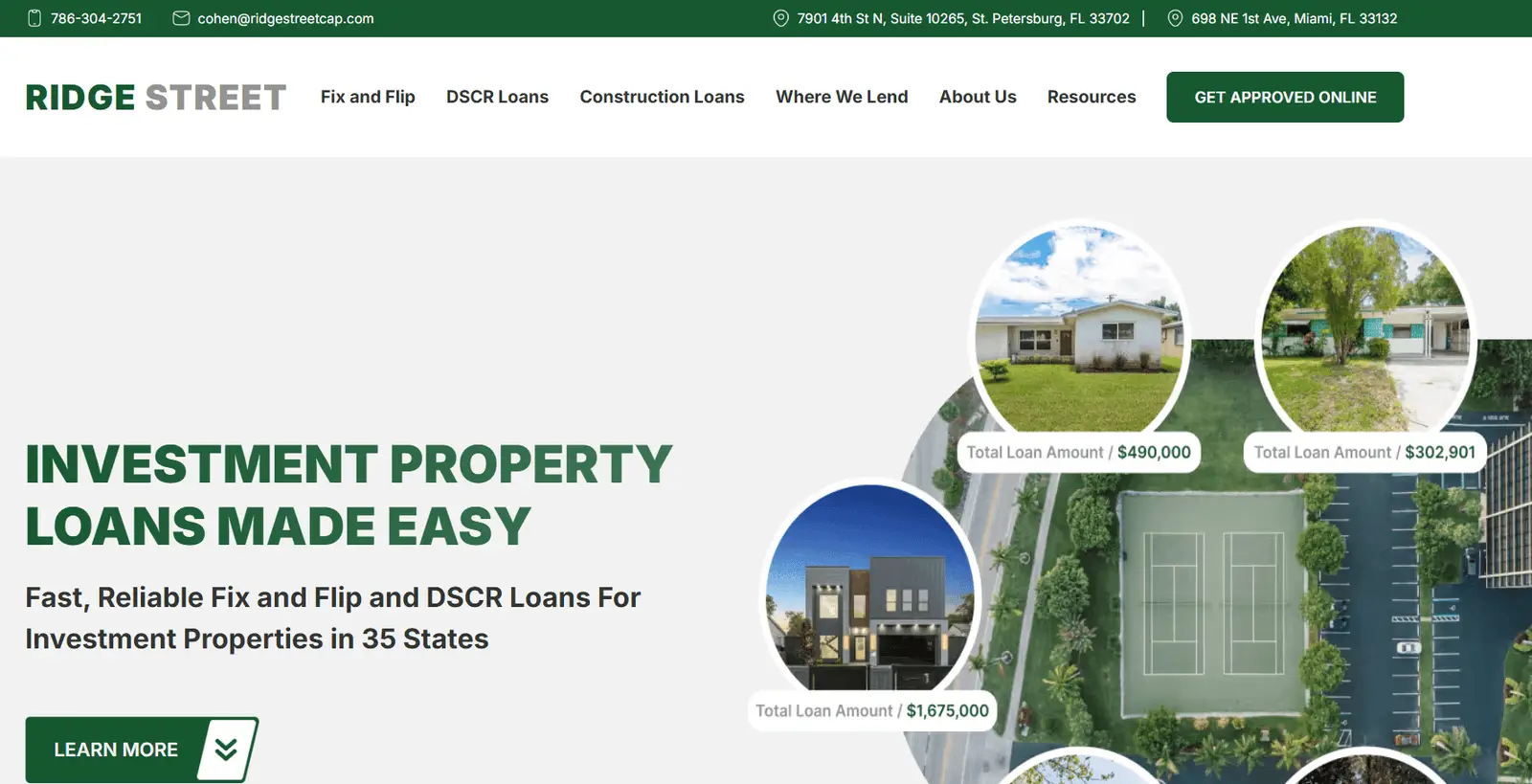
Ridge Street Capital is a direct private lender built exclusively for real estate investors and has been recognized as the Real Estate Business Review DSCR Lender of the Year for our specialization in DSCR rental loans and fix-and-flip financing. LLC closing is standard across all programs.
What distinguishes Ridge Street Capital on DSCR loans is the combination of low entry cost and fast execution. Origination starts at 0%, DSCR rates start from 6.0%, and term sheets are issued within 2 business hours of application. DSCR loans typically close in 21 to 25 days. The $50,000 minimum loan size opens the program to investors acquiring smaller properties in lower-cost markets. For investors running a BRRRR strategy, Ridge Street handles both the hard money acquisition phase and the DSCR refinance, which keeps underwriting continuity across both phases of the project.
Ridge Street finances single-family (1 to 4 units), small multifamily (2 to 4 units), and mid-sized multifamily (5 to 10 units). The firm specializes in Airbnb loans for short-term rental investors and uses AirDNA projections to underwrite STR income rather than defaulting to long-term lease assumptions.
Qualification: 660 minimum FICO. 20% down payment on DSCR purchases and 25% on DSCR Cash-out refinances.
Best for: Self-employed investors and LLC borrowers seeking fast closings for long-term and short-term rental properties, with financing available for both newer and experienced investors through a lender that handles hard money and DSCR loans in-house and offers low origination fees.
Pros and Cons:
2. MoFin Loans
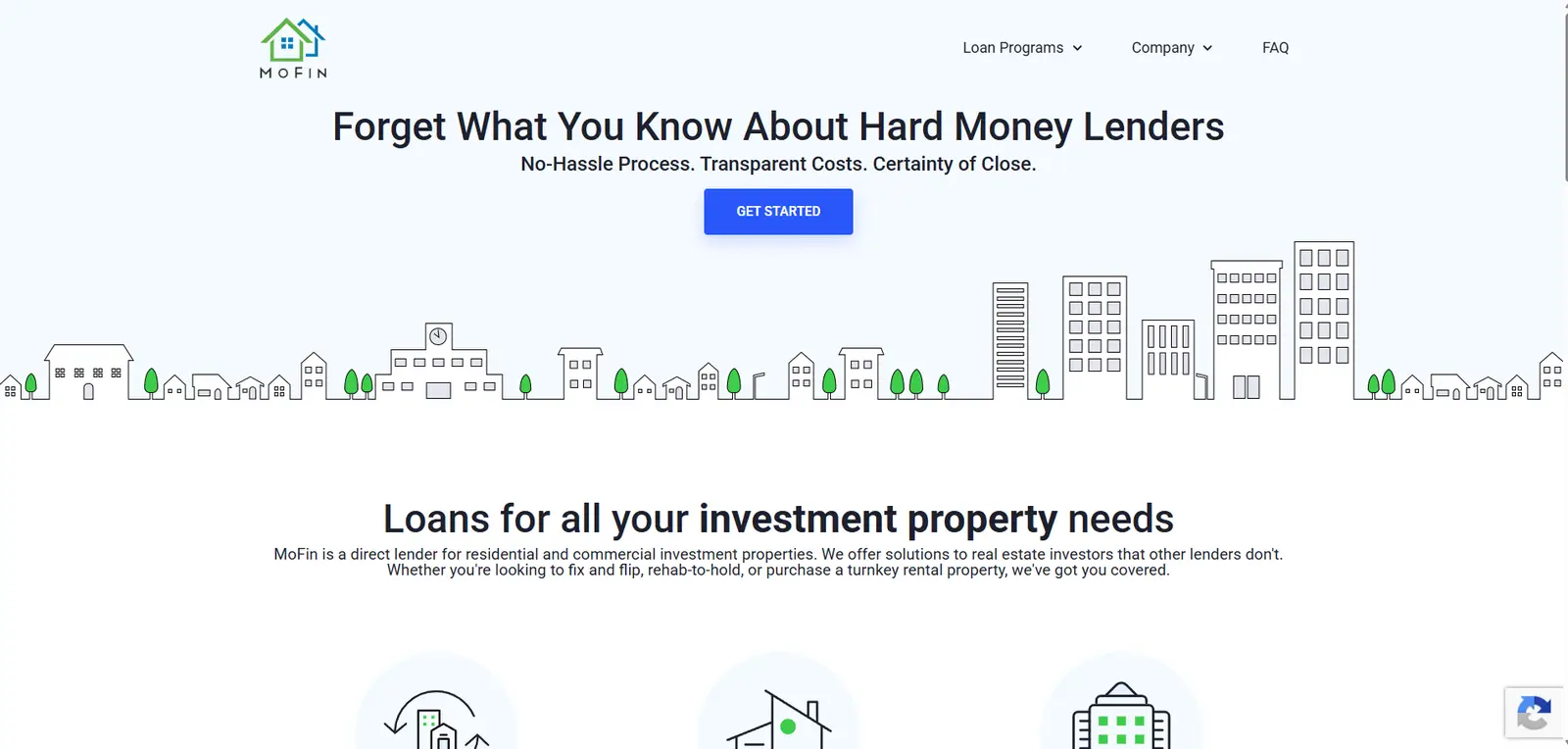
MoFin Loans is a direct lender for residential and commercial investment properties. The product suite covers bridge and fix-and-flip loans, DSCR rental loans, and ground-up construction. MoFin accepts LLC entity closing across all product lines. Their minimum loan amount is $150,000, higher than most lenders on this list. That floor excludes investors targeting lower-value properties or smaller markets where acquisition prices fall below that threshold.
Best for: Investors with loan sizes above $150,000 who want to finance multifamily or mixed-use properties.
Pros and Cons:
3. Lima One Capital
Lima One Capital is a private money lender with a full product suite: fix and flip, bridge, new construction, rental, and multifamily. LLC entity closing is accepted across their rental and bridge products. Lima One operates nationally and works with both direct borrowers and through a broker partner network.
Lima One is strong for investors managing growing rental portfolios, including those consolidating multiple properties into a single blanket loan or refinancing into a portfolio DSCR structure.
Best for: Portfolio investors who need multiple product types across fix-and-flip, rental, bridge, and construction under one lender relationship.
Pros and Cons:
4. Pimlico Capital

Pimlico Capital is a direct private lender, specializing in hard money fix-and-flip loans, bridge loans, and DSCR financing. The firm uses in-house underwriting and does not require a hard credit pull for an initial quote. Pimlico closes in LLC entity name as standard across all products. DSCR loans are capped at $1,500,000, which excludes higher-value acquisitions.
Best for: Investors seeking financing for commercial properties or refinancing completed rehab projects.
Pros and Cons:
5. Angel Oak Mortgage Solutions
Angel Oak Mortgage Solutions is a non-QM lender with a broad product suite including DSCR loans, bank statement loans, foreign national loans, and ITIN programs. Angel Oak accepts LLC entity ownership. Trust vesting is also accepted. Angel Oak is a strong option for investors with complex income structures who need non-QM products beyond standard DSCR qualification. The program supports a wide range of property types, including condo hotels.
That said, Angel Oak operates as a wholesale lender. Investors must apply through a mortgage broker, which adds an intermediary step and can affect rate and closing speed relative to a direct lender.
Best for: Investors with complex income situations, foreign nationals, or borrowers who need non-QM products that standard DSCR lenders don't offer.
Pros and Cons:
Why Conventional Lenders Don't Close Mortgages in LLC
Fannie Mae and Freddie Mac, the two government-sponsored enterprises that purchase the majority of conventional mortgages from lenders, require the borrower to be an individual. The reasoning behind this requirement is straightforward: agency guidelines are designed for owner-occupied and personal-use residential lending, where individual accountability, income verification, and personal credit history are the primary risk measures.
LLCs don't have employment histories, W-2s, or personal credit profiles in the same way individuals do. Because lenders originate conventional loans with the intention of selling them to Fannie Mae or Freddie Mac on the secondary market, they cannot deviate from those guidelines, regardless of how creditworthy the borrower is or how profitable the investment is.
It’s worth noting that many banks and credit unions that added a DSCR product to their conventional mortgage lineup still close in personal name. Their DSCR product runs through the same residential lending infrastructure built for agency compliance, and that infrastructure does not support entity vesting. An investor who applies for a bank DSCR loan expecting to close in an LLC and receives a denial is usually encountering the structural limitations of conventional lending.
Conventional lenders generally do not finance distressed properties, including bank foreclosures, homes with major deferred maintenance, or properties that fail standard appraisal requirements, which is why investors pursuing rehab projects typically go to hard money lenders. Hard money and bridge loans also close in LLC names.
In practice, investment properties require a different financing structure than primary residences or second homes. Private lenders that originate both hard money and DSCR loans can finance the full BRRRR cycle, from acquisition and renovation through long-term refinance once the property is stabilized. Keeping both loans with the same lender streamlines underwriting, reduces friction between transactions, and creates continuity across the entire project.
What to Look for in an LLC Mortgage Lender
Beyond the product structure, choosing the right lender affects both the loan terms and the reliability of the closing process. The four criteria below help investors identify lenders that handle LLC mortgages and investment-property transactions efficiently.
Direct lender vs. broker channel. Direct lenders hold their own capital and make their own underwriting decisions. A broker-channel lender adds a layer between the investor and the decision-maker, which extends timelines and introduces potential for miscommunication at critical deal moments. For LLC loans, where entity documentation and title vesting require additional coordination, that extra layer creates more opportunity for delays.
LLC closing as standard practice. Lenders that regularly close LLC loans typically have established processes for entity documentation, title vesting, and operating agreement review, because loan officers have worked through those requirements on dozens of prior deals. Lenders with limited LLC experience often create delays through redundant document requests and title coordination issues. Asking how many LLC loans a lender closed in the past 12 months usually gives a clearer picture than a general statement that they “work with LLCs
Geographic coverage. Private lenders do not operate in every state, and DSCR loan structures can vary by jurisdiction. In some states, lenders require DSCR loans to close in an LLC entity structure. Before moving forward, confirm that the lender is active in the subject property’s state and clarify how the loan must be vested before committing to the application process.
Minimum loan size. Private lenders set minimum loan thresholds ranging from $50,000 to $150,000 or more. Investors in lower-cost markets or targeting smaller deals should confirm the lender's floor before committing to an application. A lender with a $150,000 minimum excludes a significant portion of deals in markets where acquisition prices run below that figure.
LLC Mortgage Loan Requirements
Understanding what documentation an LLC mortgage requires, both from the entity and its principals, helps investors prepare before applying. Incomplete LLC documentation is one of the most common causes of closing delays on investment property loans.
Entity documents:
- Articles of organization or articles of formation
- Operating agreement
- EIN (Employer Identification Number) confirmation letter
- Certificate of good standing from the state of formation
- LLC registration in the state where the property is located, or registration as a foreign entity in that state
Borrower documents:
- Government-issued photo ID
- Credit score 660 or above (varies by lender and program)
- Bank statements showing reserves, typically 6 months of PITIA
- Completed loan application
Personal tax returns and W-2s are not required for DSCR loans. The LLC's operating history and financial records are also not part of the qualification. For the complete document checklist and a full walkthrough of the LLC closing process, see the DSCR loan for LLC guide.
Get an LLC Mortgage from Ridge Street Capital
Ridge Street Capital funds investment property loans in 35 states with no income verification and LLC title closing as a standard part of every deal. DSCR rental loans close in 21 to 25 days with term sheets issued within 2 business hours. Investors with an active deal or a property under contract can submit directly online.
LLC Mortgage Lenders FAQ
What types of loans close in an LLC name?
Private lenders offer three loan structures that close with the LLC as borrower of record. DSCR loans are the primary option for rental property purchases and refinances: qualification is based on the property's rental income, no W-2s or tax returns required, with 30-year fixed or ARM terms available. Hard money and bridge loans are used for distressed acquisitions that need renovation before qualifying as rentals — short-term, asset-based, typically 10% to 13%. Portfolio loans cover multiple properties under a single structure with DSCR qualification on blended rental income, suited to investors consolidating several rentals.
Can a newly formed LLC get a mortgage on an investment property?
Yes. DSCR lenders do not require the LLC to have an operating history. The loan qualifies on the property's rental income, not the entity's financial track record. The LLC must be registered in good standing in its formation state and registered in the state where the subject property is located.
Does an LLC mortgage require a personal guarantee?
Yes, in most cases. DSCR and hard money lenders require the principals of the borrowing LLC to sign a personal guarantee. The guarantee means the individual is personally liable if the LLC defaults. DSCR loans that close in LLC name do not appear on the guarantor's personal credit report.
Can investors use one LLC for multiple mortgaged properties?
Yes. DSCR lenders place no cap on the number of properties financed through a single LLC or related entities. Each property is underwritten individually on single-asset DSCR loans or as part of a combined structure on portfolio loans. Conventional lending caps investors at 10 financed properties regardless of entity structure. DSCR financing removes that ceiling entirely.
Do LLC mortgage rates differ from personal-name investment loan rates?
Generally, no. Entity vesting does not create a separate pricing tier. Investment property mortgage rates are primarily based on the loan program, LTV, credit score, and DSCR ratio.
Can investors use a mortgage to finance the replacement property in a 1031 exchange?
Yes. A loan on the replacement property is a separate transaction from the exchange funds held by the qualified intermediary, so adding leverage does not disqualify the tax deferral. Most investors use a DSCR loan for this, since it qualifies on the replacement property's rental income rather than personal income documents, which fits comfortably within the 180-day closing window. The mechanics of how financing works inside a 1031 exchange, including how the loan satisfies the IRS debt replacement requirement, depend on how the transaction is structured.

Zach Cohen is the Managing Partner of Ridge Street Capital, a direct private lender providing hard money and DSCR loans to real estate investors across 36 states. Under his leadership, the firm has funded nearly $100 million in investment property loans. He regularly works with real estate investors on rental property acquisitions, refinances, and fix-and-flip projects across the country.
Fix and Flip Loans
Funding For Purchase + Rehab
- $50,000 up to $3,000,000
- Interest Rate 10.5%-11.5%
- Origination Fee From 1.5%
- Up to 90% of Purchase and 100% of Rehab

DSCR Loans For Long Term Rentals
Perfect for first-time investors or experienced investors scaling their rental portfolio.
- Up to $2,000,000
- Interest Rates from 6.0%
- Origination Fee From 0%
- Up to 80% of LTV

DSCR Loans For Short Term Rentals
Designed for investors pursuing higher rents with a short term rental strategy.
- Up to $2,000,000
- Interest Rates from 6.25%
- Origination Fee From 0%
- Up to 80% LTV
Ready to Get Started?
.svg)