Investment Property Appraisal: How Lenders Set Value and Market Rent
An appraisal can change your loan amount or cash to close. Learn how property value and market rent are determined, what Form 1007 does, and what happens when results come in low.
nmin readReleased on:November 2, 2026Last updated on:November 2, 2026


Overview:
- An investment property appraisal establishes both property value and market rent. For a single-family rental, Form 1004 reports the appraised value, while Form 1007, the Single-Family Comparable Rent Schedule, provides an independent estimate of monthly rental income.
- The appraisal process is independent. Neither the lender nor the borrower selects the appraiser. The order goes through an appraisal management company, which assigns a licensed appraiser working in the property's market, and the borrower pays the fee.
- Properties with five or more units follow commercial valuation methods. Appraisers place greater emphasis on the property's net operating income and capitalization rate, rather than on comparable sales.
An investment property appraisal is an independent assessment of a property's market value, prepared by a state-licensed or certified appraiser through the lender's appraisal process.
For a single-family rental, appraisers traditionally use Form 1004 to determine the property's value and Form 1007 to estimate monthly market rent. For two- to four-unit properties, they typically use Form 1025. Investment property lenders rely on these figures to determine how much they can finance and whether the property's rental income can support the mortgage payment.
The appraiser determines both figures independently. Neither the borrower nor the lender can influence the appraiser’s independent judgment or the final valuation.
However, borrowers can request a reconsideration if the report contains factual errors or overlooks relevant comparable properties.
Our guide to investment property loans explains the available financing options. Here, we focus on the appraisal process: who orders it, how appraisers determine property value and market rent, and what investors can do when the results fall short of expectations.
What Is an Investment Property Appraisal?
An investment property appraisal typically gives two key figures: the property's market value and its estimated monthly market rent. Appraisers document these numbers using specific methodology and appraisal forms, depending on the property type and loan program.
The table below shows the most common appraisal forms for each property type.
It could be surprising to see Form 1007 included in the appraisal documents. Although it is a separate form, lenders typically request it as part of the appraisal process when qualifying a single-family rental property based on rental income.
The appraiser prepares the market rent schedule and submits it alongside the property valuation report.
Who Orders an Investment Property Appraisal?
The lender orders the appraisal, the borrower pays for it, and neither one chooses the appraiser.
Investment property lenders typically order appraisals through an appraisal management company (AMC). The lender submits the property address and loan details through the AMC's platform, and the borrower receives a payment link to cover the appraisal fee.
Next, the AMC assigns the work to a licensed or certified appraiser familiar with the local market. Depending on the company's process, appraisers may bid on assignments or accept them directly. Once selected, the appraiser inspects the property and prepares an independent valuation. The loan officer has no role in selecting the appraiser and cannot influence the final assessment.
This separation is an important part of maintaining appraisal independence. Under Fannie Mae's Appraiser Independence Requirements, mortgage production staff cannot select appraisers, order appraisals directly, or attempt to influence property valuations. However, using an AMC is not mandatory. Lenders can also manage the process through independent internal appraisal teams.
There is also an important regulatory distinction. Federal appraisal independence provisions under Regulation Z generally apply to consumer credit secured by a borrower's principal dwelling. Business-purpose investment property loans typically fall outside that scope. Still, many private lenders follow similar independence standards because their funding partners and institutional investors require reliable, unbiased valuations.
What does this mean for the borrower?
Any property value discussed before the appraisal is completed is an estimate. Neither the borrower nor the loan officer can influence the appraiser's independent judgment.
If the appraisal comes in lower than expected, the lender can request a review or clarification supported by relevant market data. However, the final valuation must reflect the appraiser's independent professional assessment.
How Much Does an Investment Property Appraisal Cost?
An appraisal for a one- to four-unit investment property typically costs $650 to $750. For buildings with five to ten units, a commercial narrative appraisal generally ranges from $2,500 to $3,000.
The difference reflects the scope of the appraisal. Commercial reports are more detailed, sometimes exceeding 100 pages, and require a thorough analysis of the property's rental income, operating expenses, and market value.
For example, in our New York multifamily cash-out refinance case study, Ridge Street Capital provided a $1.55 million DSCR loan for a five-unit property appraised at $2.65 million. The 117-page appraisal report included a submarket analysis, income capitalization and sales comparison approaches, property photos, maps, and supporting valuation calculations.
Borrowers typically pay the appraisal fee upfront when the order is placed, using a payment link provided by the appraisal management company. Since the appraisal is a separate service, the fee is generally nonrefundable, even if the loan does not close.
How Long Does an Investment Property Appraisal Take?
Once the property inspection is complete, appraisers typically need about a week to prepare and deliver the report. However, the full process can take longer, especially in rural areas where finding an available appraiser and scheduling an inspection may require additional time.
For occupied rental properties, access can be a common source of delays. The appraiser needs to inspect the interior, which requires coordinating with the tenant. If the tenant is unavailable or difficult to schedule, the inspection alone can be delayed by a week or more.
What Is Form 1007?
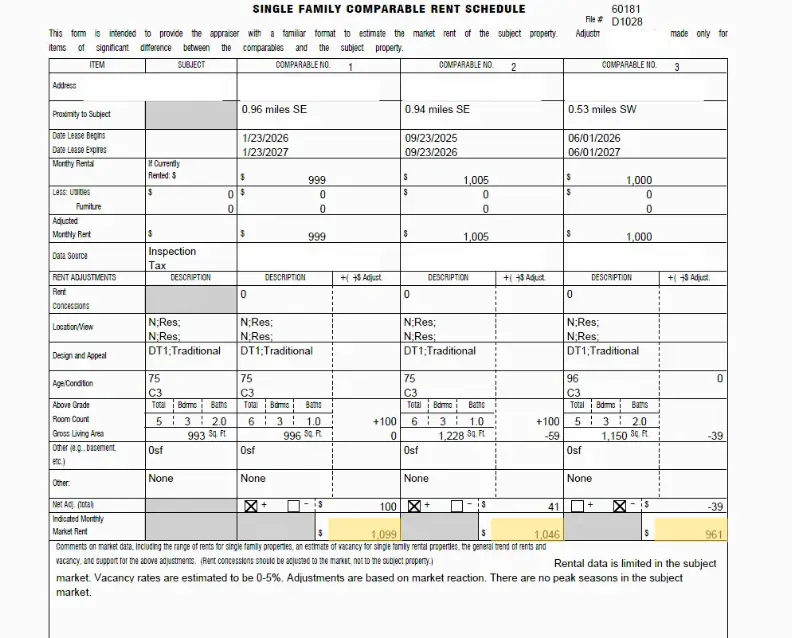
Form 1007, also known as the Single-Family Comparable Rent Schedule, is an appraisal form used to estimate the monthly market rent of a one-unit investment property.
Lenders require this independent rent assessment to verify how much income the property can reasonably generate. Borrowers can estimate rental income using a rental property pro forma, but their projections and advertised rental rates can’t replace the appraiser's independent market rent assessment used for loan qualification.
Once the appraiser determines market rent, lenders use that figure differently depending on the loan program.
For conventional investment loans, lenders generally count 75% of the estimated market rent toward the borrower's qualifying income, allowing for vacancy and maintenance. DSCR lenders, on the other hand, compare the property's qualifying monthly rent with its full mortgage payment.
If the property already has a signed lease, DSCR lenders typically compare the contracted rent with the Form 1007 estimate and use the lower of the two for qualification.
How Does the Appraiser Set Market Rent on the 1007 Rent Schedule?
The appraiser selects at least three comparable rental properties and adjusts their rental rates to account for differences in location, size, condition, and amenities. Next, the appraiser compares the adjusted figures to determine a supported estimate of the property's monthly market rent.
A recent Ridge Street funded deal in Birmingham, Alabama shows the whole process on one page. The subject was a vacant three-bedroom, two-bath rental of 993 square feet. Below is the rent schedule the appraiser produced.
Two things in the rent schedule are particularly important for investors.
First, appraisers make specific adjustments for differences between properties. In this example, an additional full bathroom increased the estimated rent by $100, while a 235-square-foot difference in living area resulted in a $59 adjustment.
These relatively small adjustments show how precisely appraisers compare rental properties and why an investor's general expectations may differ from the final estimate.
Second, the final market rent is based on the appraiser's professional judgment, not a simple average. The three adjusted comparables indicated monthly rents of $1,099, $1,046, and $961, averaging $1,035. However, the appraiser concluded that $1,000 was the appropriate market rent, noting that comparable rental data in the area was limited.
That final figure can be significantly lower than the owner's expectations. At the time of closing, the same property was advertised on Zillow for $1,350 per month, 35% above the appraiser's estimate.
By the way, two weeks later, the listing was updated to a $1,000 per month lease.
Nevertheless, the lender used $1,000 for underwriting because an advertised asking rent does not establish what tenants are actually willing to pay.
Does the Rent Figure Affect the Appraised Value?
For one- to four-unit investment properties, rental income generally does not determine the appraised value. Appraisers primarily rely on comparable sales to establish market value, while rental income is evaluated separately.
The Birmingham appraisal report illustrates this distinction. The appraiser developed three approaches to value:
- Sales comparison approach: $115,000
- Cost approach: $117,020
- Income approach: $100,000, based on the estimated monthly market rent of $1,000 and a gross rent multiplier of 100.
Despite the differences, the appraiser concluded that the property was worth $115,000, giving full weight to the sales comparison approach. The report also noted that the cost and income approaches were completed at the lender's request.
With a purchase price of $100,000, the investor acquired the property for $15,000 below its appraised market value.
This example shows why rental income and property value serve different purposes in loan underwriting. For one- to four-unit properties, higher rent does not automatically increase the appraised value, just as lower rent does not necessarily reduce it.
Instead, lenders use the appraised value to determine maximum loan amounts and evaluate rental income separately to assess whether the property can support its mortgage payments.
What Happens If the Appraisal Comes In Low?
Investment property lenders use the appraised value to determine how much they can lend and the estimated market rent to assess the property's ability to cover its mortgage payments. If either figure comes in below expectations, the investor may qualify for a smaller loan or need to contribute more cash to closing.
However, the available options depend on which figure is lower.
When the appraised value falls below the contract price, the investor can renegotiate with the seller, cover the financing shortfall with additional cash, or cancel the purchase if the contract includes an applicable appraisal contingency.
Our guide to investment property down payments explains how a lower valuation can affect the cash required at closing.
When the estimated market rent is lower than expected, the property may not meet the lender's minimum DSCR requirement. In that case, the investor can request a review of the rental comparables, reduce the loan amount by contributing additional cash, or explore a different loan structure.
In either situation, the borrower can request an appraisal review supported by new market evidence. A formal reconsideration of value (ROV) addresses the appraised property value, while concerns about the market rent estimate can be raised through a review of the rental analysis.
The key is providing verifiable comparable data. For rental estimates, this means recently leased properties similar to the subject, with documented rental rates, lease dates, and terms. MLS rental records and signed leases can support the dispute.
By comparison, the borrower's own projections, advertised asking rents, and unsupported disagreements with the appraiser's conclusions won’t change the conclusions in the appraisal report.
Even with additional evidence, the appraiser may review the information and leave the original numbers unchanged. The lender can’t just override the appraiser's independent valuation.
How Are Appraisals Different for Properties With Five or More Units?

For properties with five or more residential units, appraisers take a different approach to valuation. While smaller investment properties are valued primarily through comparable sales, commercial multifamily buildings are assessed largely on their ability to generate rental income.
The primary method is the income capitalization approach, which divides the property's net operating income (NOI) by a market capitalization rate (cap rate).
For example, in a Ridge Street Capital refinance of a five-unit multifamily building in New York, the appraiser estimated annual NOI at $164,873 and applied a 6.00% capitalization rate. This produced a value of $2,747,883, rounded to $2,750,000, or $550,000 per residential unit.
What Is the Difference Between As-Is and Stabilized Value in Commercial Appraisals?
Commercial appraisals can distinguish between a property's current as-is value and its prospective stabilized value, which reflects what the building could be worth once it reaches a certain level of occupancy and rental income.
In the Hamilton Heights example, the building was 80% occupied. The appraiser therefore concluded a prospective stabilized value of $2,750,000, using a valuation date eight months after the inspection.
However, reaching that value involved additional costs and lost income. To determine the property's current value, the appraiser made three deductions:
- Loss to lease: $9,675
- Rental income loss: $14,647 across four units during their lease-up month
- Entrepreneurial profit: $3,648
Together, these adjustments totaled $27,970. Deducting them from the unrounded prospective value of $2,747,883 produced an as-is value of $2,719,913, rounded to $2,720,000.
This distinction matters for investors planning a cash-out refinance. Lenders generally use the current as-is value to determine the maximum loan amount, while the prospective stabilized value shows what the property could be worth after the remaining leasing and stabilization work is complete.
How Does the Appraiser Choose the Capitalization Rate?
Appraisers evaluate several sources of market data to select an appropriate capitalization rate. In the New York refinance example, the appraiser used three methods: comparable local sales, published investor surveys, and a band-of-investment calculation. Each produced a different indication.
Local sales carried the greatest weight. The appraiser analyzed seven nearby multifamily buildings, ranging from four to 16 units, most built before 1920. Their cap rates ranged from 4.34% to 6.55%. These transactions provided direct evidence of how investors priced similar properties in the area.
National investor surveys, meanwhile, reflected broader market conditions that may not fully capture pricing in a specific neighborhood.
The band-of-investment calculation considered the property's financing structure. The appraiser assumed a qualified buyer would finance 70% of the property value at a 7.00% interest rate over 30 years, producing a mortgage constant of 7.98%. The remaining 30% would come from an equity investor targeting a 4.00% initial return.
Combining these two components according to their respective shares produced a capitalization rate of 6.79%.
After reviewing the evidence, the appraiser selected a 6.00% capitalization rate, above the average indicated by local sales but below the financing-based estimate.
The report also explained the reasoning behind this choice. Since the stabilized valuation already assumed full occupancy at market rents, the property had limited potential for additional rental income growth compared with a building whose existing rents were below market.
Why the Capitalization Rate Has Such a Large Impact on Value
Even when a property's income stays the same, a change in the capitalization rate can significantly affect its appraised value.
Using the same $164,873 in annual net operating income from the New York appraisal, a 5.20% capitalization rate, based on the investor survey average, produces an estimated value of $3.17 million. At the 6.79% rate indicated by the band-of-investment analysis, that figure drops to approximately $2.43 million.
That's a difference of more than $740,000, with no change in rental income or operating expenses.
Around the appraiser's selected 6.00% rate, a shift of just 25 basis points (0.25 percentage points) changes the estimated value by roughly $110,000, or about 4%.
This sensitivity explains why commercial appraisers evaluate capitalization rates using multiple sources of market evidence. For investors exploring DSCR loans for 5- to 10-unit multifamily properties, understanding the appraiser's selected capitalization rate and the reasoning behind it is essential, as even a small difference can significantly affect the property's value and available financing.
Even a small difference can affect the property's valuation and, ultimately, how much a lender is willing to finance.
Investment Property Financing with Ridge Street Capital
Ridge Street Capital specializes exclusively in investment property financing, with DSCR rental loan, Fix and Flip Loan and Ground-Up Construction programs available across 36 states. Every loan goes through an independent appraisal process, and our underwriting decisions are based on verified property values and rental income.
Planning to purchase or refinance an investment property? Share the property address, along with the purchase price or current rental income. Our team will review the details and prepare a term sheet outlining the estimated loan amount, financing terms, and cash required to close, subject to final appraisal and underwriting.
Frequently Asked Questions
Can I use my own appraiser on an investment property loan?
No. Borrowers cannot select the appraiser or choose one from a lender's approved list. To maintain independence, the appraisal must be ordered through a process controlled by the lender or an authorized independent party, such as an appraisal management company (AMC). Even if you have worked with a particular appraiser before, you cannot request that person for your loan.
Do I get a copy of the appraisal I paid for?
Yes. For loans secured by a first lien on a one- to four-unit residential property, federal Regulation B requires lenders to provide a copy of the completed appraisal promptly, or at least three business days before closing, whichever comes first. This requirement also applies to business-purpose investment property loans. Borrowers can waive the advance delivery deadline under certain conditions.
For commercial properties with five or more units, appraisal delivery requirements may differ. If you have not received the report, contact your lender and request a copy.
Does the tenant have to let the appraiser inside?
When the lender requires an interior appraisal, access to the property must be arranged. However, the landlord must follow applicable state laws and lease provisions governing tenant notice and entry. Notice requirements can be different.
If the tenant refuses access or cannot accommodate the appointment, the inspection may be delayed. An exterior-only appraisal may not satisfy the lender's underwriting requirements, so coordinate with the tenant as early as possible.
How long is an investment property appraisal valid?
Many lenders, including Ridge Street, consider an appraisal current for approximately 120 days. Some programs allow older reports, including those up to 180 days old, with an appraisal update when permitted by their guidelines.
The update involves reviewing current market conditions to determine whether the original valuation remains acceptable. However, if the property has declined in value or the report exceeds the lender's permitted age, a new appraisal may be required. Exact requirements depend on the loan program and lender.
What is the difference between an appraisal and a home inspection?
An appraisal determines the property's market value for lending purposes. A home inspection examines its physical condition to help the buyer identify potential problems.
Although the borrower may pay for both services, they serve different purposes. Appraisers consider visible property conditions that affect value, but they do not conduct the same detailed evaluation of structural components, electrical systems, plumbing, HVAC, and other features that a home inspector performs.
As a result, one cannot replace the other.
Can an appraisal transfer from one lender to another?
Sometimes. A lender may accept an appraisal originally ordered by another lender, provided it meets the new lender's independence, underwriting, and appraisal requirements. However, acceptance is not automatic.
At Ridge Street Capital, an appraisal previously ordered through an AMC may be eligible for review to determine whether it can be used for originating a loan.
For example, if a bank ordered an appraisal directly from a local appraiser, the report may not meet a private DSCR lender's requirements. At Ridge Street Capital, we can review an existing appraisal ordered through an appraisal management company to see if it can be reused. Otherwise, a new appraisal may be required.
Zach Cohen is the Managing Partner of Ridge Street Capital, a direct private lender providing hard money and DSCR loans to real estate investors across 36 states. Under his leadership, the firm has funded nearly $100 million in investment property loans. He regularly works with real estate investors on rental property acquisitions, refinances, and fix-and-flip projects across the country.
Fix and Flip Loans
Funding For Purchase + Rehab
- $50,000 up to $3,000,000
- Interest Rate 10.5%-11.5%
- Origination Fee From 1.5%
- Up to 90% of Purchase and 100% of Rehab

DSCR Loans For Long Term Rentals
Perfect for first-time investors or experienced investors scaling their rental portfolio.
- Up to $2,000,000
- Interest Rates from 6.0%
- Origination Fee From 0%
- Up to 80% of LTV

DSCR Loans For Short Term Rentals
Designed for investors pursuing higher rents with a short term rental strategy.
- Up to $2,000,000
- Interest Rates from 6.25%
- Origination Fee From 0%
- Up to 80% LTV
Ready to Get Started?