Overview:
- Build profit into the offer. Start with ARV, then subtract selling costs, holding costs, rehab, contingency, and required profit. The number left is the maximum purchase price. Profit should be planned before the offer.
- Use inputs that leave room for mistakes. Set ARV near the middle of the comp range, not the highest sale. Model a full retail commission, budget both purchase and resale closing costs, and add a rehab contingency of about 10% even after inspection.
- Price the exit for the buyer, not the spreadsheet. Carrying costs increase every month the finished property sits. A faster sale at a slightly lower price can net more than holding out for the full asking price.
Yes, it is still profitable to flip houses in 2026, but the margin for error is smaller than it has been in a decade. According to ATTOM's Q1 2026 Home Flipping Report, the typical flip generated a gross profit of $66,000 and a 25.4% gross return, which was the first improvement in returns in nearly two years and still roughly half of what flippers earned in the mid-2010s. In other words, the market no longer produces the profit on its own. Investors who underwrite conservatively, budget honestly, and sell quickly are still making money on flips, while investors who count on a strong exit to fix a weak purchase are the ones losing it.
This article covers:
- How much profit does the average house flip make in 2026, and the difference between the gross and net numbers;
- Why have flipping margins compressed over the last several years;
- The four underwriting adjustments that separate profitable flippers from break-even ones;
- Why a fast sale usually beats a higher price;
- Whether flipping houses is worth it for a first-time investor entering the market now.
How Much Profit Does the Average House Flip Make in 2026?
Investors asking whether flipping houses is worth it usually start with gross profit. Gross profit is simply the difference between the purchase price and the resale price. It does not account for the renovation, the financing, the holding period, or the cost of selling.
The number investors actually take home is net profit:
Net profit = resale price minus purchase price, rehab costs, holding costs, and selling costs
Rehab costs, financing costs, and closing expenses typically consume 20% to 33% of a property's after-repair value. That is why the same $66,000 gross spread mentioned above can produce a strong five-figure net profit on a disciplined project, or disappear entirely when the investor loses control of renovation costs, holding time, and exit expenses. To pre-screen a specific deal against these numbers, run it through Ridge Street's fix and flip calculator.
Purchase price plays a role as well. In the Q1 2026 data, homes bought between $100,000 and $200,000 produced the strongest typical margins at 32%, while homes bought below $50,000 typically lost 14%. The cheapest properties often need the heaviest work and sell into the thinnest buyer pools, so a low entry price rarely compensates for what comes after it.
Why Flipping Profits Have Compressed
The obvious follow-up question is why returns fell from over 50% a decade ago to about 25% today. The compression came from both sides of the deal at once: costs went up, and the premium buyers were willing to pay for renovated homes went down.
Costs Rose on Every Line of the Deal
Acquisition prices sit near record highs, the cost of financing for flipping houses remains a big line item in the budget, and labor and materials still cost more than they did before the pandemic. On top of that, projects simply take longer. The average flip now runs 165 days from purchase to resale, and every additional month adds interest, taxes, insurance, and utilities that come straight out of the spread.
Active flippers feel this drag more than any other cost. In the ResiClub Q1 2026 survey of 201 operators, 56% named lower holding costs as the single change that would most improve their returns, well ahead of better contractors or faster capital draws.
Buyers Stopped Paying the Flip Premium
The demand side changed just as much. In 2021, flipped listings attracted 25% more page views than comparable older homes on Realtor.com. By October 2025, that advantage had narrowed to 6.5%. The sale prices tell the same story: flips listed in June 2026 sold at a median 8.3% discount from their peak list price, compared to a 2.9% discount for other older homes, and back in 2021 that flip discount was only 0.9%.
The reason is simple mortgage math. A buyer who purchases a flipped home is financing the cost of someone else's renovation at today's interest rates, so more buyers choose a cheaper fixer-upper and put in the work themselves. Renovated homes still sell, and they still sell faster than the rest of the market. What changed is that buyers now pay for renovation only when the price fits what they can finance.
What Profitable Flippers Do Differently in 2026
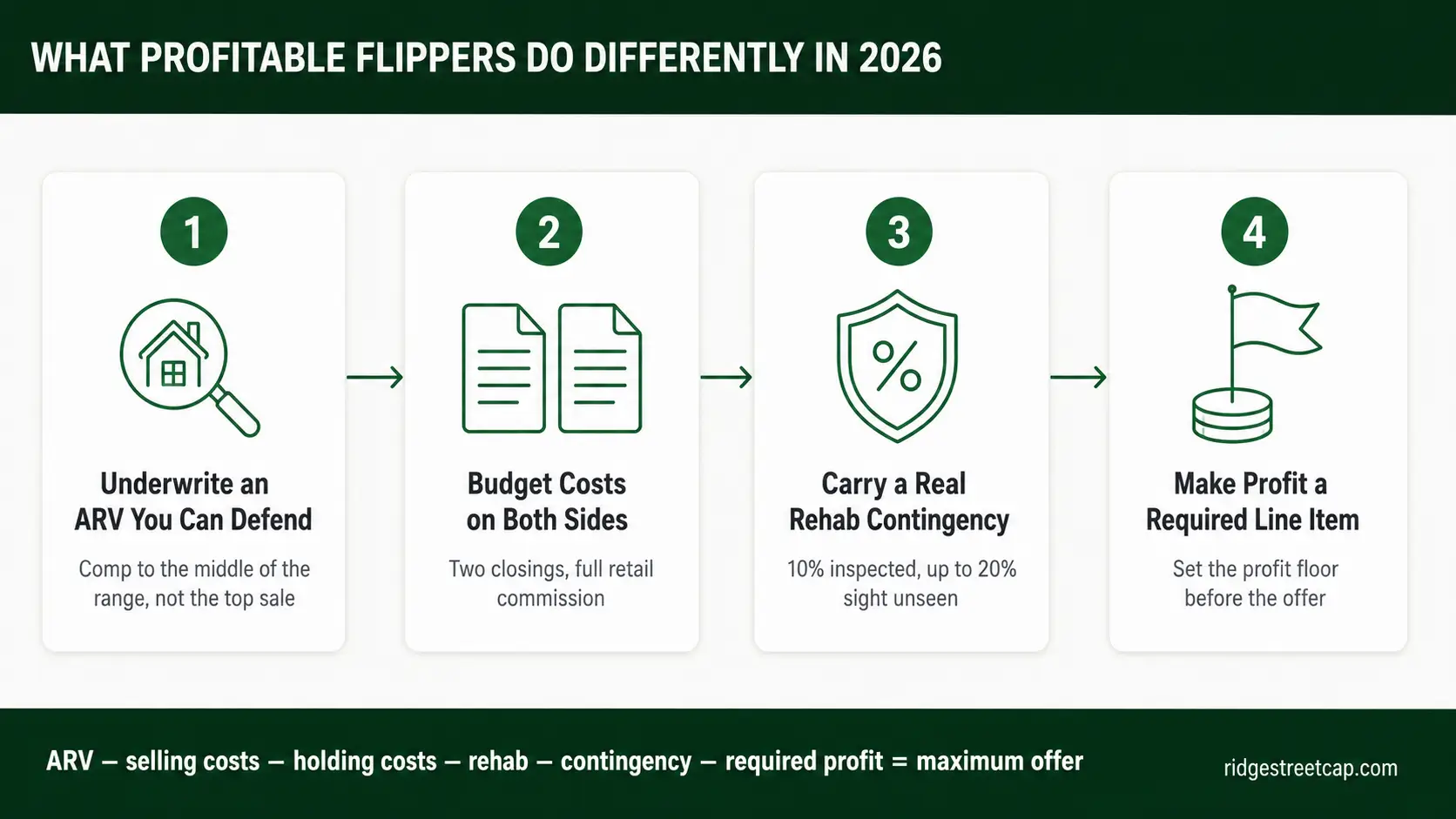
Margin compression did not push everyone out of the business. In the same survey, 90% of active flippers said they plan to complete at least one project in the coming year. What the numbers show is that whether it is profitable to flip houses now depends less on the market and more on the operator, because at a 25% gross return, a single bad assumption can consume the entire margin. The flippers who continue to make money adjusted their underwriting before anything else. Below are the four adjustments that show up consistently.
1. They Underwrite an ARV They Can Defend
Every flip depends on the after-repair value, or ARV, which is the price the finished property can realistically sell for. That number needs careful comp selection. The highest sale in the neighborhood should not be treated as the baseline unless the project will match its design, finishes, condition, and buyer appeal.
If the finished property will not compete with that comp, the investor should not underwrite to that price.
Because of this, experienced flippers usually set ARV in the middle or lower end of the comp range, not at the top. They also model the exit with room for a price reduction, buyer closing cost credit, and a longer holding period than planned.
If the deal only works at the highest comp and a perfect resale, the margin is too thin. Strong underwriting should pressure-test the deal before the investor buys it. A flip that still produces a profit after conservative resale assumptions is the one worth pursuing.
2. They Budget Transaction Costs on Both Sides of the Deal
Commissions and closing costs are among the most predictable expenses in a flip, but investors still miss them in two common ways.
The first mistake is underwriting to the lowest possible commission. Careful flippers usually model a full retail commission, often around 6% of the resale price, even if they expect to negotiate a lower rate. If the commission comes in lower, the savings become upside instead of a condition the deal needs to work.
The second mistake is budgeting for only one closing. Every flip has two: the purchase closing and the resale closing. First-time flippers often account for the sale-side costs but miss part of the acquisition-side expense.
These numbers do not need to be guessed. A title company can prepare a preliminary settlement estimate for a specific property before the offer is submitted. That turns closing costs from a rough assumption into a real line item in the underwriting.
3. They Carry a Real Rehab Contingency
Major renovations often uncover costs that were not visible during the walkthrough. Something may appear behind a wall, under flooring, or inside an older system after work begins. The question is whether the budget already has room for it.
Experienced flippers usually hold about 10% of the rehab budget as contingency when the property was fully inspected before purchase. If access was limited, or the investor bought the property with little visibility, that contingency may need to move closer to 20%.
The same discipline applies to contractor pricing. Profitable flippers underwrite the rehab at market-rate contractor costs, even if they have access to cheaper crews. Discounted pricing can disappear once the project is underway. If the work comes in below budget, the savings increase profit instead of covering a plan that only worked because of a special price. Lenders review that same budget when underwriting rehab loans, so a conservative rehab number holds up in financing as well as in construction.
4. They Make Profit a Required Line Item
Successful flippers do not treat profit as whatever is left after closing. They build the required profit into the offer price before the deal is purchased.
The maximum offer is calculated by working backward:
ARV minus selling costs, holding costs, rehab budget, contingency, and required profit = maximum purchase price
Experienced flippers usually set a profit floor before making an offer. Some target a profit roughly equal to the renovation budget, so the reward matches the size and risk of the project. Others require a minimum return of about 15% on the total cash invested.
That profit floor should adjust to the risk of the deal. A simple renovation in a proven submarket may support a tighter margin because the investor has more confidence in the resale price, buyer demand, and construction scope. If similar homes are selling consistently and the floor plan matches what buyers want, there is less uncertainty in the exit.
A wider margin is needed when the deal has more moving parts. An unusual layout, weaker location, limited comp support, heavy renovation scope, or uncertain resale price all increase the chance that the project takes longer, sells lower, or costs more than expected. The less confidence the investor has in the exit, the more profit cushion the deal needs before it is worth buying.
The formula only works if the investor follows it. Many flip losses come from ignoring the purchase limit, often because the investor gets pulled into a bidding war or buys a marginal deal just to keep a crew busy.
Why Selling Fast Beats Holding Out for a Higher Price
Conservative underwriting sets the price an investor pays. The exit determines what the deal actually earns, and in the current market, a fast sale at a slightly lower price usually nets more than a slow sale at full price. The delay data backs this up: in the survey, 30% of flippers named the sale phase as their biggest source of delays, ahead of construction and acquisition.
A realistic example shows why speed wins. Take the typical flip: purchased for $260,000 with a target resale of $325,000. Financed with a hard money loan at 11% interest-only, a $234,000 loan balance costs about $2,145 per month in interest, and taxes, insurance, and utilities add roughly $855 more. In total, the finished property carries about $3,000 per month while it waits for a buyer.
Now compare two exit strategies on that same house:
Option 1 gives up $15,000 of list price and still finishes $6,000 ahead. More importantly, the investor gets the capital back three months earlier and can move it into the next deal.
That is not an edge case. According to Realtor.com, the median flip listed in July 2025 eventually sold 8.3% below its peak list price. On a $325,000 listing, that equals roughly a $27,000 price reduction for sellers who waited too long to meet the market.
Experienced flippers price the exit based on buyer behavior, not their target profit. They track the actual sale-to-list ratio for comparable renovated homes, average days on market, and seller concessions in the submarket. If nearby flips are closing below list or sitting longer than expected, the resale price should reflect that before the property is listed.
The reward for getting this right is speed. Flipped homes can still sell faster than comparable older listings, but only when the price creates buyer interest early. If the resale price is too aggressive, the project loses the speed advantage that makes the flip work.
When a flip has uncertainty, the price should leave less room for buyer hesitation. An unusual layout, weaker street, heavy nearby competition, or limited comp support can all justify pricing below the most relevant competing listing.
The logic is simple. A buyer comparing homes in the same neighborhood needs a clear reason to schedule the showing. That usually comes from one of two things: a better price or a better product. If the finished home is not clearly better than the competition, the price has to do more of the work.
Where It Is Still Profitable to Flip Houses in 2026
National flipping data can make the market look more uniform than it really is. Margins improved nationally in Q1 2026, but the spread between markets remains wide. Lower-priced metros such as Pittsburgh and Buffalo posted high gross flip margins, affordable Midwest and Southern markets continued to support workable returns, and several major Texas metros were much closer to break-even.
Ridge Street’s analysis of the best real estate markets for flipping houses separates these markets into three groups: prime, liquid markets where experienced flippers can operate at scale; selective markets where deal quality matters more than market reputation; and popular metros where investor demand has moved faster than actual profit margins.
Two variables explain much of the difference. The first is resale speed. Homes in Indianapolis sell in about 28 days on average, while San Antonio runs closer to 73 days. On a $300,000 hard money loan at 10%, each extra week on market adds about $575 in interest before taxes, insurance, utilities, and other carrying costs are included.
The second variable is fixed carrying cost. Annual homeowners insurance averages about $7,136 in Florida compared with roughly $1,700 in western New York. That means the same gross spread can produce very different net profits depending on where the property sits and how long it takes to resell.
The takeaway is not that investors should chase another metro every time the national data changes. It is that pricing discipline matters more when local costs and resale timelines vary this much. Whether flipping houses is worth it in a specific market depends on the entry price relative to the local median, the speed at which renovated homes resell, and the fixed costs that accrue while the property is waiting for a buyer.
That is why the national sweet spot in Q1 2026 was the $100,000 to $200,000 purchase range. In those markets, a renovation can move a house up the price ladder without pushing it beyond what local buyers can afford.
Is Flipping Houses Worth It in 2026?
Flipping houses can still be worth it in 2026, but only for investors who treat it as an underwriting business. It is a poor bet for investors relying on appreciation, loose cost estimates, or a strong resale market to cover thin margins.
Active flippers are still putting capital to work. In a recent survey, 75% expected strong buyer demand over the next 12 months, and just over half planned to convert some projects into rentals as a second exit strategy. In that fix-to-rent path, a variation of the BRRRR method, the investor refinances the hard money loan into long-term financing instead of selling.
For first-time investors asking whether it is profitable to flip houses, the answer depends on the first deal. A flip should be underwritten conservatively enough to survive a price reduction, an unexpected repair, and a longer holding period than planned. Deals that still pencil under those assumptions are the ones worth serious consideration.
The Q1 2026 data shows returns improving for the first time since 2024, but that does not make flipping easy again. It means disciplined operators still have room to make money when they buy correctly, control the renovation, and price the exit based on the market. The guide to fix and flip loans for beginners covers how lenders structure that first project.
Run the Numbers With Ridge Street Capital
Ridge Street Capital is a direct private lender providing hard money fix and flip loans to real estate investors across 36 states. We underwrite the same way this article describes: conservatively, transparently, and on the actual numbers of the deal.
Investors send the property address, purchase price, rehab budget, and ARV. We review the deal, run the numbers with the investor, and move forward only when there is a realistic path to profit. If the numbers do not work, we say so before the investor is committed.
From there, the investor receives a term sheet with the rate, leverage, and closing timeline. Ridge Street can finance up to 90% of the purchase price and 100% of the rehab budget, with closings typically completed in 7 to 14 days.
Frequently Asked Questions
What is the 70% rule in house flipping, and does it still work in 2026?
The 70% rule says an investor should pay no more than 70% of a property's after-repair value, minus rehab costs. It remains a useful first screen in 2026, but experienced flippers no longer treat it as underwriting, because the rule ignores holding time, transaction costs, and contingency, which are the three lines where thin-margin deals now fail. Any deal that passes the screen should still go through the full net profit math.
Do you need a real estate license to flip houses?
No. Flipping requires no real estate license in any state. Some full-time flippers get licensed anyway to save the listing-side commission, which typically amounts to 2.5% to 3% of every sale price. The trade-off is additional paperwork and phone time that most investors prefer to delegate to an agent.
Can you flip houses with little or no money of your own?
Investors can fund most of a flip with borrowed capital. Hard money lenders finance a large share of the purchase price and the rehab budget, secured by the property itself; Ridge Street Capital's fix and flip loans, for example, cover up to 90% of the purchase price and 100% of the rehab budget. Most lenders still require a down payment and cash reserves, so a true zero-cash flip is rare, but a low-cash flip with the right financing is realistic. See the full fix-and-flip loans guide for how the mechanics work.
How are house flipping profits taxed?
The IRS generally treats flip profits as ordinary income rather than capital gains, because the investor bought the property to resell rather than to hold. Frequent flippers can also owe self-employment tax on top of income tax. The tax line is large enough to change whether a deal pencils, so a CPA who works with investors should confirm the treatment before the first purchase closes.
Should I flip a house or hold it as a rental instead?
The right answer depends on what the capital needs to do next. Flipping returns the investor's cash in months rather than years, which is the entire advantage the speed argument earlier in this article is built on, and it lets that capital go straight into the next deal. Holding the same property as a rental ties up capital far longer, but it trades the one-time flip profit for recurring cash flow, long-term appreciation, and tax advantages a flip never touches, since a flip's profit is taxed as ordinary income the year it sells.
Investors with more deal flow than capital tend to lean toward flipping; investors building long-term wealth on a smaller number of properties tend to lean toward holding. See Is Rental Property a Good Investment for the full buy-and-hold math.

Zach Cohen is the Managing Partner of Ridge Street Capital, a direct private lender providing hard money and DSCR loans to real estate investors across 36 states. Under his leadership, the firm has funded nearly $100 million in investment property loans. He regularly works with real estate investors on rental property acquisitions, refinances, and fix-and-flip projects across the country.
Fix and Flip Loans
Funding For Purchase + Rehab
- $50,000 up to $3,000,000
- Interest Rate 10.5%-11.5%
- Origination Fee From 1.5%
- Up to 90% of Purchase and 100% of Rehab

DSCR Loans For Long Term Rentals
Perfect for first-time investors or experienced investors scaling their rental portfolio.
- Up to $2,000,000
- Interest Rates from 6.0%
- Origination Fee From 0%
- Up to 80% of LTV

DSCR Loans For Short Term Rentals
Designed for investors pursuing higher rents with a short term rental strategy.
- Up to $2,000,000
- Interest Rates from 6.25%
- Origination Fee From 0%
- Up to 80% LTV
Ready to Get Started?
.svg)

.png)