Duplex Financing: What Lenders Require on a Two to Four Unit Rental
Buying a duplex as a rental? Conventional lenders want 25% down, DSCR lenders 20%, and rent from both units counts toward what you qualify for.
nmin readReleased on:November 6, 2026Last updated on:November 6, 2026


Overview:
- Down payment: Conventional duplex loans require 25% down for non-owner-occupied properties, compared with 15% for single-family rentals. DSCR lenders offer duplex financing from 20% down.
- Rental income: Rent from both units counts toward qualification and is documented on Form 1025, which combines property valuation and rental income analysis.
- Property classification: Duplexes, triplexes, and fourplexes follow residential financing guidelines. At five units, commercial multifamily financing rules generally apply.
Lenders classify duplexes as residential properties because residential financing covers buildings with one to four units, while commercial financing generally begins at five. For investors who do not plan to occupy either unit, conventional duplex loans typically require a 25% down payment, compared with as little as 15% for a single-family rental.
Rental income from both units can contribute to loan qualification, with market rents documented by the appraiser using Form 1025, designed for two- to four-unit properties. However, buyers planning to live in one unit follow different financing rules, including significantly lower down payment requirements.
Our guide to investment property loans explains the broader financing options. Here, we focus specifically on duplex financing: lender requirements, how rental income from both units is calculated, and how much cash investors need at closing.
Is a Duplex Residential or Commercial Property?
Lenders classify duplexes as residential properties. Under Fannie Mae and Freddie Mac guidelines, residential financing covers properties with one to four units. This places a duplex in the same financing category as a single-family rental.
That classification affects the available loan terms and underwriting requirements. Residential duplex mortgages offer repayment terms of up to 30 years, fixed-rate options, and pricing based on residential loan programs.
As a result, duplexes follow residential appraisal standards, which focus primarily on comparable sales, without the detailed income analysis that forms the basis of commercial property valuations.
At five units, however, the financing approach changes. Lenders generally treat these buildings as commercial multifamily properties, with appraisals focused on net operating income and capitalization rates instead of relying primarily on comparable sales.
Our guide to loans for multifamily properties explains how private lenders evaluate buildings with five or more units.
How Much Down Payment Does a Duplex Require?
Conventional lenders generally require a 25% down payment on a duplex the investor will not occupy. That's 10 percentage points higher than the 15% minimum for a single-family rental. And this reflects stricter agency loan-to-value limits for two- to four-unit investment properties.
DSCR lenders, however, may offer more flexible financing for the same purchase. Ridge Street Capital finances one- to four-unit rental properties with as little as 20% down.
For example, on a $400,000 duplex, an investor would need $80,000 for the down payment, compared with $100,000 under conventional financing. That's a $20,000 difference.
The table below compares down payment requirements for each financing option.
Keep in mind that the down payment is only part of the cash required at closing. Investors must also account for closing costs and reserves. For a detailed breakdown, see our guide on how much you need to put down on an investment property.
Can You Buy a Duplex With Less Than 25 Percent Down?
Yes. Investors can purchase a duplex with as little as 20% down through a DSCR loan. However, buyers who are willing to live in one of the units can consider options with a lower down payment.
FHA loans allow eligible borrowers to purchase a two- to four-unit property with as little as 3.5% down. VA financing can go further, offering eligible borrowers a 0% down payment option. Both are federal programs that require the owner to occupy one unit while renting out the others.
The important thing here is that owner occupancy is required. FHA borrowers must intend to live in the property as their primary residence for at least one year. VA borrowers must also intend to occupy the property as their primary home, subject to VA occupancy requirements.
Neither program finances a duplex purchased exclusively as a rental property. For non-owner-occupied purchases, investors generally need 20% to 25% down through DSCR or conventional financing.
Does the Rent From Both Units Count Toward Qualifying?
Yes. For a non-owner-occupied duplex, lenders consider rental income from both units. Conventional lenders generally count 75% of eligible gross rent when calculating qualifying income, allowing for vacancy and maintenance.
Since duplex units often differ in size and layout, their rental rates can vary. For example, in a two-unit refinance in Marlborough, Massachusetts, the one-bedroom unit rented for $1,700 per month, while the two-bedroom brought in $2,550.
Together, they generated $4,250 in monthly rent. Applying the conventional 75% factor would leave $3,187.50 in qualifying rental income before accounting for the property's mortgage expenses.
DSCR lenders evaluate rental income differently. They compare the property's qualifying rent directly with its monthly mortgage payment, including taxes, insurance, and association fees.
This allows investors who may not qualify under conventional debt-to-income requirements to finance the same duplex.
In the Marlborough case, Ridge Street Capital qualified the loan using the full $4,250 in monthly rent, without personal tax returns or income verification.
Having two rental units also reduces the impact of vacancy. When a single-family rental becomes vacant, rental income stops entirely until a new tenant moves in. With a duplex, the occupied unit continues generating income.
For example, if the smaller Marlborough unit became vacant, monthly rent would decrease from $4,250 to $2,550 instead of dropping to zero.
How Lenders Document Duplex Rent on Form 1025
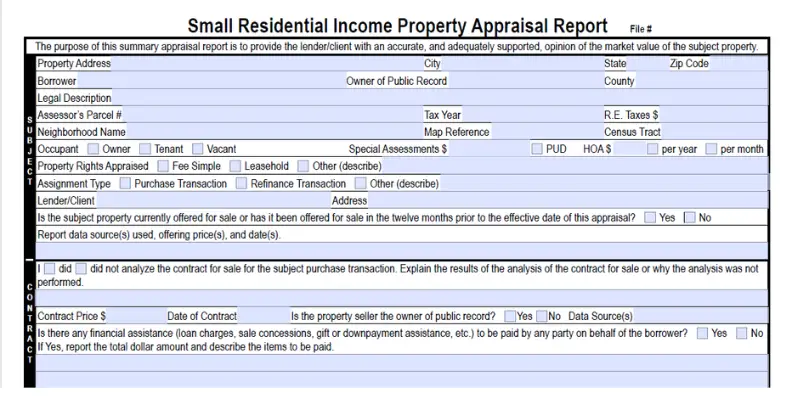
For duplexes, appraisers document property value and rental income using Form 1025, the Small Residential Income Property Appraisal Report, designed for properties with two to four units.
A single-family rental appraisal generally uses two forms: Form 1004 for property valuation and Form 1007 for estimated market rent. Form 1025 combines both analyses into one report. It includes a rental schedule for each unit, comparable sales, and an operating income analysis.
In the Marlborough case study, covered in this article, the appraiser developed three approaches to value, with results falling within $2,000 of each other:
- Sales comparison approach: $678,000
- Income approach: $680,000
- Cost approach: $679,845
The appraiser ultimately concluded a market value of $678,000. It was consistent with the sales comparison approach.
For investors reviewing Form 1025, it's important to check the estimated market rent for each unit, not just the combined total. If the appraiser estimates a lower rent for one unit, it may reduce the rental income the lender recognizes for qualification, even when the property's total rental income appears sufficient.
Our guide to investment property appraisals explains how appraisers determine market rent and what investors can do when an estimate comes in below expectations.
What Cash Reserves Does a Duplex Loan Require?
Many investment property lenders require six months of mortgage payments in reserves after closing. This includes principal, interest, property taxes, insurance, and any association fees (PITIA).
Unlike a down payment, cash reserves are not paid to the lender. Instead, the lender verifies that the borrower has sufficient funds available, typically through bank or brokerage statements. The money remains in the borrower's accounts after closing and cannot be counted toward both the down payment and the reserve requirement.
Importantly, lenders calculate reserves based on the full mortgage payment for both units, not just one unit's share. For example, if a duplex has a monthly PITIA payment of $2,600, an investor would need $15,600 in reserves remaining after covering the down payment and closing costs.
Is Financing a Triplex or Fourplex Different From a Duplex?
Not significantly. Lenders classify duplexes, triplexes, and fourplexes under the same residential financing category, so the core loan requirements remain similar.
Four key requirements apply across two- to four-unit investment properties:
- Down payment. Conventional lenders generally require 25% down on non-owner-occupied properties with two to four units.
- Appraisal form. Appraisers use Form 1025 to assess property value and rental income, regardless of whether the building has two, three, or four units.
- Rental income. Conventional lenders generally apply a 75% factor to eligible gross rental income from each unit when calculating qualifying income.
- Cash reserves. Lenders calculate required reserves based on the property's full monthly mortgage payment, with the number of months varying by loan program.
The main difference is scale. A fourplex generates four rental income streams against one mortgage payment, allowing lenders to consider more rental income while spreading vacancy risk across multiple units.
However, larger properties also tend to cost more, increasing the dollar amount of the down payment even when the required percentage stays the same.
For example, Ridge Street Capital financed a four-unit multifamily property in Clinton Hill, Brooklyn. The appraiser estimated monthly market rent at $8,500 for the garden duplex and $4,800 for each of the three units above it, totaling $22,900 per month.
Ridge Street qualified the loan using these market rent estimates instead of the existing rental income.
The number of units also determined the financing structure. With four units, the property qualified for residential rental property financing with a 30-year fixed rate. At five units, it would have fallen under commercial multifamily guidelines, with an appraisal focused on net operating income and capitalization rates.
How Much Cash Flow Does a Duplex Produce?
Actual cash flow is usually lower than the lender's calculations suggest. Conventional lenders generally count 75% of eligible rental income for qualification, while private lenders compare rent against the full mortgage payment. However, neither calculation fully accounts for property management, repairs, capital expenditures, or owner-paid utilities.
The Marlborough duplex illustrates the difference. With $4,250 in combined monthly rent and a mortgage payment of $3,724.28, the property generated a monthly surplus of $525.72 before accounting for vacancy, maintenance, and management expenses.
Duplexes also come with additional operating costs. Two units can mean two sets of appliances, separate water heaters, and tenants moving out at different times. As a result, investors who rely solely on the lender's rental income calculations may underestimate the property's actual expenses.
Our guides to estimating rental property cash flow and building a rental property pro forma explain how to account for these expenses and evaluate a duplex's financial performance before making an offer.
Duplex Financing at Ridge Street Capital
Ridge Street Capital specializes exclusively in investment property financing, with loan programs available across 36 states. We finance one- to four-unit rental properties with as little as 20% down, qualifying borrowers based on rental income without personal tax returns or W-2s. Investors can also close through an LLC.
Planning to purchase or refinance a duplex? Share the property address, purchase price, and monthly rent for each unit. Our team will review the details and prepare a preliminary term sheet outlining the loan amount, interest rate, and estimated cash required at closing.
Frequently Asked Questions
What credit score do you need for a duplex loan?
Ridge Street Capital requires a minimum credit score of 660 for long-term rental loans, with better pricing available at higher credit tiers. Conventional lenders may accept lower scores, depending on the borrower's overall financial profile.
In either case, lenders also review credit history, including recent mortgage delinquencies, bankruptcies, and foreclosures, which can affect eligibility.
Does a duplex count as one financed property or two?
One. Under Fannie Mae guidelines, a duplex, triplex, or fourplex counts as a single financed property, regardless of the number of units. For example, an investor with four financed fourplexes has four properties, not sixteen, toward the conventional ten-property limit, assuming the investor is personally obligated on each mortgage.
This makes small multifamily properties attractive for investors looking to buy multiple rental properties and expand their portfolios.
Can you buy a duplex that needs repairs with a rental property loan?
Yes, if the property is habitable and rent-ready, with only minor repairs needed. However, duplexes requiring major renovations or repairs affecting habitability generally do not qualify for standard rental property financing.
In those cases, investors can obtain a rehab loan first, complete the improvements, and then refinance into a long-term rental property loan.
Can you close on a duplex in an LLC?
Yes. Private lenders generally allow borrowers to purchase and finance duplexes through an LLC, although a personal guarantee is usually required. Conventional agency mortgages, by comparison, generally require ownership in the individual borrower's name.
Depending on the state and loan program, closing through an LLC may be optional or required. Our guide to LLC mortgage lenders explains the available financing options and requirements.
Is it harder to finance a duplex than a single-family rental?
Not necessarily, although duplexes generally require more cash upfront. Conventional lenders typically require 25% down on a non-owner-occupied duplex, compared with as little as 15% on a single-family rental.
The appraisal also covers both units, including their condition and estimated market rents. On the other hand, rental income from two units can help support qualification and reduce the financial impact of vacancy.
How long does it take to close a duplex loan?
DSCR loans for duplexes generally close within 3 to 4 weeks, while conventional investment mortgages often take 30 to 45 days. Appraisal scheduling can affect the timeline, particularly when both units are occupied. Since the appraiser needs interior access to each unit for a Form 1025 appraisal, coordinating with tenants early can help prevent delays.
Zach Cohen is the Managing Partner of Ridge Street Capital, a direct private lender providing hard money and DSCR loans to real estate investors across 36 states. Under his leadership, the firm has funded nearly $100 million in investment property loans. He regularly works with real estate investors on rental property acquisitions, refinances, and fix-and-flip projects across the country.
Fix and Flip Loans
Funding For Purchase + Rehab
- $50,000 up to $3,000,000
- Interest Rate 10.5%-11.5%
- Origination Fee From 1.5%
- Up to 90% of Purchase and 100% of Rehab

DSCR Loans For Long Term Rentals
Perfect for first-time investors or experienced investors scaling their rental portfolio.
- Up to $2,000,000
- Interest Rates from 6.0%
- Origination Fee From 0%
- Up to 80% of LTV

DSCR Loans For Short Term Rentals
Designed for investors pursuing higher rents with a short term rental strategy.
- Up to $2,000,000
- Interest Rates from 6.25%
- Origination Fee From 0%
- Up to 80% LTV
Ready to Get Started?