
Overview:
- Start with the strategy, then choose the loan. A long-term rental needs 30-year rent-based financing. A renovation needs short-term, interest-only funding with rehab draws. A ground-up build needs staged construction funding.
- Conventional financing works best early. It is usually cheaper for a first or second rental when the borrower has strong W-2 income and holds title personally. It becomes harder to use as the portfolio grows, because more mortgages raise DTI while tax write-offs can reduce reported income.
- Match the loan term to the exit. Flip financing creates refinance pressure if the investor keeps the property. A DSCR loan can work for a hold, but selling during the prepayment window can give back part of the gain.
No single loan works best for every investment property. Most new investors spend their early research on two things: finding a market with strong fundamentals and finding a deal that pencils. Financing usually comes third, and that ordering causes problems. A deal that is not matched to the right loan structure often stays exactly where it started, on paper.
Paying cash avoids the problem entirely, and some investors do. But investors who want to scale a portfolio and build long-term wealth typically use financing to acquire more properties, and they protect what they build with the right ownership structure around each one.
Which Loan Type Fits Your Investment Strategy?
The question of what type of loan is best for investment property becomes concrete once it is tied to a specific scenario. The five situations below cover most of the deals investors bring to a lender.
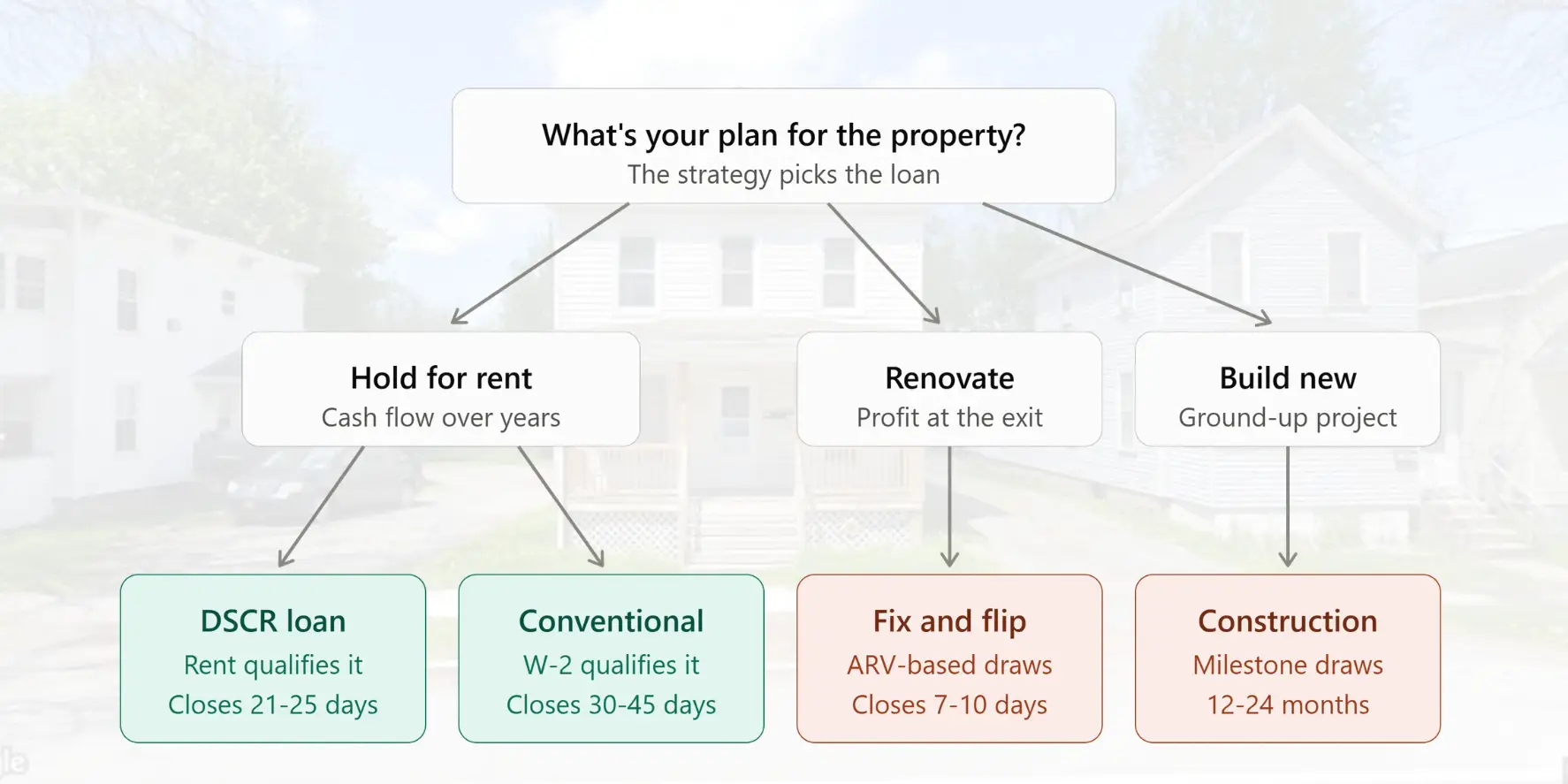
What's the Best Loan for a Buy-and-Hold Rental?
Buy-and-hold is a long-term strategy. The investor typically holds the property for several years while it collects rent, pays down the loan, and appreciates in value. A DSCR loan matches that timeline.
It is structured as a 30-year mortgage, often with an interest-only option, so the investor can acquire a cash-flowing rental, whether a single-family home, condo or a multifamily property, cover the debt service from rent, and keep the difference.
The loan qualifies on the debt service coverage ratio, or DSCR: rental income divided by the total monthly payment of principal, interest, taxes, insurance, and association dues (PITIA). A ratio at or above 1.00 means the rent covers the payment.
DSCR loans also close in the name of an LLC, which conventional loans generally do not allow. That matters for two reasons: the LLC separates the property from the investor's other assets, and DSCR programs do not cap the number of properties an investor can finance.
What's the Best Loan for Flipping or Renovating to Sell?
On a flip, the return is made in the renovation. The investor buys a distressed property, repairs it quickly without cost overruns, and returns the capital through the exit: a sale on a fix and flip, or a refinance into a rental loan on a fix to rent.
Fix and flip loans are built for that timeline. They are short-term, interest-only loans, typically 6 to 18 months. The rehab budget is released in draws based on construction progress.
At Ridge Street, interest accrues only on the funds that have been disbursed, not on the full approved rehab budget. This helps lower carrying costs while the renovation is underway.
Investors following the BRRRR method use the same structure from a different angle: acquire and renovate the property, lease it at a rent that covers the payment, refinance at the appreciated value, and move the capital into the next deal.
What's the Best Loan for Building a Rental Portfolio?
For scaling and diversifying across properties, a DSCR loan is the practical tool. Conventional financing ties every new mortgage to the investor's personal debt-to-income ratio, and that ratio becomes harder to clear with each property added.
DSCR loans qualify each property on its own cash flow, so the investor's personal income never becomes the ceiling on the portfolio. Find more information about DSCR loans vs conventional loans in our guide.
For investors adding several rentals at once, DSCR lenders offer a blanket or DSCR portfolio loan that finances multiple properties under a single loan, which simplifies closing and servicing.
What's the Best Loan for a First Investment Property?
A conventional investment property loan can make sense for a first rental if the investor qualifies based on personal income, credit, and debt-to-income ratio. The process will feel familiar to investors who have already financed a primary residence, and conventional pricing is usually 0.25-0.5% lower than for DSCR rental loans.
There are two things to confirm before using a conventional loan for a first rental.
- First, the property must be classified correctly. An investment property is underwritten differently from a second home, especially if the investor plans to rent it instead of using it personally.
- Second, conventional financing can become harder to use as the investor buys more properties. Tax write-offs can reduce reported income, and each new mortgage adds to the investor’s debt-to-income ratio. At that point, many investors move to DSCR financing because the loan is based on the property’s rental income rather than personal income.
What's the Best Loan for New Construction?
A ground-up construction loan is the right structure for building a rental or a spec property, meaning one built without a buyer or tenant lined up before construction begins. These loans fund the project in stages tied to construction milestones rather than a single disbursement at closing, and they typically convert into permanent financing once the certificate of occupancy is issued.
How Do the Main Investment Property Loan Types Work?
The examples above match each investment strategy with the loan structure that usually fits it. The next section breaks down how each loan type works, what it costs, and what investors should review before choosing a lender.
How Does a DSCR Loan Work for an Investment Property?
A DSCR loan is a non-QM mortgage, so it is not priced the same way as a conventional loan. Rates are usually higher because the property is non-owner-occupied, the loan is tied to rental income, and the lender takes on more investment-property risk. In return, investors get more flexible underwriting, ability to close loan in LLC and a faster process.
DSCR loans require at least 20% down and include a prepayment penalty if the loan is paid off early. The penalty is often structured as a step-down, such as a 3-2-1 schedule where the fee decreases each year.
Investors can close DSCR loans in 21 to 25 days, which is faster than most conventional underwriting timelines. In a competitive rental market, that timeline can help an investor make a stronger offer and secure the property.
How Does a Fix and Flip Loan Work for an Investment Property?
A fix and flip loan typically finances up to 90% of the purchase price and up to 100% of the rehab budget, with the total loan amount capped against the property's after-repair value, or ARV: what the property is expected to sell for once the renovation is complete.
Many experienced investors apply the 70% rule as a screening filter before approaching a lender, offering no more than 70% of ARV minus estimated repair costs, which preserves enough margin to cover flipping financing costs and still produce a profit.
Hard money loans usually carry higher rates (10-12%) than DSCR or conventional loans, and the cost increases the longer the project takes. Each extra month adds interest and other holding costs without adding value to the exit price.
If the renovation runs past schedule, those costs reduce the investor’s margin. The loan may be extended, but extension fees add another cost while interest continues to accrue.
Hard money lenders typically close loans in 7 to 10 business days, which lets an investor put a fast, credible offer on a strong deal before a competing buyer does.
How Does a Bridge Loan Work for an Investment Property?
A bridge loan is short-term financing for a property that does not need renovation. It covers the gap between an acquisition and whatever comes next, usually permanent financing or a sale. Investors commonly use bridge loans to close quickly on investment property, to buy a new property before an existing one sells, or to hold a rental until it meets the lease-up or seasoning requirements of a refinance.
The main difference is how the loan is underwritten and funded. A bridge loan is based on the property’s current as-is value and is usually funded in one disbursement at closing, with no rehab budget or construction draws.
A fix and flip loan is based on the property’s after-repair value and includes renovation funds released in stages as work is completed. If the deal’s return depends on repairs, the fix and flip structure is usually the better fit. If the property is already stable and the investor only needs short-term financing before a sale or refinance, a bridge loan is the cleaner structure.
How Does a Conventional Loan Work for an Investment Property?
A conventional investment property loan is a mortgage sold to Fannie Mae or Freddie Mac. Underwriting relies on the investor's personal income, credit score, and debt-to-income ratio, the same inputs used to qualify a primary residence mortgage. Down payments typically fall between 15% and 20%, and pricing is generally the most competitive of the investment loan rates.
A conventional file is larger and more document-heavy than other loans and approval commonly takes 30 to 45 days. In a competitive market where a rental property draws multiple offers, that timeline alone can cost the investor the deal to a buyer using faster financing.
How Does a Construction Loan Work for an Investment Property?
A ground-up construction loan finances a new build in stages rather than a single disbursement. The loan amount is based on the project's total cost, including land, materials, and labor, plus the projected value of the finished property.
Funds are released through draws tied to completed construction milestones and verified by inspection at each stage. Equity requirements typically fall between 20% and 30% of total project cost, higher than a fix-and-flip loan, because construction carries more execution risk than a renovation.
What Other Loan Options Exist for Investment Properties?
A few additional loan types apply in narrower situations:
- FHA loan: Available when the investor occupies one unit of a multi-unit property and rents out the rest, a strategy known as house hacking. Down payments start at 3.5%, but the property cannot be purchased purely as an investment.
- VA loan: Available to eligible veterans and active-duty service members under the same house-hacking structure, with down payments as low as 0%. The Department of Veterans Affairs restricts VA loans from financing a property bought purely as an investment.
- HELOC: A home equity line of credit draws on the equity in an investor's primary residence to fund a down payment on an investment property. Most lenders cap the combined loan-to-value at 80% to 85% of the primary residence, and the home itself stands as collateral.
What Mistakes Do Investors Make When Financing an Investment Property?
Mistake 1: Using the wrong financing source.
An investment property should usually be financed around the property’s income, value, and exit strategy. Cash, HELOCs, and personal-name loans can work, but they should be chosen because the deal supports them, not because the money is easiest to access.
Closing in an LLC can also keep the property, loan, and operating risk cleaner. Since entity structure affects liability and taxes, investors should confirm how ownership is set up before closing.
Mistake 2: Chasing the lowest rate.
A lower rate does not help if the lender moves slowly, adds unclear fees, or misunderstands the property type.
Before comparing investment property lenders by rate alone, investors should review documentation requirements, closing speed, fees, prepayment terms, and experience with the deal strategy.
Mistake 3: Choosing a lender that only lists the product.
Some lenders advertise DSCR, fix-and-flip, or bridge loans but still underwrite them like traditional mortgages. That can create delays, extra documentation, or late-stage issues.
The lender should understand how the strategy works. A DSCR rental loan needs rent-based underwriting. A BRRRR loan needs both the rehab plan and refinance exit to make sense. The right lender identifies problems early and structures the loan around the intended exit.
Finance Your Investment Property With Ridge Street
Investors ready to move forward on a DSCR, fix and flip, or ground-up construction deal can start with a pre-approval through our Quick Application. Our underwriting team reviews the deal's numbers and confirms which loan structure fits the strategy. Investors receive a term sheet outlining rate, leverage, and next steps in writing, and from there the file moves into underwriting and toward closing.
Frequently Asked Questions
Can I use a conventional mortgage for an investment property?
Yes, but the property must be non-owner-occupied to qualify as investment financing rather than a second home loan. Lenders typically add a 0.5% to 0.75% rate adjustment for investment properties compared to a primary residence mortgage.
Do self-employed investors qualify for investment property loans?
Yes. Self-employed investors who do not show enough income on tax returns for a conventional loan can qualify for a DSCR loan based on the property's rent instead, or a bank statement loan that uses 12 to 24 months of deposits to calculate income.
Is a hard money loan the same as a fix and flip loan?
The terms are used interchangeably across most of the industry. Both describe short-term, asset-based financing underwritten on the property's after-repair value rather than the investor's personal income.
Can I use a HELOC or cash-out refinance to cover the down payment on an investment property?
Yes. Investors commonly draw equity from a primary residence or another rental through a HELOC or cash-out refinance to fund a down payment. This works best when the source property retains at least 20% to 30% equity after the draw.
Is there a way to buy an investment property with less than 20% down?
Yes, in specific cases. FHA and VA loans allow down payments as low as 3.5% and 0%, but only when the investor occupies one unit of a multi-unit property, and VA eligibility is limited to veterans and active-duty service members.
What credit score do investment property loans typically require?
Most DSCR and conventional investment property loans require a minimum credit score of 660 to 680, with stronger pricing available at 700 and above. Fix and flip loans are more flexible, and hard money lenders working with experienced investors will sometimes approve deals with scores in the low 600s when the deal's numbers are strong.
What type of loan works best for a 1031 exchange replacement property?
A DSCR loan is usually the better fit. Investors completing a 1031 exchange must identify a replacement property within 45 days of selling the relinquished property and close within 180 days, so closing speed matters as much as the loan terms. DSCR financing qualifies on the replacement property's rental income and can close in 21 to 25 days, comfortably inside that window.
A fix and flip loan is generally the wrong tool for an exchange, since a 1031 requires the replacement property to be held for investment, not renovated and resold, which runs against both the loan's underwriting and the IRS's intent requirement. For financing details specific to exchange timing, see our guide to 1031 exchange loans.

Zach Cohen is the Managing Partner of Ridge Street Capital, a direct private lender providing hard money and DSCR loans to real estate investors across 36 states. Under his leadership, the firm has funded nearly $100 million in investment property loans. He regularly works with real estate investors on rental property acquisitions, refinances, and fix-and-flip projects across the country.
Fix and Flip Loans
Funding For Purchase + Rehab
- $50,000 up to $3,000,000
- Interest Rate 10.5%-11.5%
- Origination Fee From 1.5%
- Up to 90% of Purchase and 100% of Rehab

DSCR Loans For Long Term Rentals
Perfect for first-time investors or experienced investors scaling their rental portfolio.
- Up to $2,000,000
- Interest Rates from 6.0%
- Origination Fee From 0%
- Up to 80% of LTV

DSCR Loans For Short Term Rentals
Designed for investors pursuing higher rents with a short term rental strategy.
- Up to $2,000,000
- Interest Rates from 6.25%
- Origination Fee From 0%
- Up to 80% LTV
Ready to Get Started?
.svg)

_result.webp)